

Previously, Mr. Thuan's family was among the most disadvantaged in Long Son commune, lacking farming knowledge and investment capital, so poverty plagued them for a long time. Their lives gradually changed as Mr. Thuan and his wife worked diligently, accumulating knowledge to focus on developing the economy from the hills and forests.
Now, his family's assets include over 3 hectares of purple ginseng; in addition, there are over 3 hectares of southern ginseng and many other fruit trees. He was the first person in Tau village to cultivate purple ginseng on a large scale, a medicinal plant considered the "miracle drug for gentlemen," with many beneficial health uses.
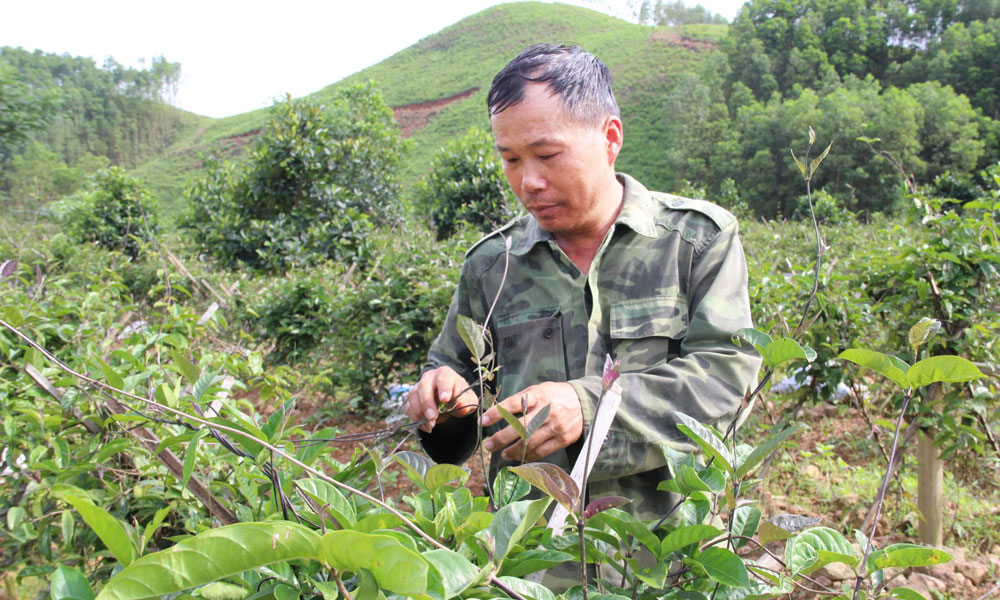
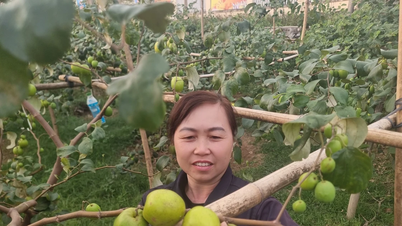
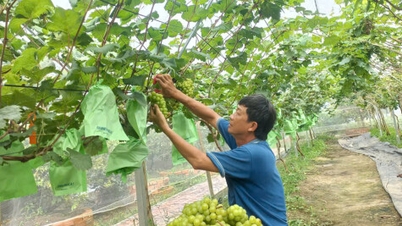
Mr. Le Van Thuan takes care of his purple ginseng garden.
The lush green garden under the autumn sun, with smart automatic sprinklers every few meters and sturdy trellises for climbing plants, shows the meticulous, systematic investment and dedication of the grower. It is known that his family previously cultivated various crops on this land. “Growing acacia, eucalyptus, and other crops was profitable, but valuable medicinal plants like purple ginseng yielded many times more economic value. Thinking it over, in 2022 I discussed it with my family and decided to convert all the acacia and eucalyptus trees, focusing all our efforts on this new crop,” he shared.
The initial anxieties about the new crop were gradually alleviated when he received dedicated assistance from farmers' association officials at all levels in the province regarding seeds, techniques, and fertilizers. Furthermore, he also received preferential loans from the Social Policy Bank branch to rent machinery to transform his neglected garden into a concentrated production area.
Starting with a 2.5-hectare trial plot, Mr. Thuan found that the new plant quickly took root and thrived, so he continued to improve and convert the remaining barren hillside land of nearly 1.2 hectares to cultivate purple ginseng for easier care. This plant is not difficult to care for, but to achieve a high survival rate and good growth, growers must do well in all stages, from seed selection to soil preparation.
Regarding seedlings, he carefully selects them based on criteria such as being free from pests and diseases, having intact tops, fully developed root systems, and retaining their root balls. Because they are medicinal plants grown for their tubers, he absolutely does not use chemical pesticides. On intensely hot days, he may use damp straw to mulch the base of the plants and water them regularly to protect them from the heat.
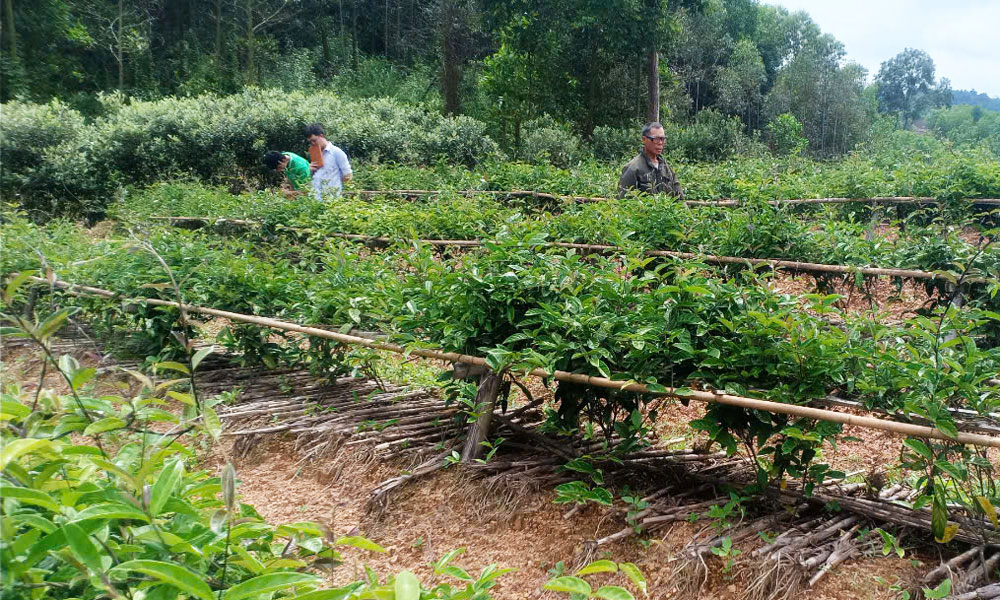
Mr. Thuan's family's purple ginseng garden.
The farming area is located in a high mountainous region, and the water from the wells is insufficient to irrigate thousands of purple ginseng plants. When drilling a well in the forest proved impossible, his relatives noticed that for many days, he had become noticeably darker from his solitary trips into the forest to find water.
Finally, the farmer's perseverance paid off. He was overjoyed when he found an underground water source on the mountaintop and decided to invest in over 2,000 meters of pipes to bring cool water to irrigate his precious plants.
The initiative to bring forest water to the ginseng gardens has overcome the long-standing water scarcity in Tau village. The Provincial and District Farmers' Associations have sent many officials and members to learn from this experience. Ginseng is a valuable medicinal herb beneficial to health, so the market is favorable.
According to calculations, one hectare planted with over 20,000 purple ginseng plants yields approximately 3-4 tubers per plant, weighing 1.5-2 kg each. With the selling price of fresh wild ginseng tubers purchased by traders at the farm ranging from 150,000 to 200,000 VND/kg, it is expected that in a few years, this will bring in billions of VND for the owner.
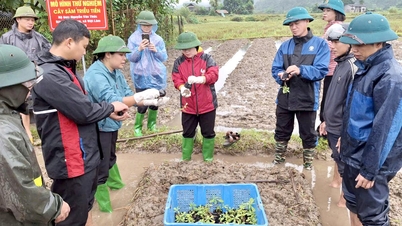
Mr. Thuan said: "Recently, many farmer members from various localities have come here to learn about the experience of growing purple ginseng. I am ready to share technical information on soil preparation, planting, and plant care to achieve the highest efficiency."
According to Mr. Nguyen Van Lap, Chairman of the Long Son Commune Farmers' Association, the commune has over 6,500 hectares of natural land, of which forestry accounts for 88%, giving the locality many advantages for developing forestry and medicinal plants.
Along with purple ginseng and several other medicinal plants, the People's Committee of the commune is building a supply chain to turn Long Son into a large-scale concentrated cultivation area.
Currently, the entire commune has nearly 12 hectares of medicinal plants, with Mr. Thuan's household alone accounting for about 30% of the area. In support of farmers, the commune's People's Committee is proactively linking with businesses to purchase and market products for the people. The locality is also promoting a plan to establish a cooperative for deep processing to contribute to exploiting the multi-layered value of medicinal plants, increasing revenue and economic efficiency.
This is considered one of the solutions to improve income levels, create jobs, and achieve sustainable poverty reduction, enabling Long Son to reach the goal of becoming an advanced new rural commune in the near future.
Source: https://danviet.vn/trong-cay-than-duoc-cua-quy-ong-quy-mo-lon-anh-nong-dan-bac-giang-sap-thu-tien-ty-20240830113240898.htm



























































Comment (0)