

In Phuoc Hoa hamlet, Bien Bach commune (Ca Mau province), the Ca Mau Provincial Agricultural Extension Center, in coordination with the Commune's Economic Department, recently organized a workshop to summarize the results of the high-quality, low-emission rice production model in the rice-shrimp farming area. The workshop aimed to evaluate the implementation results and provide guidance for expanding the model in the future.
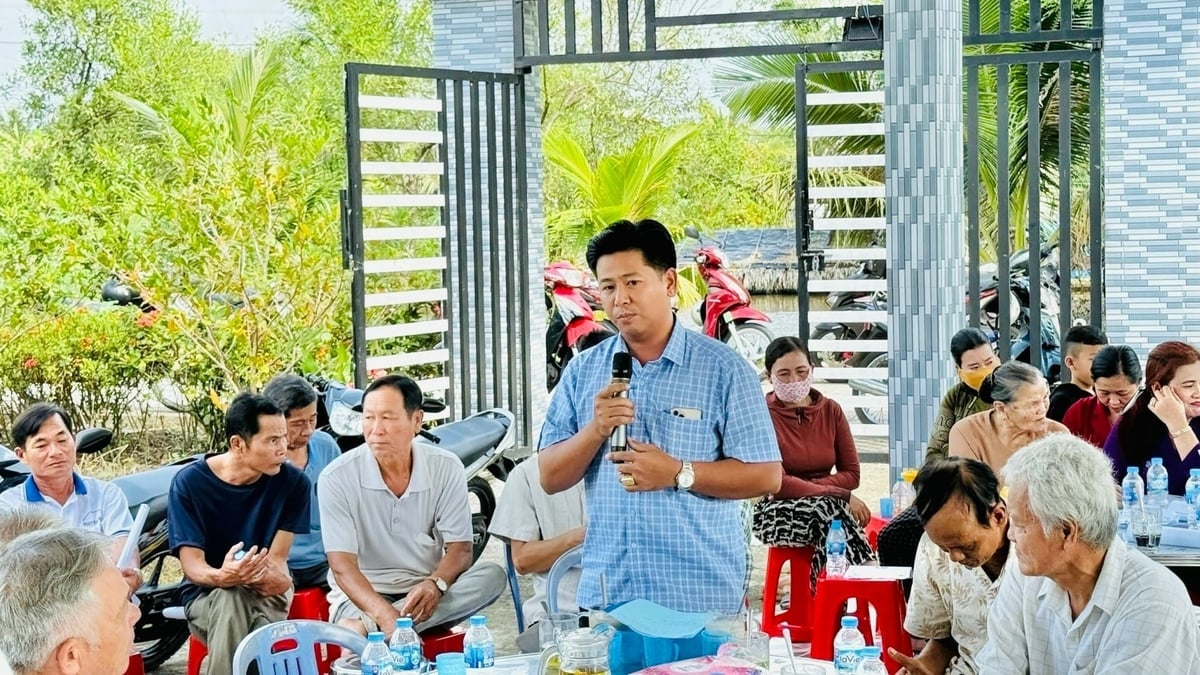
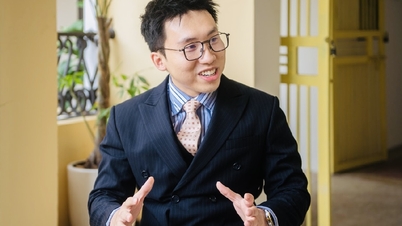
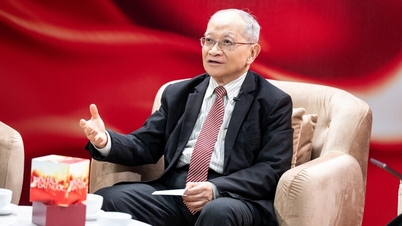
Mr. Do Vu Luc, Deputy Head of the Economic Department of Bien Bach commune, shared his insights at the workshop. Photo: Thuy Lam.
Ca Mau is a locality with a large area of rice-shrimp farming in the Mekong Delta, enjoying favorable natural conditions, nutrient-rich coastal soil, and a water source primarily from rainwater with minimal pollution. However, traditional rice farming practices that maintain constant water levels in the fields increase production costs and greenhouse gas emissions, impacting the goal of sustainable agricultural development.
In response to the need to innovate production methods while protecting the environment and adapting to climate change, in 2025, the Ca Mau Provincial Agricultural Extension Center will implement a model of high-quality, low-emission rice production in the rice-shrimp farming area of Bien Bach commune, contributing to changing farming practices towards greater efficiency and sustainability.
The model was implemented on a scale of 50 hectares, using the ST25 rice variety, applying a high-quality, low-emission rice production process as guided by the Department of Crop Production and Plant Protection. Farmers participating in the model were guided to reduce the amount of seeds sown to 100 kg/ha, apply balanced fertilization, reduce nitrogen fertilizer, limit the use of pesticides, apply integrated pest management, and drain water mid-season 1-2 times for eligible fields.

The model has proven remarkably effective. Photo: Thuy Lam.
In addition, the collection and processing of rice straw after harvest is emphasized to reduce greenhouse gas emissions, improve the farming environment, and protect the rice-shrimp farming ecosystem.
After more than 5 months of implementation, the model has shown clear effectiveness. Rice yield is estimated at 5.2 tons/ha, exceeding the set target, profit reached over 24.3 million VND/ha, and the profit margin is over 58%.
Compared to traditional farming methods, this model reduces the amount of seeds sown, the use of fertilizers, and the number of pesticide applications. As a result, production costs are reduced, while also contributing to a reduction in greenhouse gas emissions and improved resource efficiency.
Based on the practical results, farmers in the area have proactively replicated the model to approximately 75 hectares, while gradually forming product consumption linkages, creating a foundation for concentrated commodity production.
Besides bringing economic benefits, the model also creates positive social and environmental impacts. Organizing production in a collaborative manner helps farmers improve their sense of cooperation, share experiences, and gradually change traditional farming practices to more modern and sustainable production methods.

Farmers visit the model farm. Photo: Thuy Lam.
The workshop unanimously agreed that the model is suitable for the rice-shrimp farming conditions, easy to apply, and has high potential for replication. In the coming time, the locality will continue to promote and encourage farmers, cooperatives, and production groups to participate in expanding the area, aiming to build a high-quality, low-emission rice production area linked to the value chain.
This model serves as an important foundation for the sustainable development of the rice industry in Ca Mau province, adapting to climate change and achieving the goal of reducing emissions in agricultural production.
Source: https://nongnghiepmoitruong.vn/hieu-qua-mo-hinh-lua-chat-luong-cao-phat-thai-thap-vung-lua--tom-d790503.html

![[Photo] General Secretary and President To Lam presides over a working session with the Central Policy and Strategy Committee on the development of the materials industry.](https://vphoto.vietnam.vn/thumb/1200x675/vietnam/resource/IMAGE/2026/05/21/1779359935432_a3-bnd-3129-1412-jpg.webp)

![[Photo] National Assembly Chairman Tran Thanh Man working with the Standing Committee of the Law and Justice Committee](https://vphoto.vietnam.vn/thumb/1200x675/vietnam/resource/IMAGE/2026/05/21/1779378929214_ndo_br_1-4610-jpg.webp)






















































Comment (0)