

QUANG BINH - Despite the barren sandy soil, thanks to focusing on organic farming and soil enrichment, Mr. Han's family earns 500 million VND per year from their 3 hectares of guava trees.
Nearly five years ago, the coastal sand dunes of Ly Trach commune, Bo Trach district ( Quang Binh province) had many licensed sand mining operations. After the sand was extracted, a layer of red basalt soil was exposed, which could be reclaimed for planting fruit trees.
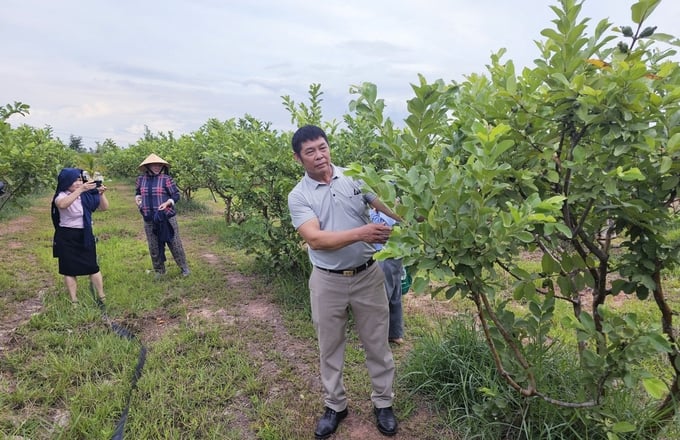
The guava orchard of Mr. Nguyen Van Han's family, cultivated using organic methods. Photo: Tam Phung.
Recognizing this, Mr. Nguyen Van Han (Ly Trach commune) boldly leased nearly 3 hectares of hilly land that had been previously used for sand mining. He confidently borrowed capital from the Social Policy Bank of Bo Trach district to plant guava trees on the relatively flat, leveled land.
Through research on television and in newspapers, Mr. Han learned how to garden, grow guava, and orient his farming towards organic methods. “We must bring clean products to people for production and consumption to be sustainable. Although organic production faces many difficulties at first, it brings many benefits in the long run,” Mr. Han explained.
The guava variety that Mr. Han chose to plant is the Taiwanese pear guava. "This variety is drought-resistant, less susceptible to pests and diseases, and yields high-quality fruit," Mr. Han said.
To obtain fertilizer for his guava orchard, Mr. Han collected various types of animal manure and composted it with organic microbial phosphorus fertilizer. After two weeks of composting, the fertilizer was ready to be used on the plants.
In addition, Mr. Han also buys scraps of fish from fishing boats and freshwater fish to ferment with probiotics in a specific ratio. After more than 12 months of fermentation, the organic nutrient solution can be introduced into the drip irrigation system for the guava trees. Thanks to this, the guava trees are always healthy, branch out, and bear abundant fruit that is large, uniform, visually appealing, and of high quality and sweetness.
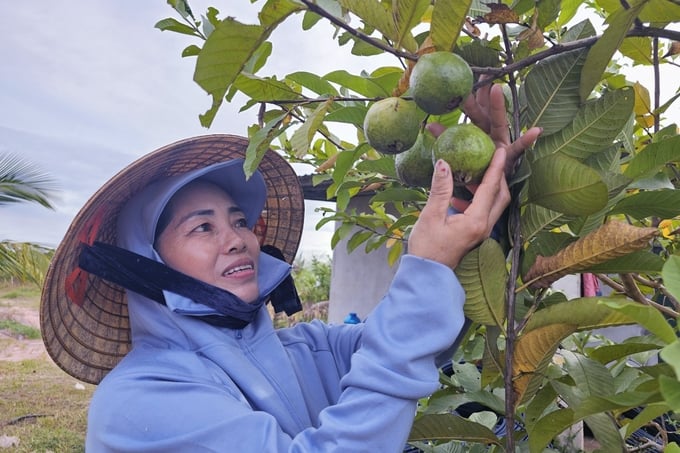
Despite being grown on barren sandy soil, the guava orchard thrives and yields high returns thanks to a focus on organic farming practices. Photo: Tam Phung.
To limit pests and diseases affecting his guava trees, Mr. Han buys biological preparations (made from fermented garlic, chili peppers, etc.) to spray as a preventative measure. "My farm doesn't use pesticides; we only use biological preparations," Mr. Han said.
To ensure high-quality fruit, after pruning the guava trees to encourage new shoots, flowering, and fruiting, Mr. Han trims the fruit on each branch, leaving only 1-2 fruits. He explains that this ensures the fruit grows larger and is of better quality. If too many fruits are left, they will be smaller, less attractive, and less delicious.
After being carefully selected, the young guavas are wrapped in bags to protect them from pests and ensure they look appealing. The main guava harvest usually begins in August each year. At this time, traders call to place orders daily, allowing Mr. Han's family to proactively harvest the fruit.
According to Mr. Han, the farm currently covers nearly 3 hectares, with approximately 800 guava trees planted per hectare. On average, the guavas weigh 3 fruits per kilogram, selling for about 20,000 VND per kilogram. Each guava tree yields an income of about 3 million VND per year. "Calculated out, each hectare generates an income of around 249 million VND. After deducting expenses, the family earns a profit of over 500 million VND per year," Mr. Han stated.
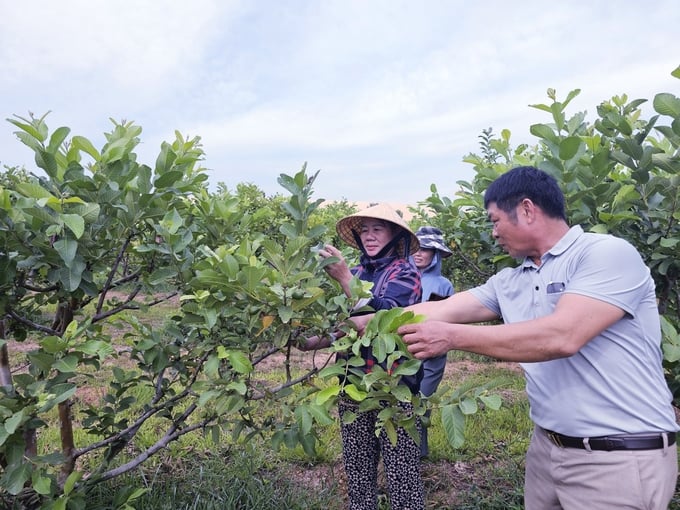
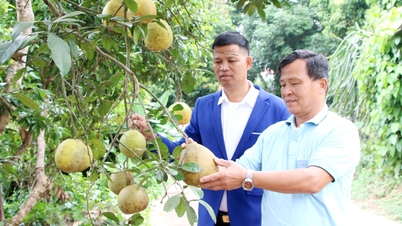
Mr. Nguyen Van Han inspects his guava orchard after pruning the young fruit. Photo: Tam Phung.
When harvesting the fruit, Mr. Han selects some branches and prunes the tips to encourage new shoots, flowering, and fruiting. Using this method, Mr. Han's guava farm always has fruit to supply customers year-round.
To build a product brand, Mr. Han established the Phuc Loc General Agricultural Service and Trade Cooperative (Phuc Loc Cooperative) with 7 members, and Mr. Han was elected as the Executive Director. Currently, Phuc Loc Cooperative has over 10 hectares of guava orchards cultivated organically.
With the rainy season approaching, Phuc Loc Cooperative will plant approximately 1,000 new red-fleshed guava trees to diversify its products and gradually introduce several high-quality and economically valuable guava varieties into production. The cooperative is also organizing production by expanding the cultivated area and establishing linkages from production to consumption based on the application of advanced techniques, organic farming, and VietGAP standards.
Source: https://nongsanviet.nongnghiep.vn/trong-oi-huu-co-บน-vung-dat-cat-kiem-nua-ti-dong-moi-nam-d390987.html





































































Comment (0)