Faced with the prospect of retaliating against US tariffs with certain economic consequences, experts believe that Europe and other partners of Washington are likely to seek more stable trade opportunities in the Chinese market.

US President Donald Trump threatened to impose a 200% tariff on wine, champagne, and other alcoholic beverages imported from European countries if the EU does not stop imposing retaliatory tariffs on $28 billion worth of US goods starting in April 2025. - Photo: AFP
"The one standing on the sidelines laughing or watching from the other side is China," Kaja Kallas, the European Union's High Representative for Foreign Policy, told Bloomberg Television on March 13, suggesting that Beijing would benefit from the EU-US trade war.
Consumers on both sides suffer the consequences first.
Earlier that day, US President Donald Trump threatened to impose a 200% tariff on wine, champagne, and other alcoholic beverages imported from European countries if the EU did not stop imposing retaliatory tariffs on $28 billion worth of US goods starting in April 2025.
Speaking about the EU's retaliatory tariff measures against Washington's tariffs, European Commission President Ursula von der Leyen stated that the EU was "forced" to choose this measure because it would "threaten jobs" and cause "prices to rise in both Europe and the US."
According to CNBC, European consumers are about to face rising prices on a range of goods, from cars to jeans, as industries such as steel, retail, and agriculture struggle with increasing costs amid tit-for-tat tariff retaliation between the US and Europe.
Susannah Streeter, director of currency and markets at financial advisory firm Hargreaves Lansdown, said EU tariffs would drive up costs for "a range of manufacturers, particularly carmakers and food producers." The scale of the impact on consumers would be profound, with Streeter citing the potential for increased costs on everyday items like a can of Coca-Cola or a box of beans.
Echoing Ms. Streeter's sentiment, Stuart Katz, Chief Investment Officer of Robertson Stephens Asset Management, also predicted that prices would begin to rise once the EU's retaliatory tariffs take effect on April 1st. Katz stated that consumers would soon feel the impact of the tariffs, as businesses raise prices to ensure profit margins.
For American consumers, tariffs of up to 200% on alcoholic beverages from Europe mean they will have to pay two to three times the previous price to enjoy a bottle of French wine.
"I don't think customers are willing to pay two or three times the price for their favorite wine or champagne," Ronnie Sanders, CEO of Vine Street Imports (New Jersey), told the Associated Press.

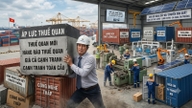
Meanwhile, Jeff Zacharia, president of Zachys, a wine retailer in Port Chester, New York, said that 80% of the wine he sells is imported from Europe. Zacharia added that the distribution system for wine importers in the U.S. relies heavily on European wines and there won't be enough American supply to compensate for the reduced imports due to high tariffs.
According to data from the International Trade Centre, the US is an important export market for European wine producers. In 2024, the US imported €13.1 billion (over $14.2 billion) worth of beverages, spirits, and vinegar from the EU.

Source: EUROSTAT - Content: NGHI VU - Graphics: T. DAT
China benefits.
In response to Washington's unilateral tariff moves, former US diplomat Wendy Cutler suggests that this could prompt US allies to forge closer ties with China or India.
The Diplomat magazine also noted that the US-EU relationship could be shaken under the Trump administration, and this presents a golden opportunity for China to mend relations with the bloc, as both are victims of US tariffs.
Already embroiled in a trade war with the US, Beijing could avoid this volatility spreading by being more flexible in negotiations with the EU, conceding to some demands or tariffs to build political trust.
Regarding opportunities to leverage China's influence, Ms. Cutler noted that Beijing is courting many markets around the world, and also highlighted China's recent upgrade of its free trade agreement with the ASEAN region.
"They (China) are making offers to many other countries. And when our partners can't rely on us, they will find other countries, including China, more attractive," Cutler observed.
Sharing Cutler's view, many experts also believe that Europe is eyeing other markets as tensions with the US escalate.
"The reality is, given the vastness of the world, Europe will have to look for alternative markets to the US market, and China could lend a helping hand," David Roche, strategist at Quantum Strategy, told CNBC.

Tesla also warned of the consequences of tariffs.
According to Reuters on March 13, billionaire Elon Musk's Tesla warned that it and other major US exporters would suffer losses from retaliatory tariffs imposed by other countries in response to Trump's tariffs.
This letter, dated March 11th, was sent to the Office of the U.S. Trade Representative. The content of Tesla's letter reflects the concerns of many American businesses regarding Trump's tariff war, but it's noteworthy that Tesla is owned by billionaire Musk – a close ally of the current U.S. President.
In the letter, Tesla stated that American export businesses are being disproportionately impacted by how other countries respond to Washington's trade moves.
"For example, previous U.S. trade actions have led to immediate reactions from targeted countries, including increased tariffs on electric vehicles imported into those countries," Reuters quoted the letter as saying.
Tesla also warned that even with a highly localized supply chain, "some parts and components remain difficult or impossible to source domestically in the U.S."
Source: https://tuoitre.vn/trung-quoc-huong-loi-tu-thuong-chien-my-au-2025031508015049.htm


![[Photo] Prime Minister Le Minh Hung presides over the thematic session on promoting science and technology development and innovation.](https://vphoto.vietnam.vn/thumb/1200x675/vietnam/resource/IMAGE/2026/06/23/1782207872934_ndo_br_dsc-1724-jpg.webp)