China claims to be producing hypersonic electromagnetic artillery shells capable of changing their trajectory, a "dream" projectile that the US has failed to develop successfully.
This artillery shell, developed by scientists at the Chinese Naval Engineering University, can reach speeds of Mach 7 when fired from an electromagnetic cannon, equivalent to over 8,600 km/h.
Feng Junhong, the research team leader, said that during flight, the artillery shell will receive signals from the Beidou satellite system to continuously adjust its trajectory, maintaining an error margin of less than 15 meters until it hits the target.
This level of accuracy may not be high enough to hit small, moving targets like tanks and armored vehicles, but it is suitable for targeting larger objects such as warships or ports.
According to the development team, the idea for this weapon originated from the "dream artillery shell" concept first proposed by the US Navy in 2012. The "dream artillery shell" that the US wants to develop has a flight speed of Mach 5 (approximately 6,000 km/h) and is guided by GPS signals.
The US Navy intended to develop and test this artillery shell within five years, but failed to achieve its goal and the research was canceled in 2021. The US subsequently developed several other smart artillery shells, such as the M928 Excalibur 155 mm, but these were fired from conventional artillery, not electromagnetic weapons, and therefore had much lower flight speeds.

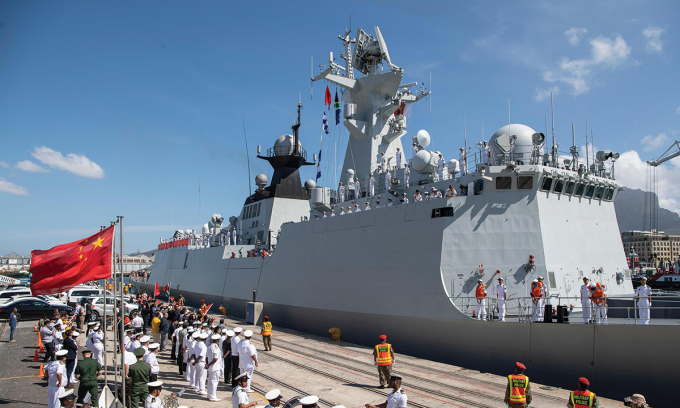
A Chinese frigate docked in Cape Town, South Africa in 2019. Photo: Xinhua
Although the US was the first to propose the idea, the Chinese development team claims they received no foreign support to carry out the "smart artillery shell" project.
To overcome this, the development team said they created a new type of antenna that can resist electromagnetic radiation while still receiving signals from the satellite navigation system. The artillery shell casing is made from aerogel, a material with high thermal insulation and durability, thereby reducing the risk of cracking or breaking due to the heat generated by friction with the air.
The development team also designed a special algorithm to ensure that the satellite signal would not be interrupted throughout the missile's flight path, thereby increasing the accuracy of the strike.
It is currently unclear whether China has successfully tested this type of artillery shell. The development team has also not released any images of this "dream" artillery shell.


The Chinese Navy recently announced several breakthroughs in the field of electromagnetic weapons, including advanced energy storage systems, high-strength alloy coatings, and sophisticated control and monitoring systems. Last September, Beijing announced the development of a new electromagnetic cannon called "Gauss," capable of accelerating a 124 kg projectile from 0 to 700 km/h in 0.05 seconds.
Pham Giang (Based on RT, Eurasian Times, IE )
Source link




![[Photo] Prime Minister Le Minh Hung presides over the thematic session on promoting science and technology development and innovation.](https://vphoto.vietnam.vn/thumb/1200x675/vietnam/resource/IMAGE/2026/06/23/1782207872934_ndo_br_dsc-1724-jpg.webp)