


Video : Artichoke medicinal herb growing area in Cao Son

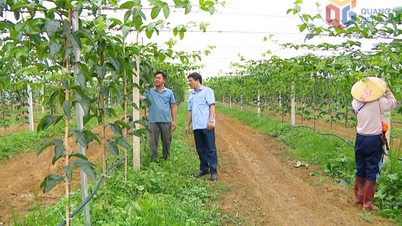
Located at a relatively high altitude compared to the midland region, Son village in Cao Son area enjoys a cool climate year-round, with loose soil and high humidity, making it suitable for growing medicinal plants.

The gently sloping fields along the hillsides, formerly primarily used for growing corn and cassava with uncertain yields, are now covered in rows of artichokes, their dense foliage and vibrant green foliage gradually transforming the landscape. A new agricultural landscape is emerging in an area once considered "difficult to cultivate."

In recent years, implementing the policy of developing commercial agriculture, Co Lung commune has gradually transformed its crop structure to take advantage of its soil and climate conditions. In Son village, the model of linking artichoke cultivation with Hanoi GPM Pharmaceutical Company Limited is proving to be very effective, not only bringing economic benefits but also creating a shift in the production mindset of the people.

According to Mr. Bui Van Phan, Secretary of Son village, artichoke plants were introduced to the area a few years ago through a partnership with a business. Based on practical experience, artichokes have shown good adaptability to the natural conditions of Cao Son area, Co Lung commune, exhibiting stable growth, minimal pest and disease problems, and significantly higher economic efficiency compared to traditional crops.

"Growing artichokes through a cooperative helps people feel secure in their production because there are businesses guaranteeing the purchase of their products. On average, each plot of artichokes yields an income of 8-10 million VND per year, significantly higher than growing corn or cassava before," Mr. Phan said.

In 2023, the herbal medicine company established a partnership with the people of Son village in the form of land lease combined with labor contracts. The company leased the land at a price of 1 million VND/sao/year, and also paid for labor for weeding, planting, caring for, and harvesting artichoke leaves, flowers, and roots. All seeds, fertilizers, and input materials were supplied by the company; the people only focused on planting and caring for the plants according to the instructed technical procedures.

According to local calculations, with proper care, each plot of artichokes yields nearly 10 million VND per year, including land rent and labor costs. Contract farming eliminates concerns about market access, preventing situations of "bumper harvests leading to low prices" or dependence on middlemen as in the past.

Ms. Ha Thi Than's family is one of the exemplary households participating in the artichoke farming model in Son village. With 9 sao (approximately 0.9 hectares) of cultivated land, the couple earns between 80 and 90 million VND per year.

"Compared to other crops, artichokes don't require any initial investment because the company takes care of everything from seeds to fertilizers. When it's time to harvest, we just have to deliver the produce to the company, ensuring a stable income and clear payment, so we feel very secure and committed to long-term employment," Ms. Than shared.

Besides bringing economic benefits to individual households, the artichoke farming cooperative model also contributes to changing people's production practices towards organized, contract-based commodity production. To date, 18 households in Son village participate in artichoke cultivation with a total area of 3.2 hectares, forming a concentrated raw material area serving the processing of medicinal herbs.

According to Mr. Bui Van Phan, Secretary of Son village and head of the village's artichoke production group, the need to expand the cultivated area in the near future is very high. It is expected that by the end of 2025, approximately 10 more households will register to participate, covering an area of about 2 hectares. However, because the enterprise has not yet secured a supply of standard-compliant seeds, the signing of new contracts cannot be implemented temporarily.

Commenting on this model, a representative from the Co Lung Commune People's Committee stated that Son village currently has 102 households, and over the past five years, the lives of the people have improved significantly thanks to effective production models such as linked artichoke cultivation. This is a model that needs to be maintained and expanded. The involvement of businesses throughout the entire process, from supplying materials to purchasing the products, helps people minimize risks and increase the value per unit area of cultivated land.

Local authorities stated that they will continue to coordinate with businesses, creating favorable conditions for the development of agricultural production linkage models; while also strengthening technical training and orienting production according to market demand, contributing to the achievement of sustainable poverty reduction goals and the construction of new rural areas in the locality.
Hoang Dong
Source: https://baothanhhoa.vn/tu-dat-doc-cao-son-den-vung-duoc-lieu-atiso-276016.htm
![[Photo] National Assembly Chairman Tran Thanh Man attends the opening session of IPU-152](https://vphoto.vietnam.vn/thumb/1200x675/vietnam/resource/IMAGE/2026/04/16/1776277863731_ctqh5-jpg.webp)
![[Photo] The General Secretary, President and his wife meet with Vietnamese-Chinese friendship leaders.](https://vphoto.vietnam.vn/thumb/1200x675/vietnam/resource/IMAGE/2026/04/15/1776264829725_vna-potal-tong-bi-thu-chu-tich-nuoc-to-lam-gap-mat-nhan-sy-huu-nghi-viet-nam-trung-quoc-8703641-3130-jpg.webp)
![[Photo] My Son at night: A thousand-year-old heritage site amidst the Milky Way](https://vphoto.vietnam.vn/thumb/1200x675/vietnam/resource/IMAGE/2026/04/15/1776261039184_ndo_br_chon6-jpg.webp)
![[Photo] Mrs. Ngo Phuong Ly meets and exchanges views with Mrs. Peng Li Yuan](https://vphoto.vietnam.vn/thumb/1200x675/vietnam/resource/IMAGE/2026/04/16/1776277858080_phu-nhan-1-jpg.webp)
























































Comment (0)