

Editor's Note: Why, in a developing society like Vietnam, has reading not yet become a widespread habit? This series of articles by author Pham Quang Vinh suggests a different approach: Reading is not a single individual choice but a product of an ecosystem – where policies, education , the market, and social values all come together to shape it.
VietNamNet presents this series as an open forum, hoping to receive diverse perspectives from readers, managers, educators, and publishers: How to build a reading society in the context of a knowledge-based economy ?
When I was about to turn six, my father taught me to read. Near my birthday, he took me to Cau Bung, to a small bookstore by the highway. I don't remember exactly which books we chose, but I always remember the low tiled house, now called a single-story house, and the feeling of stepping inside, standing in front of the bookshelves, as if entering another world , separated from the dusty road outside.
My father bought me many books, not only on my birthdays. I remember when I was seven, he bought me *The Temple in the Sea*, *Tsiolkovsky's Story*, and a book whose author I no longer remember, only that it was called *The Eldest Brother and the Youngest Brother*, a story about young soldiers. It was in that not-so-famous book that I read a sentence that later stayed with me throughout my life: "There is gold and jewels in books."[1] That sentence was said by an older soldier to a younger one, when telling stories about the countryside and mentioning the teachings of a teacher. It wasn't a lesson from school, just a saying of a character in a story. But it has stayed with me ever since.
From a young age, I read everything I could get my hands on. As a child, it was every book I could get my hands on. As I grew older, curiosity led me to other, broader, and more challenging things. Looking back, I think I learned many important things not from school, but from those books I read so haphazardly.
But if the saying "books contain treasures" was once true, guiding a child's upbringing, the question today is, is it still true for modern Vietnamese society? Or, to put it another way, why, in a society where almost everyone receives an education, has reading not become a widespread habit? And more broadly, is the problem that Vietnamese people are "lazy readers," or that society no longer provides strong enough reasons for people to read?
Reading, I think, is not primarily a personal choice; it's a result of how a society defines the value of knowledge, understanding, and the act of reading itself.
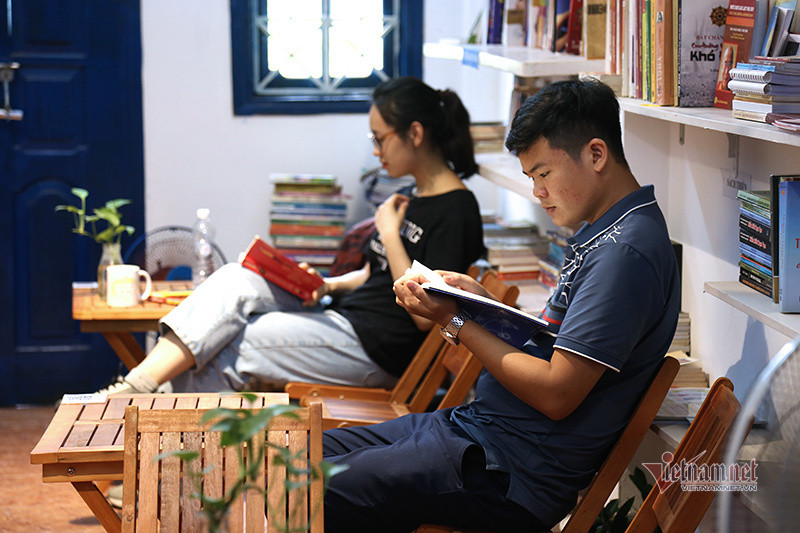
Reading is not a personal habit, but a product of a social structure.
Looking at the world and people's reading habits, we can see that many elements of social structure shape these habits. Highly reading societies aren't necessarily those with many diligent readers; they are societies with structures that compel people to read.
Japanese people have a lot of "dead time" when commuting on public transport, whether waiting for a train or on board, and this context has led to the habit of reading on trains. Others are influenced by the image of people reading on trains as a suggestion to find a book to read as well. They read more not because they love books more, but primarily because they have more free time on public transport.
According to data from the World Intellectual Property Organization, in 2023, Japan published 68,429 book titles, including 66,885 commercial books and 1,544 educational books, meaning commercial books accounted for 97.7% of the total. Also in 2023, Japanese people spent $9.315 billion on books, of which $8.7 billion was for commercial books (the remaining $629.7 million was for educational books).
This can also be explained by the fact that the Japanese live in a highly competitive intellectual society, and Japanese students are educated from a young age that reading is a part of life. When looking around, Japanese children will easily see an adult reading a book, and it serves as a good suggestion for them to pick up a book.
In another Asian country, South Korea, the pressure of exams and career competition has created an extremely strong reading ecosystem, ranging from textbooks to skill-building books and academic publications. The South Korean publishing market in 2023 had sales of $6.654 billion, with $3.39 billion in commercial books and $3.26 billion in educational books.
In other developed Western countries such as the US and Europe, the existence of a publishing industry, universities and research institutions, along with a culture of debate and critical thinking, has made people's reading habits more sustainable. In 2023, Americans spent $26.15 trillion on books, including $17.36 trillion in commercial books and $8.79 billion in educational books. Similar figures were recorded in France at $2.9 billion ($2.156 billion in commercial books, $752 million in educational books), and in Germany at $9.945 billion ($7.99 billion in commercial books, $1.949 billion in educational books),…
In these societies, reading is not merely a noble act; it is a survival tool in a knowledge-based society.
Structurally, modern Vietnamese society doesn't really support reading habits. Urban dwellers are accustomed to a fast-paced life; while they have ample time and means of transportation, reading is difficult when their primary mode of transport is personal vehicles. Our society today tends to value power and money more than knowledge; advancement and success depend less on knowledge and more on connections.
The underestimation of the value of knowledge and understanding leads to a decline in reading habits, which in turn impacts young people, causing them to disregard the importance of reading. For a few others, reading published works serves short-term goals rather than deep reading, while some readers consider reading a noble act, thus isolating themselves from society.
To some extent, the structure of Vietnamese society today does not support the formation and maintenance of reading habits.
Note:
[1] This sentence is probably a simplified, concise translation of the ancient Han idiom "In books there are beautiful women with faces like jade, in books there is a golden house," which is said to have originated during the Song Dynasty, implying encouragement for children to study.
Next installment: The breakdown of the scholarly tradition and its consequences for reading culture.
Source: https://vietnamnet.vn/tu-giac-mo-thu-trung-huu-kim-ngoc-den-thuc-te-kinh-te-tri-thuc-2512540.html





![[Image] Nearly 125,000 Hanoi students completed the Literature exam for the 10th grade entrance exam.](https://vphoto.vietnam.vn/thumb/1200x675/vietnam/resource/IMAGE/2026/05/30/1780117233041_ndo_br_thiet-ke-chua-co-ten-2-png.webp)


























































































Comment (0)