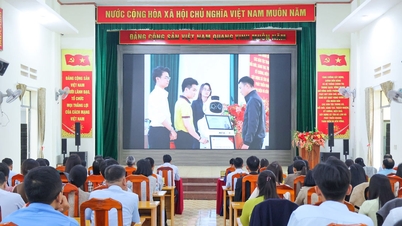
This is not only a direction for the development of digital publishing, but also an important step in forming a learning society and promoting the widespread dissemination of knowledge.
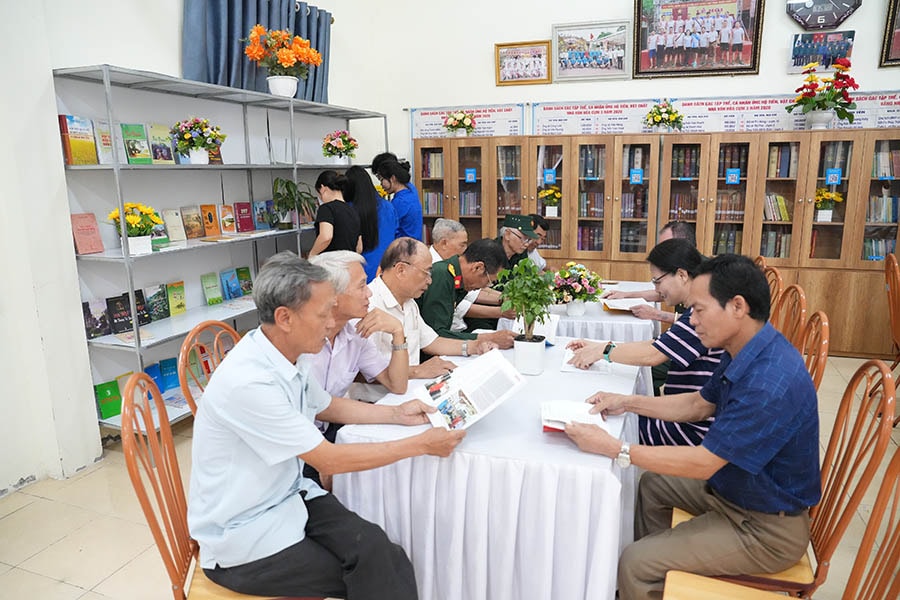
A familiar destination for locals.
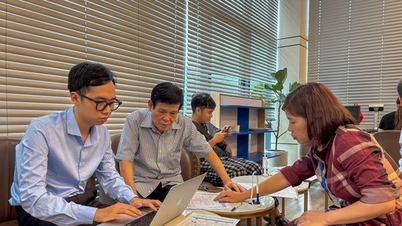
In Hanoi , the system of over 1,000 community libraries and reading rooms, along with 15 private libraries serving the community, has become a vital source for nurturing reading habits among the people. Notably, at the grassroots level, closest to the people, small-scale bookshelf and reading room models are proving highly effective. For example, the "Community Reading Room" in Lien Minh commune is not only a place to store books but also a cultural meeting point, connecting knowledge and the community.
Sharing about the process of establishing the "Community Reading Room" in Lien Minh commune, Deputy Head of the Culture and Social Affairs Department of Lien Minh commune, Nguyen Thi Hai Yen, said: "We determined that building a community reading room is a necessary step to enhance knowledge and enrich the spiritual life of the people. When books reach every village and hamlet, reading culture will naturally permeate and become an essential need for everyone."
With approximately 1,500 books, the Lien Minh Commune "Community Reading Room" is designed to serve a diverse range of users. This includes over 400 children's books; 500 literary works; and 200 political and professional books to cater to the needs of various groups. A notable feature is the book selection, which is not random but based on the principle of "serving multiple generations." Every resident entering the reading room can find "the book they need." This approach has quickly made the reading room a familiar destination for local residents.

In Nghia Do ward, the "Cultural Staircase" model of residential group 17, established in 1999, has become a unique cultural symbol of the community. From a small 20m² corner of the staircase, residents have cleverly created a "mini-library" with a full range of books and newspapers: from legal documents and resolutions to history books and life skills books, meeting the learning and research needs of people of all ages. Beyond serving reading needs, the "Cultural Staircase" also brings practical social values. Mr. Nguyen Van Hung, head of residential group 17, said: "Since the bookshelf was installed, the corner of the staircase is always bustling with people reading and exchanging information. Thanks to this, security and order have also improved."
For young people, the reading corner at the "Cultural Staircase" is like a free extra lesson. Hoang Tue Minh, a 10th-grade student at Do Muoi High School, shared: "We come here not only to read books but also to listen to the elders tell stories about history and cultural life. Sometimes we even get guidance on how to distinguish between real and fake information online. For us, this is a truly inspiring, beneficial, and welcoming cultural space."
Building a learning society in the digital age.
Alongside traditional models, the development of "Digital Libraries" is opening up many positive avenues for reading culture. For example, the "Digital Library" model in Ba Dinh ward has been effectively utilizing QR code technology to connect readers with an online knowledge repository. With over 500 books across 15 categories, residents can access the library anytime, anywhere simply by scanning the QR code.
Pham Thu Phuong, Secretary of the Ba Dinh Ward Youth Union, said: “This is an initiative of the Ward Youth Union in deploying QR codes simultaneously in 130 residential areas and some schools. Since its implementation in July 2025, the model has attracted thousands of visits, showing that people, especially young people, are increasingly interested in this new and convenient way of accessing reading culture.”
While Ba Dinh ward has a "Digital Library" model, Xuan Dinh ward boasts a system of digital books, audiobooks, podcasts, etc., helping residents access knowledge across multiple platforms, alongside the traditional "Community Bookcase" model with approximately 3,000 books located at the ward's People's Committee office. Mr. Nguyen Minh Tu, a specialist from the Culture and Social Affairs Department of Xuan Dinh ward, stated: "Although not yet officially inaugurated (expected in Q2 2026), the model has already attracted a large number of people to learn about it. This is a positive sign showing that the need for reading in the community remains very high."


However, in practice, the model still faces many difficulties. According to Mr. Nguyen Minh Tu, the bookshelves are currently still placed in the citizen reception room, lacking a separate reading space, and the facilities are limited, affecting the reader's experience. Therefore, the need for an independent reading room, fully equipped with tables, chairs, and other facilities to serve the public, has become urgent.
Beyond infrastructure, copyright barriers are also a major issue hindering the development of digital libraries. Digitizing materials for community use is still hampered by numerous copyright regulations, making it difficult for localities to expand their digital resources. This reality necessitates a more flexible mechanism from publishers to facilitate the effective operation of grassroots library models and meet the growing demand for knowledge access among the population.
Source: https://hanoimoi.vn/tu-mo-hinh-tu-sach-cong-dong-den-thu-vien-so-da-dang-hinh-thuc-lan-toa-van-hoa-doc-746100.html













![[Video] Weather forecast for tonight and tomorrow, July 4, 2026: The remnants of Typhoon No. 1 will cause widespread and prolonged heavy rain in Northern Vietnam.](https://vphoto.vietnam.vn/thumb/402x226/vietnam/resource/IMAGE/2026/07/03/1783083905760_thum-dem-png.webp)