

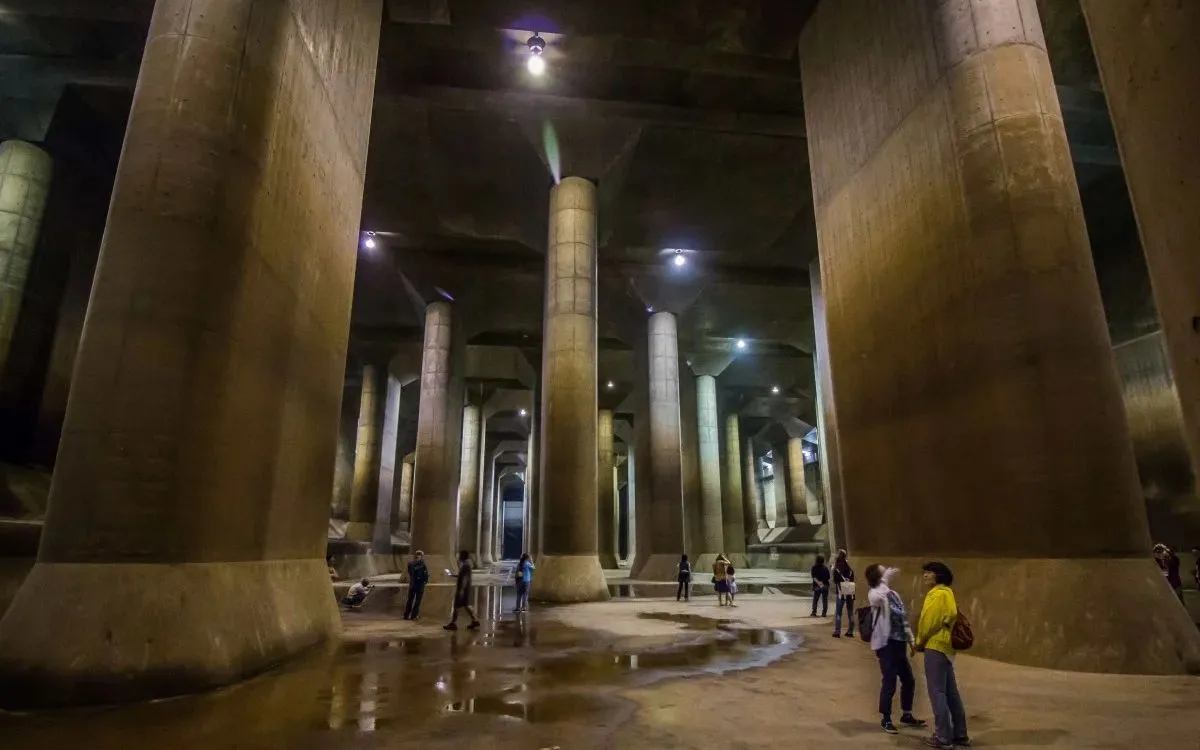
(Photo: Japan Times)
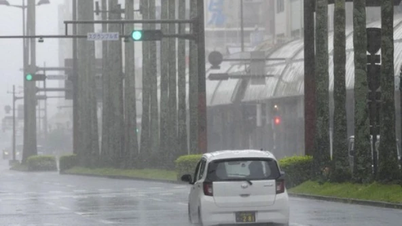
Intense and increasingly extreme rainfall is turning Asian cities into flood control hotspots. In Tokyo, the Japanese government has opted to dig deep underground, creating a massive structure known as a "shrine"—where hundreds of thousands of cubic meters of floodwater are collected and safely discharged into the Edo River. In Singapore, flood control infrastructure has been expanded horizontally, with the Marina Barrage tidal barrier system combined with a network of drainage channels and reservoirs.
Two different strategies reflect the same philosophy: as climate change outpaces design capabilities, investing in smart infrastructure is no longer an option but a condition for the survival of modern cities.
When the old standards are no longer sufficient.
Tokyo is situated in a low-lying coastal plain, where numerous small rivers flow into the city center. Typhoon Shanshan (September 2023) caused severe flooding in the northern suburbs of Tokyo, a reminder that large cities cannot underestimate the risks of extreme rainfall. Therefore, the Japanese government has expanded its urban flood control network, most notably the Metropolitan Area Outer Underground Discharge Channel (MAOUDC) – a project that began in 1992 and was fully operational in 2006 at a total cost of approximately 230 billion yen.
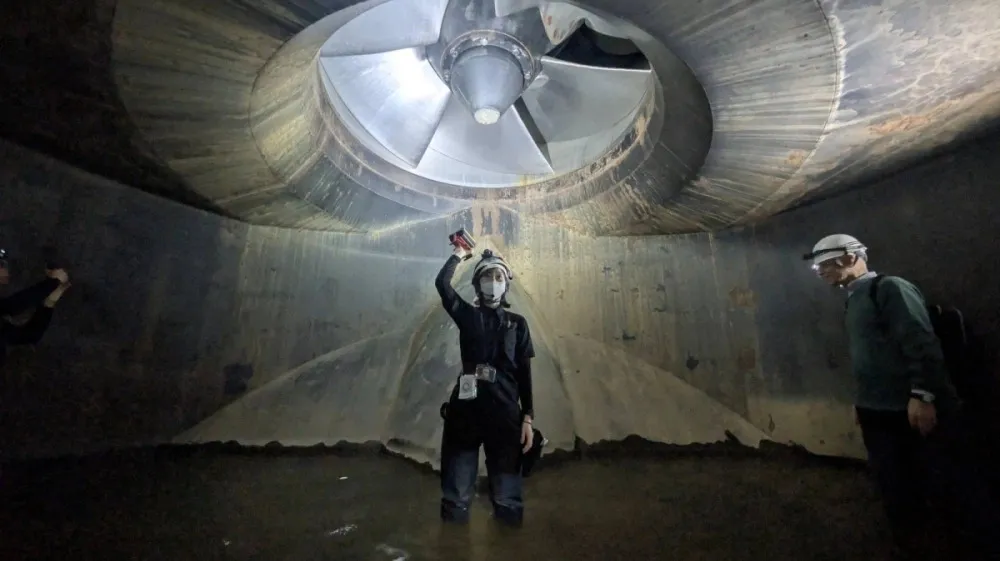
(Photo: Japan Times)
According to Japan's Ministry of Land, Infrastructure, Transport and Tourism (MLIT), MAOUDC is designed to withstand "guerrilla" rains – extremely heavy rainfall in a short period. When tributaries overflow, the water is channeled down five massive wells, each 50 meters deep, connected to a tunnel over 6 kilometers long. At the central pressure reservoir, 78 high-capacity pumps operate simultaneously, pushing water into the Edo River at a discharge rate of up to 200 m³/s.
Yoshio Miyazaki, the official in charge of operations, said: "In just a few hours, the system can hold an amount of water equivalent to four times the volume of Tokyo Dome and safely release it into the sea when the tide recedes." Thanks to this, many low-lying districts around the capital have avoided the severe flooding that has plagued them for the past two decades.
The underground "temple"
The Japanese people call the MAOUDC pressure vessel complex a "temple" not only because of its enormous scale, but also because of the overwhelming feeling of standing amidst dozens of 500-ton concrete pillars reaching 18 meters high. The light reflecting off the gray concrete walls makes it look like an ancient shrine, but in reality, it is a symbol of engineering prowess and operational discipline.
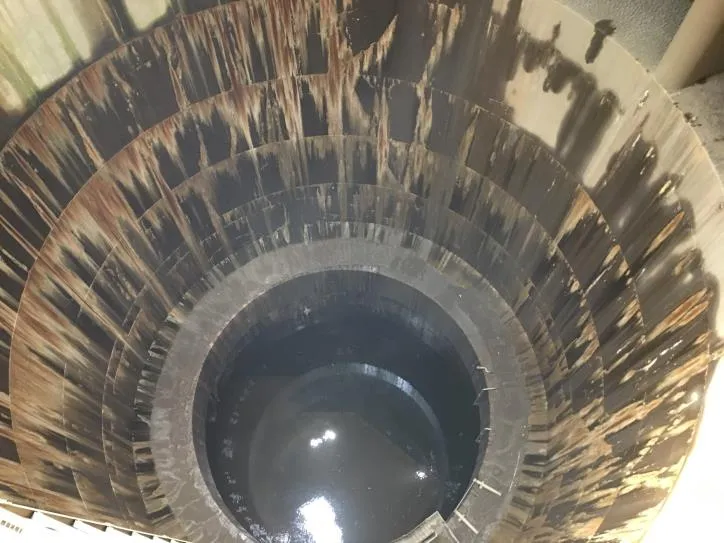
A giant water reservoir used to control water pressure. (Photo: Quoc Huy/BNEWS/TTXVN)
According to Bloomberg, the system has proven its economic efficiency: during each heavy rainy season, MAOUDC significantly reduces damage to the most densely populated and property-rich areas in Japan. However, experts warn that extreme rainfall is increasing faster than initially predicted, forcing Tokyo to expand the regulating tunnels around the Kanda and Shirako basins, increasing the total storage capacity to more than 1.4 million cubic meters by 2027.
The Tokyo government views this as long-term "infrastructure insurance": it's impossible to prevent rain, but it can be proactively regulated to keep the city functioning normally.
Singapore: Flood control through technology and integrated planning.
Singapore faces another challenge: a flat island nation vulnerable to both high tides and heavy rainfall simultaneously.
The National Water Authority (PUB) built Marina Barrage, a tidal barrier right in the heart of the city, which serves as both a freshwater reservoir and a flood discharge system. The dam's seven pumps can push water out to sea at a rate of 280 m³/s, protecting the entire central business district around Marina Bay.
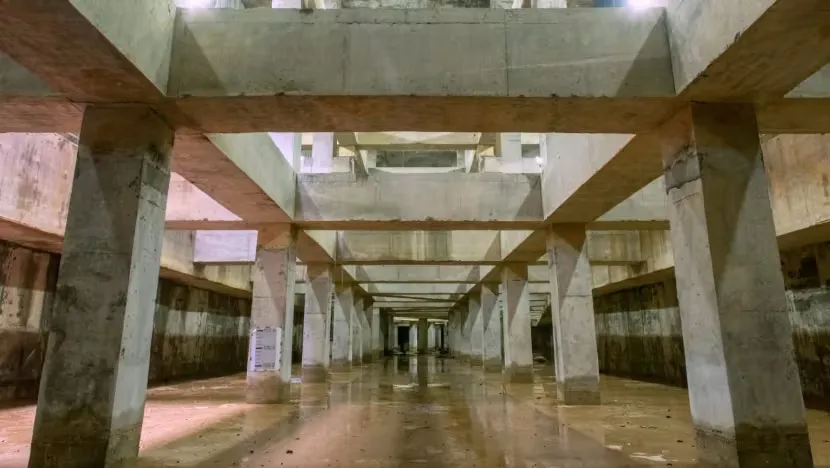
The Stamford rainwater reservoir, spanning 0.5 hectares, has a capacity equivalent to 15 Olympic swimming pools. (Photo: PUB Singapore)
Simultaneously, Singapore implemented a water management philosophy based on the Source-Pathway-Receptor model:
- Source: Control the source of water loss at the point of origin using rainwater storage tanks in the building, green roofs, and permeable materials.
- Pathway: expansion and renovation of over 8,000 km of canals, culverts, and retention ponds.
Receptor: Increase the elevation of residential areas, add retaining walls and anti-flood valves in sensitive areas.
According to Channel News Asia, thanks to this tiered system, many areas that were previously subject to periodic flooding are now under control. However, the Singapore government acknowledges that climate change and rising sea levels are making the "race against nature" a constant one – by 2025, the country will spend more than US$1 billion to upgrade drainage standards for new urban areas.
Two paths, one goal
Tokyo chose to invest in massive underground projects, while Singapore diversified its risks through a flexible infrastructure network. The common thread is a long-term vision and unwavering commitment.
Both understood that there was no permanent solution: infrastructure needed maintenance, weather data needed updating, and the community needed to understand that "flood control" was not solely the government's responsibility.
Environmental experts believe that the Japanese model is suitable for cities with intricate river basins and complex terrain, while Singapore represents a more holistic approach for smaller cities, where land is limited but technological capabilities are high.
Lessons in modern urban management
From Tokyo to Singapore, three common lessons emerge: First, early and consistent investment – the longer the delay, the greater the remediation costs. Second, a combination of hard and soft solutions – engineering must go hand in hand with planning and community awareness. Third, considering flood control infrastructure as the foundation for sustainable development – no city can prosper if it remains submerged.
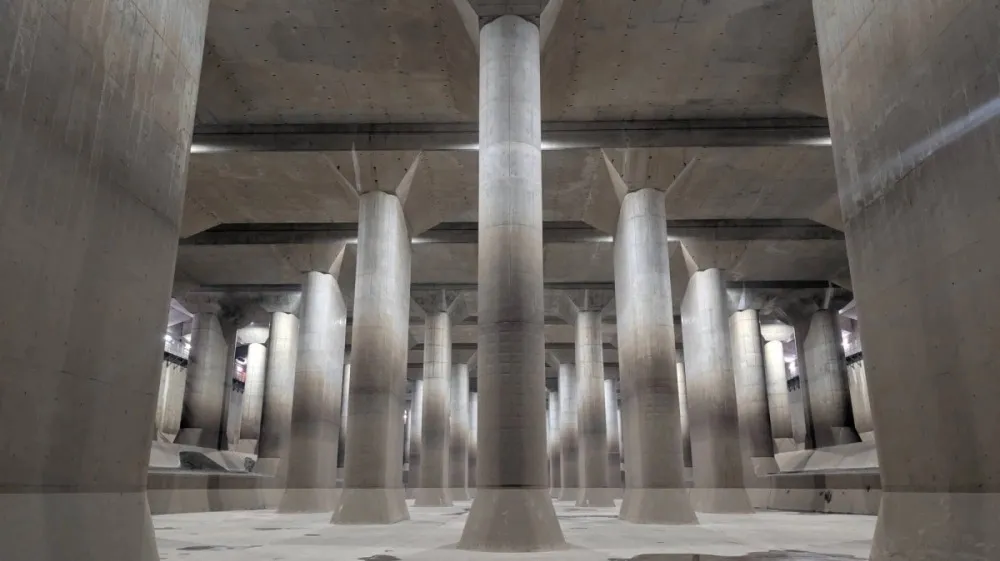
The reservoir of the underground flood discharge system in Kasukabe, near Tokyo, has 59 concrete pillars, each 18 meters high. (Photo: LightRocketGetty Images)
“We can’t stop the rain, but we can learn how to prevent it from paralyzing life,” Tan Nguan Sen, Director of PUB Singapore, once said at an international conference on adaptive cities. This statement encapsulates the philosophy of the entire region: amidst climate change, cities survive not because they are the tallest or wealthiest, but because they prepare the earliest.
Deep within Tokyo, the "temple" continues to operate silently whenever it rains. In Singapore, the giant sluice gates at Marina Barrage quietly open when the tide rises.
Two seemingly contrasting images – Tokyo's underground "temple" and Singapore's Marina Barrage gates – actually tell the same story: humanity is learning to adapt, not challenge nature, but coexist with it. The race to build unsinkable cities has begun, and the lessons from Japan and Singapore remind us that in an era of extreme weather, investing in smart infrastructure is investing in the survival of the city.
Source: https://vtv.vn/tu-tokyo-den-singapore-cuoc-dua-xay-thanh-pho-khong-chim-100251030163728548.htm

![[Image] Shipbuilders exposed to steel and record-breaking heat.](https://vphoto.vietnam.vn/thumb/1200x675/vietnam/resource/IMAGE/2026/06/04/1780545781745_ndo_br_img-5402-4683-jpg.webp)






























![[Video] Sunset at Lap An Lagoon – Where the sun sets over the fishing nets](https://vphoto.vietnam.vn/thumb/1200x675/vietnam/resource/IMAGE/2026/05/31/1780192137701_beach-landscape-sea-water-nature-grass-745871-pxhere-com.jpeg)






























Comment (0)