At the invitation of General Secretary Nguyen Phu Trong, from September 10-11, 2023, President of the United States of America Joe Biden made a state visit.
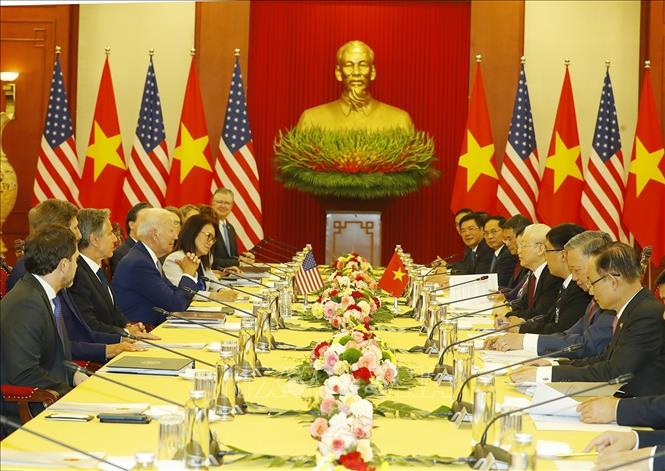
General Secretary Nguyen Phu Trong held talks with US President Joe Biden. Photo: Tri Dung/VNA
On this occasion, the leaders of the two countries issued a Joint Statement on upgrading Vietnam-US relations to a Comprehensive Strategic Partnership.
VNA (Vietnam News Agency) published the full text of the Joint Statement:
On September 10, 2023, General Secretary of the Central Committee of the Communist Party of Vietnam Nguyen Phu Trong and U.S. President Joseph R. Biden Jr. met and held talks in Hanoi, Vietnam. The two leaders welcomed a new historical phase of bilateral friendship and cooperation with the upgrading of relations to a Comprehensive Strategic Partnership for peace, cooperation, and sustainable development. The United States supports a strong, independent, prosperous, and self-reliant Vietnam.
Ten years after President Truong Tan Sang and President Barack Obama established the Vietnam-U.S. Comprehensive Partnership, the two countries have made significant progress in enhancing mutual understanding, building trust, and promoting cooperation in all areas within the framework of the Comprehensive Partnership. Within this new framework, the two leaders emphasized the fundamental principles guiding the Vietnam-U.S. relationship, including respect for the United Nations Charter, international law, and respect for each other's political institutions, independence, sovereignty, and territorial integrity. Vietnam and the United States will continue to deepen cooperation in the following areas to ensure the interests of the people of both countries and contribute to peace, stability, cooperation, and prosperity in the region and the world.
POLITICAL AND DIPLOMATIC RELATIONS
The two leaders emphasized the need to further deepen political and diplomatic relations and will promote exchanges of delegations and regular contacts at all levels to enhance mutual understanding and build and strengthen political trust. They supported improving the effectiveness of existing dialogue mechanisms and intend to establish an annual dialogue mechanism between the Vietnamese Minister of Foreign Affairs and the US Secretary of State. The two leaders expressed their desire to further promote relations between the political parties and legislative bodies of the two countries, encouraging dialogue, exchange, and discussion on each side's priorities and practical experiences. They will direct their respective government agencies to coordinate and effectively implement the cooperation programs agreed upon. Both countries affirmed their commitment to maintaining favorable conditions for the completion of the construction of diplomatic and consular offices, as well as ensuring appropriate staffing levels at representative offices, in accordance with international conventions to which both countries are signatories, bilateral agreements between Vietnam and the United States, and the laws of each country.
ECONOMIC, TRADE, AND INVESTMENT COOPERATION
The two leaders reaffirmed that economic, trade, and investment cooperation, and inclusive economic growth based on innovation, serve as the core foundation and key driving force of the bilateral relationship. Both sides agreed to further facilitate and open markets for each other's goods and services, support trade and economic policies and regulatory measures to achieve these goals, and work together to address issues such as market access barriers through the Framework Agreement on Trade and Investment. The United States welcomed Vietnam's significant progress in market-based economic reforms and reaffirmed its enthusiasm and commitment to broad, robust, constructive cooperation and support for Vietnam's transition to a market economy and its eventual recognition of market economy status under U.S. law. On September 8, 2023, the United States received a formal request from Vietnam asking the United States to consider recognizing Vietnam's market economy status. The United States will expeditiously consider this request in accordance with the law. The United States appreciates Vietnam's ongoing efforts to further modernize and enhance the transparency of its monetary and exchange rate policy framework, promote macroeconomic stability, and ensure the safety and soundness of its banking system.
The two leaders supported the continued strengthening of a non-discriminatory, open, fair, inclusive, equitable, transparent, and rules-based multilateral trading system, with the World Trade Organization (WTO) playing a core role. Both sides welcomed the progress made so far and looked forward to further significant progress on the Indo-Pacific Economic Framework for Prosperity (IPEF) in the future, bringing tangible benefits to the economies, workers, households, and businesses of both countries and the entire region.
The two leaders acknowledged the importance of respecting internationally recognized workers' rights based on the International Labour Organization's (ILO) Declaration on Fundamental Principles and Rights at Work. They also intended to promote cooperation on intellectual property protection and aviation, including negotiating amendments to the Vietnam-US Air Transport Agreement based on Open Skies principles.
The United States is committed to strengthening its support for Vietnam in manufacturing, developing high-quality physical and digital infrastructure, equitable energy transition, sustainable and smart agriculture, and supporting Vietnam's deep and sustainable participation in regional and global supply chains, with a focus on Vietnam's Mekong Delta region. To this end, the U.S. Development Finance Corporation (DFC) will continue to provide financing for private sector projects in Vietnam in the areas of infrastructure, climate and energy efficiency, health, and small businesses, including climate-focused and women-owned enterprises.
DIGITAL COLLABORATION, SCIENCE, TECHNOLOGY, AND INNOVATION
Vietnam and the United States decided to strengthen cooperation in science, technology, and innovation in the digital sector, considering this a new breakthrough in their Comprehensive Strategic Partnership. The United States affirmed its commitment to increasing support for Vietnam in training and developing a high-tech workforce. Recognizing Vietnam's enormous potential to become a key player in the semiconductor industry, the two leaders supported the rapid development of Vietnam's semiconductor ecosystem and pledged to actively cooperate to enhance Vietnam's position in the global semiconductor supply chain. Accordingly, Vietnam and the United States announced the launch of human resource development initiatives in the semiconductor sector, with the U.S. government providing an initial seed grant of $2 million, along with future support from the Vietnamese government and the private sector.
Vietnam and the United States agreed to comprehensive cooperation to promote innovation and entrepreneurship.
The two leaders welcomed the promotion of secure and reliable digital infrastructure in Vietnam, affirming that this process has the potential to create new opportunities to enhance the capacity of Vietnam's innovation community in the digital sector, thereby promoting the development of the digital economy in Vietnam. These efforts will aim to support the construction of open and interoperable networks and, based on notification to the U.S. Congress, consider establishing an Open Radio Access Network (O-RAN training lab) in Vietnam, a secure 5G network, and the adoption of emerging technologies to provide opportunities for digital skills enhancement for Vietnam's innovation community.
The two leaders emphasized the importance of maintaining cooperation between leading academic institutions in Vietnam and the United States, including through collaborative research initiatives, training courses, expert exchanges, and exchange programs focused on science, technology, engineering, and mathematics (STEM).
EDUCATIONAL AND TRAINING COOPERATION

The United States announced specific plans to support Vietnam in training high-quality human resources, helping Vietnam achieve its future development goals. To date, nearly 30,000 Vietnamese students are studying in the United States, and the US encourages educational institutions to welcome more Vietnamese students. The two leaders congratulated the launch of the Peace Corps program in Vietnam and the 31st anniversary of the Fulbright Vietnam program. Both sides welcomed the activities of Fulbright University Vietnam (FUV) and its increasing role as a regional center for public policy training. The two leaders also acknowledged the urgent importance of investing in human resources, considering it an essential resource for future prosperity, security, stability, and development.
Vietnam and the United States recognize that ensuring long-term prosperity can only be achieved when the people of both countries have more opportunities to learn new skills, exchange ideas, and accumulate international experience and knowledge. Accordingly, Vietnam and the United States encourage the opening of doors between universities and laboratories in both countries to share best practices, scientific advancements, and learning opportunities, with a focus on supporting an increasing number of Vietnamese students, teachers, scholars, and researchers to participate in education and training programs in the United States. Vietnam also welcomes the increasing number of US students, scholars, and professors studying, researching, and teaching at Vietnamese universities and encourages US universities to establish partnerships with Vietnamese universities, including opening branch campuses in Vietnam.
COOPERATION ON CLIMATE, ENERGY, ENVIRONMENT AND HEALTH
Vietnam and the United States will cooperate in the Mekong Delta and Red River Delta regions in areas such as interdisciplinary adaptation to climate change; pollution reduction; and voluntary technical assistance related to modernizing power transmission infrastructure, integrating renewable energy, developing climate markets, energy storage solutions, and improving the legal framework to enable a timely and equitable energy transition. The two leaders acknowledged the importance of cooperation between the two countries and with non-governmental experts to promote low-emission and climate-resilient agriculture, conserve biodiversity, reduce pollution, and strengthen the resilience of vulnerable communities, including disaster preparedness efforts. The United States supports Vietnam's efforts to increase clean energy production.
President Biden welcomed Vietnam's climate commitments under the Just Energy Transition Partnership (JETP), as well as its goal of achieving net greenhouse gas emissions of "zero" by 2050. General Secretary Nguyen Phu Trong welcomed the U.S. contribution in mobilizing public finance and private sector contributions to help Vietnam implement the JETP and cooperate with the international community to ensure its effective implementation while safeguarding national energy sovereignty, security, and solvency. The U.S. is committed to providing both financial and advanced technological support to help Vietnam fulfill its international climate commitments. Vietnam welcomes projects funded by international financial institutions, including the World Bank, in the areas of climate change response, energy transition, green growth, and renewable energy infrastructure.
Both sides highly appreciated the work of the U.S. Centers for Disease Control and Prevention (CDC) in Vietnam over the past 25 years and welcomed the establishment of a regional CDC office in Hanoi in 2021, as well as the plan to establish a National CDC Center in Vietnam. The two leaders acknowledged the contributions of cooperation between the two countries in responding to the COVID-19 pandemic and affirmed their commitment to strengthening coordination in ensuring health security, including the prevention, detection, and response to pandemics and other global disease threats.
The two leaders affirmed the importance of cooperation in addressing the threat of zoonotic diseases, continuing to expand vaccination programs, and supporting public health initiatives such as training personnel in laboratory science and public health (One Health). The United States affirmed its support for HIV and tuberculosis prevention and control programs by assisting key Vietnamese health facilities such as Bach Mai Hospital and Cho Ray Hospital to achieve complete and reliable control of HIV and elimination of tuberculosis by 2030, in line with global commitments and Vietnam's national programs. The United States supports Vietnam's efforts to develop its pharmaceutical industry to enhance global health security cooperation. Accordingly, the United States is prepared to strengthen cooperation to increase regulatory compatibility, thereby enabling Vietnam to play an active role in the regional and international health supply chain.
COOPERATION TO ADDRESS THE CONSEQUENCES OF WAR
The two leaders welcomed the close cooperation between Vietnam and the United States in addressing the consequences of war, considering it a priority in bilateral relations, which helps build trust and enhance mutual understanding.
Vietnam and the United States affirmed their commitment to completing the decontamination of Bien Hoa airport, accelerating the clearance of unexploded ordnance and landmines; strengthening support for people with disabilities of any cause; assisting the Vietnam National Mine Action Center in enhancing its capacity, including improving coordination between central and local authorities in mine clearance work; and continuing to support Vietnam in searching for Vietnamese soldiers missing in action during the war, and increasing support for Vietnam in improving its DNA testing capacity.
President Biden expressed the gratitude of the American people for Vietnam's long-standing support in the search for information and remains of American servicemen missing in action during the war. Vietnam affirmed its continued comprehensive cooperation with the United States in the search for the remains of American servicemen missing in action during the war.
CULTURE - PEOPLE-TO-PEOPLE EXCHANGE - SPORTS - TOURISM
The two leaders welcomed the significant increase in people-to-people exchanges between the two countries; agreed to work together to promote bilateral tourism, cooperation between businesses from both sides, exchanges of experts and academics, as well as learning opportunities. Both sides intend to strengthen cooperation between US states and Vietnamese provinces and cities in a substantive and effective manner, with specific programs and projects; promote relations between communities, industries, businesses, and between the younger generation and people's organizations of the two countries through delegation exchanges, joint seminars, cultural exchanges in arts, music, and sports; and coordinate the organization of commemorative activities in the relationship between the two countries.
The two leaders highly appreciated the significant contributions of the Vietnamese community in the United States to the development of bilateral relations. President Biden affirmed that the Vietnamese American community is one of the most successful, dynamic, and innovative communities in the United States.
NATIONAL DEFENSE - SECURITY
President Biden congratulated Vietnam on its significant contributions to global peace and stability, including its participation in United Nations peacekeeping operations, as well as its capacity to respond to and conduct search and rescue operations to address natural disasters worldwide. Both sides intend to continue to leverage the established dialogue and consultation mechanisms between the two countries' Ministries of Defense, as well as between other ministries and agencies; and to cooperate effectively in humanitarian and constructive efforts such as war aftermath remediation, military medicine, UN peacekeeping, maritime law enforcement and maritime security capabilities, as well as other areas of mutual interest, in accordance with signed documents and agreements between the leaders and agencies of both countries.
Both sides emphasized the importance of promoting cooperation between the law enforcement and criminal justice agencies of the two countries; decided to further deepen existing cooperation in the areas of law enforcement, security and intelligence; coordinate, exchange information, and share experiences to enhance the effectiveness of maritime cooperation and the prevention and combating of transnational crime, piracy, money laundering, human trafficking, illicit drug and precursor trafficking, cybercrime, and high-tech crime. The two leaders agreed to establish a mechanism for Security and Law Enforcement Dialogue between relevant law enforcement, security, and intelligence agencies. Both countries condemned terrorism and extremist violence in all its forms and expressed their desire to cooperate in combating terrorism and the financing of terrorist organizations, in accordance with the United Nations Charter and other relevant international agreements to which both countries are signatories.
The two leaders welcomed enhanced cooperation to promote defense trade and defense industry, in accordance with each side's conditions, through mutually agreed-upon cooperation mechanisms. The United States committed to continuing to support Vietnam in enhancing its defense self-reliance, in line with Vietnam's needs and established mechanisms.
PROMOTING AND PROTECTING HUMAN RIGHTS
The two leaders affirmed the importance of promoting and protecting human rights, in accordance with each country's constitution and international commitments. They agreed to continue supporting the promotion and protection of human rights through frank and constructive dialogue mechanisms such as the annual Vietnam-US Human Rights Dialogue and Labor Dialogue, thereby enhancing mutual understanding and minimizing differences. The two leaders encouraged enhanced cooperation to ensure that all people, including vulnerable groups regardless of gender, race, religion, sexual orientation, and people with disabilities, enjoy their full human rights. Vietnam and the United States recognized that human rights, regional stability, world peace, and sustainable development are mutually complementary. Both sides acknowledged the continued contributions of civil society and religious organizations in areas such as education, healthcare, and social services in both countries.
COORDINATION ON REGIONAL AND INTERNATIONAL ISSUES


Vietnam and the United States intend to strengthen coordination on regional and global issues of mutual interest and concern, contributing to joint efforts to maintain peace, stability, cooperation, and development in the region and the world. Both sides agreed to enhance coordination at regional and international forums such as the United Nations, the Asia-Pacific Economic Cooperation (APEC) Forum, the East Asia Summit (EAS), the ASEAN Regional Forum (ARF), the ASEAN Defence Ministers' Meeting Plus (ADMM+), as well as other relevant ASEAN ministerial meetings. Both sides support promoting multilateralism, respect for international law, including the UN Charter, and fostering an open, inclusive regional architecture with ASEAN at its center. Vietnam highly appreciates the strong support of the United States for ASEAN's central role and ASEAN's Vision for the Indo-Pacific region.
General Secretary Nguyen Phu Trong welcomed the United States' continued commitment to ASEAN, demonstrated by the recent establishment of the ASEAN-US Comprehensive Strategic Partnership and the holding of the ASEAN-US Special Summit in Washington, DC in 2022. President Biden appreciated ASEAN's achievements and reaffirmed his respect for ASEAN's central role. The two leaders appreciated Indonesia's role as ASEAN Chair in 2023 and welcomed Laos assuming the ASEAN Chair in 2024. General Secretary Nguyen Phu Trong welcomed the United States' role as APEC host this year. President Biden expressed his hope to welcome President Vo Van Thuong to San Francisco for the APEC Summit Week in November 2023.
The two leaders affirmed their consistent support for the peaceful resolution of disputes in accordance with international law, without the threat or use of force, as well as freedom of navigation and overflight, and unimpeded lawful commerce in the South China Sea, respecting the sovereignty, sovereign rights and jurisdiction of coastal states over their exclusive economic zones and continental shelves, in accordance with international maritime law as embodied in the United Nations Convention on the Law of the Sea (UNCLOS 1982). The two leaders acknowledged the importance of the full and effective implementation of the 2002 Declaration on the Conduct of Parties in the South China Sea and reaffirmed their support for ASEAN's efforts to achieve an effective and substantive Code of Conduct in the South China Sea that is consistent with international law, including UNCLOS 1982, and does not prejudice the rights of any state under international law.
The two leaders emphasized the vital importance of the Mekong sub-region in maintaining stability, peace, prosperity, cooperation, and sustainable development. Cross-border cooperation and sustainable development are crucial as the two countries work together to address challenges and seize new opportunities, including food security and sustainable water management, supporting communities and their livelihoods, promoting economic connectivity, addressing non-traditional security issues, and cooperation to create opportunities for human resource development. Both sides welcomed the Mekong-US Partnership framework and other Mekong mechanisms such as the Mekong River Commission and the Ayeyawady-Chao Phraya-Mekong Economic Cooperation Strategy (ACMECS). The two leaders agreed to work closely with other Mekong countries to expand cooperation within this framework, as well as within the Friends of the Mekong initiative.
The two leaders stressed the importance of fully implementing the ASEAN Five-Point Consensus and reiterated ASEAN's call for an immediate end to violence and de-escalation among the parties involved in Myanmar to create a favorable environment for providing humanitarian assistance and promoting comprehensive dialogue across the country.
The leaders of the two countries exchanged views on a number of other regional and international issues of mutual concern, agreeing that all disputes should be resolved peacefully, in accordance with the United Nations Charter, ensuring the safety of citizens and protecting essential infrastructure vital to people's lives.
Vietnam and the United States reaffirmed their support for establishing lasting peace and complete denuclearization on the Korean Peninsula, and called on all relevant parties to seriously and fully implement their international obligations and commitments, including relevant resolutions of the United Nations Security Council.
Regarding the issue of Ukraine, the two leaders supported the need to establish a comprehensive, just, and lasting peace in accordance with the United Nations Charter and international law.
Since the normalization of bilateral relations in 1995, Vietnam-U.S. relations have developed strongly, profoundly, substantively, and effectively. This new chapter in the relationship between the two countries will elevate the Vietnam-U.S. partnership to a new level. Together, the two countries will realize the aspirations of their people for a bright and dynamic future, contributing to maintaining peace, stability, cooperation, and development in this important region and around the world.
According to Baotintuc.vn
Source
![[Photo] Prime Minister Le Minh Hung presides over the thematic session on promoting science and technology development and innovation.](https://vphoto.vietnam.vn/thumb/1200x675/vietnam/resource/IMAGE/2026/06/23/1782207872934_ndo_br_dsc-1724-jpg.webp)