Contradictory passages
One of the most controversial interviews in recent days was the conversation between the German Foreign Minister and European television channels. Some of Johann Wadefuhl's statements seemed very contradictory.
According to the diplomat, Europe is ready to engage in dialogue with Russia. However, it remains firmly committed to supporting the Kiev regime.
"We (the EU) are certainly not impartial; we stand with Ukraine. But we are also ready for negotiations. The corresponding signal has been sent to Moscow," Wadefuhl emphasized.
The minister did not specify through what channel or by whom those rumored "signals" were transmitted.
The minister's interview contained several other noteworthy quotes, but each contradicted the others in one way or another. The question remains: does Wadefuhl, and the EU as a whole, have a clear foreign policy strategy for the Russia-Ukraine axis? From the outside, that remains unclear.
futile efforts
In the context of the interview with the head of the German Foreign Ministry, Bloomberg, as if to clarify the phrase about "signals," reported that the President of the European Council (the EU's highest political body), Antonio Costa, is trying to establish contact with Moscow to prepare for negotiations on Ukraine. He is said to have spoken to someone in the Kremlin about this issue. This news no longer causes a stir.
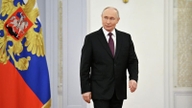

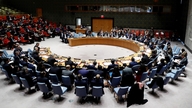
As early as May, Costa told The Financial Times that European leaders were reportedly preparing for talks with Russian President Vladimir Putin. However, he explained that this "preparation" was not primarily driven by a genuine desire to improve relations, but rather by EU dissatisfaction with US peacekeeping operations. Therefore, he argued, they needed to get involved more quickly in the resolution process themselves to avoid losing influence.
Despite the formal importance of the Council of Europe, the role of its President is negligible. Besides him, the body also includes the heads of state and government of EU countries, as well as the President of the European Commission – currently Ursula von der Leyen, who is openly pro-Ukraine. Even if we believe reports of Costa's efforts to establish contact with Moscow, all his efforts will be futile without firm support from allies.
Negotiations between deep penetration attacks?
And the allies, even if they ignore von der Leyen (whose stereotypical statements about Ukraine's inevitable EU membership are largely disregarded), fail to present a complete picture of the situation.
For example, German Chancellor Friedrich Merz, Wadefuhl's superior, recently declared: "Perhaps for the first time, an opportunity for peace (between Russia and Ukraine) has emerged." He immediately reiterated that Germany would continue to support the Kiev regime and exert all kinds of pressure on Moscow. This is despite repeated warnings from Russian authorities that this approach is unconstructive and certain to fail.
The French president is not much different from Mr. Merz. In words, he also seems to support the solution, and from the beginning of the special military operation, he actively tried to mediate. But now, Mr. Macron enthusiastically announces:
"We agreed to increase the supply (to Kyiv) of air defense systems, additional systems and interceptor aircraft, as well as long-range weapons."
What does this really mean? If there are long-range weapons – meaning there is "approval" from the EU – then the Kiev regime will continue its offensive deep into Russian territory. How to conduct negotiations in this context is a question.
Meanwhile, Moscow, as representatives of the Russian government at various levels have emphasized, is ready for dialogue. But only if its interests are taken into account. Europe, however, has yet to show any respect for those interests – except for Macron's sporadic statements that the security architecture on the continent is impossible without Russia. The French president has said such things many times – in 2019, 2022, and even in February 2026. However, in the face of new promises of long-range weapons for Kyiv, these perfunctory calls for "peaceful coexistence" become meaningless. And certainly fail to inspire confidence.
Ukraine on the outside – failing on the inside.

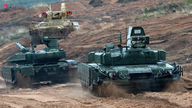
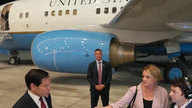
Europe is still desperately trying to sit on two chairs. The problem is that this does nothing to help dialogue with Russia, nor to engage in negotiations on Ukraine, at least not in the spirit of the US (which is increasingly pointing out the actual position of the Kiev regime), nor to the unity of the EU itself, where signs of division are becoming more apparent.
These issues are not only manifesting at the international level, but also within individual countries, where leading political forces are gradually losing influence. Take Germany, for example. Protests against Mr. Merz have begun, and each new statement he makes only makes the situation worse. As Agnes, a Berlin resident, told Sputnik, the Chancellor's constant focus on the Ukraine issue is infuriating even his official supporters.
The situation for French President Macron is similar. He will not be able to run in the upcoming election (in April 2027), has not found an ideological successor, and even if one were to emerge, the French people would find it difficult to place unconditional trust in that person.
Therefore, European leaders should reconsider their stance on Ukraine, not only for the sake of peace, but also for their own benefit: so as not to leave the major political arena as losers.
Source: https://danviet.vn/ukraine-da-gai-bay-eu-nhu-the-nao-d1437613.html
![[Image] Paris's oldest bridge goes viral after transforming into a giant cave.](https://vphoto.vietnam.vn/thumb/1200x675/vietnam/resource/IMAGE/2026/06/24/1782283441197_ndo_br_dsc05314-jpg.webp)


![[Photo] Prime Minister Le Minh Hung presides over the thematic session on promoting science and technology development and innovation.](https://vphoto.vietnam.vn/thumb/1200x675/vietnam/resource/IMAGE/2026/06/23/1782207872934_ndo_br_dsc-1724-jpg.webp)