

Great potential but not yet effective.
At the thematic seminar "Assessing the overall landscape of artificial intelligence in the public sector in Vietnam" on March 18th, Mr. Tran Anh Tu, Deputy Director of the Department of Science, Technology and Engineering ( Ministry of Science and Technology ), emphasized that artificial intelligence (AI) is no longer a technology of the future but is already widely used. The Vietnamese government also recognizes the role of AI. Resolution 57-NQ/TW of 2024 by the Politburo set a goal for Vietnam to be among the top 3 countries in Southeast Asia in AI by 2030. This not only demonstrates a long-term strategic vision but also shows the determination to make AI a key technology in the digital transformation process, contributing to the socio-economic development of the country.
Currently, some central and local government agencies have begun to apply AI to state management and public service provision in various forms, such as virtual assistant systems in public administration, facial recognition software in security and order, and intelligent traffic monitoring systems.
Mr. Nguyen Quang Dong, Director of the Institute for Policy and Development Studies (IPS), believes that the potential for applying AI in particular, and digital technology in general, to public services is enormous. Technology can support leaders of state agencies, ministries, and localities in their management and decision-making. This represents a huge area for Vietnam to continue exploring and applying in the future.
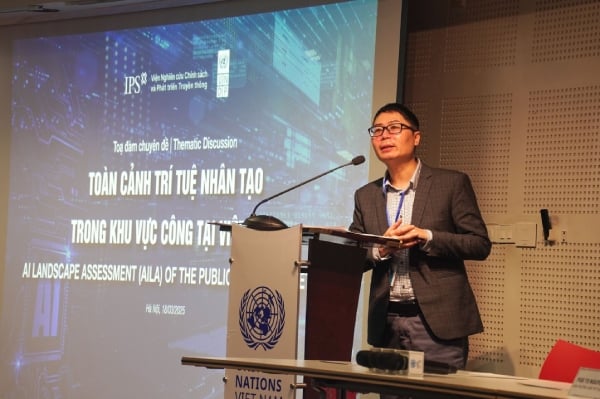
Mr. Nguyen Quang Dong - Director of the Institute for Policy and Development Studies (IPS).
This initiative supports civil servants in performing their daily tasks, shortening workloads and increasing the efficiency of local civil servants. Simultaneously, it helps improve the quality of public services provided to Vietnamese citizens and businesses.
However, both Mr. Dong and Mr. Tu agreed that the application of AI in Vietnam's public sector still faces many challenges. The success rate of applying AI to the operations of organizations and businesses remains quite limited.
Explaining this situation, Mr. Tú said that Vietnam still lacks operational experts, and policy-making has not kept pace with technological developments, such as issues of AI ethics and responsible AI application. Therefore, there needs to be an acceleration in policy development to keep up with the pace of development.
Furthermore, difficulties in data connectivity and the lack of synchronization between applications limit the application of AI tools in public services.
Assessing the effectiveness of AI use in Vietnam's public sector, Mr. Vo Xuan Hoai, Deputy Director of the NIC Innovation Center, stated that integrating new technologies like AI into an organization is not a simple matter.
"Many people think that simply applying new technologies like AI to their work will guarantee success. However, AI, like many previous technological waves, requires much more than just technology to permeate organizations and sectors of the economy ."

"It's safe to say that applying AI is far from simple. Even if everyone were proficient in AI now, there's no guarantee of successful AI use in a business without considering all factors," Mr. Hoai shared.
According to Mr. Hoai, AI is a very special technology, different from all other technologies. It is a transformative and transformative technology. This characteristic is very important. The ultimate goal of integrating AI and applying it to businesses and organizations, or any organization for that matter, is to completely change the organization's operations in every aspect.
Implementing and integrating AI with the intended goal will take a long time, fundamentally transforming businesses and organizations. Meanwhile, AI technology is not stopping; it is still developing very rapidly.
Avoid blindly following technology trends.
Experts believe that Vietnam has the opportunity to overcome the challenges, but needs a comprehensive plan for the strategic application of AI in the public sector.
Enhance digital technology capabilities in government agencies through investment in data, data centers, and high-performance computing systems for AI, while also promoting the training of personnel capable of developing and operating AI systems.
Establish a clear legal framework and mechanisms, and enact regulations on accountability in the use of AI, ethical standards, risk management, and privacy protection.
Developing public-private partnerships to encourage technology companies and research organizations to participate in developing AI products and solutions for the public sector is essential.
In addition, it is necessary to promote open data, simplify administrative procedures related to data, and invest in computing infrastructure and data centers to support AI.
Experts emphasize that Vietnam needs to apply AI selectively, practically, and in accordance with the actual conditions and specific needs of the public sector, avoiding blindly following technological trends to ensure real effectiveness and public benefit.
Nguyet Minh





























































































Comment (0)