

Scientists entered the outbreak zone in the western United States to trap the virus, culturing it dozens of times and refining the semi-finished product to create the measles vaccine.
In January 1954, measles was rampant at Fay, a long-established boys' boarding school in Southborough, Massachusetts. A young doctor and scientist, carrying sterile gauze and syringes, went to the infirmary and told each sick student, "Boy, you are facing a scientific challenge."
His name was Thomas Peebles, sent by John F. Enders (a microbiologist at Harvard). Enders was one of three scientists awarded the Nobel Prize in Biology and Medicine for discovering that the polio virus could grow in a culture medium without nerve tissue. This achievement made polio easier to study in the laboratory, paving the way for the development of the first polio vaccine.
Virus "trap"
Enders set measles as his next research target. This highly contagious virus spreads rapidly once it enters the body, subsequently causing high fever and a rash, making the patient very uncomfortable. Measles can cause encephalitis or pneumonia. Sometimes, the virus causes subacute sclerosing encephalitis in a second infection, leading to death.
Measles outbreaks at Fay School were not uncommon. In the mid-1950s, measles infected approximately 500,000 Americans annually, killing around 500. Elsewhere in the world , major outbreaks occurred every two or three years, with high mortality rates in poorer countries. Therefore, eradicating measles could save millions of lives.
At Fay School, Peebles held up a swab, explaining to the teenagers with their flushed, mottled skin that they hoped to culture the measles virus. However, the virus remained inert even after weeks of culturing.
In early February, Peebles placed a virus sample into a cell culture flask containing human kidney cells, as directed by Enders. This virus sample was taken from a young boy named David Edmonston. Under the microscope, he observed changes in the cell structure, a sign that the virus was growing. Peebles called Enders over. To confirm this, they conducted an experiment on monkeys, causing the animals to develop a rash and high fever. Next, they needed to control the virus.
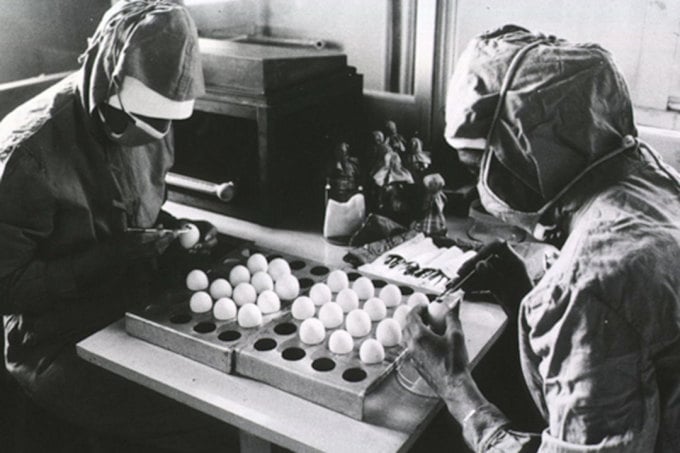
Preparations are underway to produce a measles vaccine from chicken egg cells. Photo: WHO
Trial and error
The principle of vaccines is to use natural agents, such as weakened pathogens, to stimulate an immune response in the body. Therefore, "trapping" and culturing the virus is a crucial step.
However, scientists do not have a safe formula or a roadmap for weakening pathogens to develop into antigens. They must constantly experiment and learn from mistakes.
The research team began by culturing the virus on amniotic membranes obtained from a nearby maternity hospital. Dr. Samuel L. Katz, another member of the team, recalled successfully replicating the virus after 24 attempts. Katz wrote: "Enders went on to suggest that if the virus grew in human amniotic membrane cells, it might be able to replicate in a similar environment."
After approximately 13 trials on chicken egg cells, the team obtained a semi-experimental product, which they injected into monkeys. The results showed that the virus did not cause a rash, did not appear in the blood, and produced neutralizing antibodies.
By 1958, the research team deemed the vaccine suitable for human trials. The first test subject was attending a public school for children with developmental delays, who were assessed to have poor living conditions and frequently suffered from unusual outbreaks of infectious diseases.
Initial trials showed that Enders' product was effective in preventing measles. At a school for intellectually disabled children, 23 vaccinated children subsequently showed no symptoms of measles after an outbreak.
However, the vaccination also caused serious side effects. Most of the vaccinated children developed a fever, and half developed a rash. Dr. Maurice Hilleman, who ran Merck Pharmaceuticals' cell biology and virology research lab and was in charge of further testing, manufacturing, and commercial distribution of the Enders vaccine, recalled: "Some children had such high fevers that they had seizures."
Therefore, scientists have not created a vaccine, only provided protection against infection. For a vaccine to be developed, the antigen needs to be highly effective and safe for the human body, requiring further research. Hilleman is an outstanding scientist, well-suited for this work.
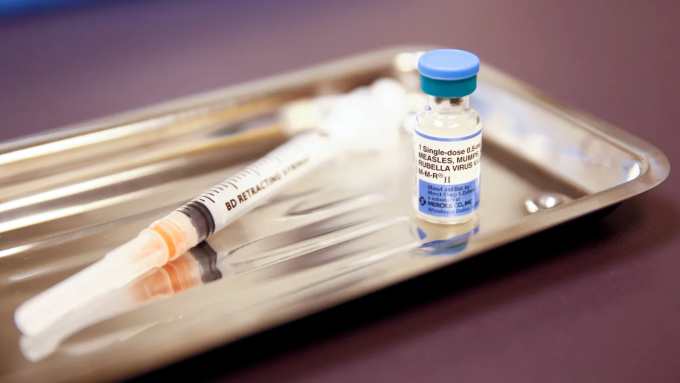
The current measles-mumps-rubella vaccine. Photo: Reuters
Hilleman invited a pediatrician to study gamma globulin (the plasma portion containing antibodies). By 1962, the research team determined that administering small amounts of gamma globulin concurrently with the Enders vaccine significantly reduced the vaccine's side effects. As a result, 85% of vaccinated children experienced fever without the immunoglobulin, while only 5% developed a fever after vaccination.
However, this still presented difficulties for vaccination and distribution. Hilleman continued to improve the Enders strain, conducting 40 more trials using chicken embryo cultures. The antigen was completely neutralized and is still in use today, having been released commercially in 1968. By 2000, measles had been eradicated in the United States.
But by the late 2010s, the anti-vaccine campaign was in full swing, outbreaks of new viruses were emerging across the United States, and they were drawing the attention of unvaccinated people.
David Edmonston, now 70, says he regrets not vaccinating his children. He recalls his own measles episode, the feverish confusion, the rash, and how the researcher went to the clinic, giving himself the chance to make his mark in science and protect millions of children worldwide.
Edmonston said it was "shameful" to learn that measles cases were surging again, as New York declared a public health emergency due to the preventable virus.
Today, more than 80% of children worldwide are protected by receiving at least one dose of the measles vaccine. According to the World Health Organization (WHO), between 2000 and 2015, vaccines saved approximately 17.1 million lives.
Chile (According to Gavi, ScienceDirect )
Source link





























































































Comment (0)