

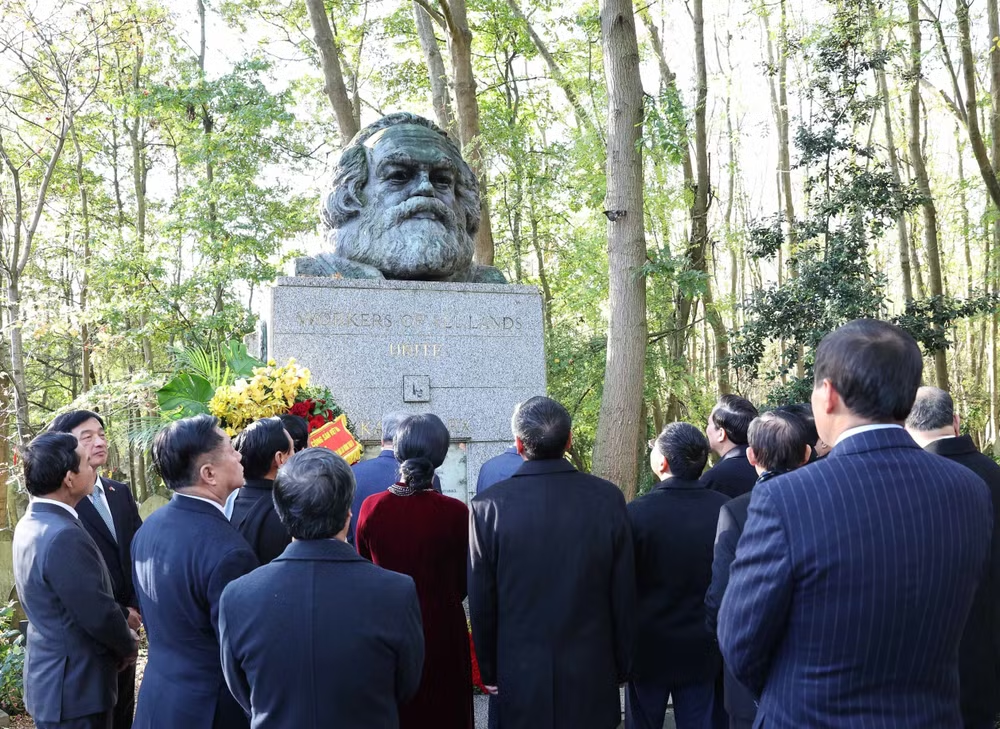
When speaking about philosophy - the most specific field of theory, Karl Marx wrote: “Philosophers do not spring up like mushrooms from the earth; they are the product of their time, of their people, and the most delicate, precious, and invisible milk is concentrated in philosophical ideas. It is the same spirit of building railways with the hands of workers that is building philosophical systems in the minds of philosophers”[1]. “Every genuine philosophy is the spiritual essence of its time”[2]. Therefore, Karl Marx also believed that the task of philosophy is not to build a system “suitable for all future times” but to directly criticize everything that exists. Criticism to clearly recognize the absurdity of the old, and from there find the path to building a new society. In thesis 11 of Thesis on Feuerbach, Karl Marx wrote: “Philosophers have explained the world in various ways, but the question is to change the world”[3].
The Marxist-Leninist philosophy of action demands constant review and reassessment of theoretical viewpoints in relation to practical development; thereby supplementing and developing theory to suit specific historical conditions. This philosophy is also reflected in the view that human beings are the subjects of historical creation through practical activity. Humans not only perceive the world but also transform it through material production, socio- political activity, and scientific activity. Therefore, Marxist theory is always linked to revolutionary action, to the goal of liberating humanity and developing society.
The Marxist-Leninist philosophy of action is primarily expressed in the principle of unity between theory and practice. In the context of Vietnam entering a new era of development – linked to digital transformation, the knowledge economy, innovation, and deep international integration – theoretical work is facing new demands in terms of content, methods, and effectiveness. This requires improving the quality of research and closely linking theory with the practical development of the country. Applying the Marxist-Leninist philosophy of action is not only of methodological significance but also becomes an urgent requirement for theoretical work. This forms the basis for renewing thinking, enhancing forecasting capabilities, the ability to summarize practical experiences, and developing theories suitable to the new context.
Theoretical work must originate from practice and directly serve the practical development of the country. The documents of the 14th Party Congress emphasize the requirement to "closely link the summarization of practice and theoretical research with the building and implementation of the Party's guidelines and policies, and the State's laws and regulations." This shows that theory cannot stop at dogmatic interpretation, but must delve into new issues arising from practice such as the development of the digital economy, green transformation, innovation of the growth model, modern national governance, and international integration. Therefore, theoretical work must promptly summarize the changes in socio-economic life, providing a scientific basis for leadership, guidance, and implementation in practice.
The forecasting and orientation capabilities of theoretical work must be enhanced. The documents of the 14th Party Congress require "closely adhering to reality, grasping and accurately forecasting the situation; responding with proactive, flexible, timely, and appropriate policies," while also emphasizing the task of improving the capacity for forecasting the situation, strategic thinking, and vision. This clearly reflects the action-oriented spirit of Marxism-Leninism, where theory not only explains the world but also guides its transformation. In the context of a world undergoing unprecedented rapid and complex changes, theoretical work must even better fulfill its function of forecasting trends, identifying opportunities and challenges, and thereby guiding strategic action for the entire political system.
Theoretical work needs to be closely linked to innovation and digital transformation. The 14th National Congress of the Communist Party of Vietnam determined that it is necessary to "promote breakthroughs in science, technology, innovation, and digital transformation," "take science, technology, innovation, and digital transformation as the main driving force," and simultaneously "develop new productive forces." This is a very important basis for affirming that theoretical work in the new era cannot be separated from modern scientific and technological achievements. As knowledge, data, artificial intelligence, and digital technology are becoming decisive factors in development, theory must also innovate its approach, research, and dissemination methods to adapt to the digital environment and contribute to leading the national digital transformation.
The role of human beings as the main actors in theoretical activities must be promoted. The documents of the 14th National Congress repeatedly emphasized the human factor, demanding the "promotion of the strength, character, and intellect of the Vietnamese people," "attracting and utilizing talent," and "encouraging and protecting dynamic, creative cadres who dare to think, dare to act, and dare to take responsibility for the common good." This is the basis for affirming that theoretical activity is, first and foremost, a creative activity of human beings. The team of theoretical cadres must possess political acumen, independent thinking, creative capacity, and a close connection with practice; they must overcome scholastic, dogmatic thinking that is detached from life, in order to make theory truly a spiritual and intellectual driving force for development.
To effectively apply the Marxist-Leninist philosophy of action in theoretical work, it is necessary to focus on the following basic orientations:
Firstly, it is necessary to strengthen the summarization of practical experience and theoretical research related to major national issues. The 14th National Congress called for "strengthening the summarization of practical experience and theoretical research on socialism, on the socialist model and the path to socialism in Vietnam; continuing to perfect the theoretical system on the reform line." This requires theoretical work to be carried out scientifically and systematically, closely linked to the major, new, and difficult issues facing the country in the new stage of development.
Secondly, we must innovate the methods of research and dissemination of theory in a modern direction, strongly applying digital technology. We must "promote administrative reform and digital transformation within the Party," "apply digital technologies and artificial intelligence in the management and operation of the Party and State," and "research and develop a strategy for ideological work in the context of digital transformation." This is an important orientation for modernizing theoretical activities, expanding the scope of dissemination, and enhancing the persuasiveness of theory in social life.
Thirdly, we must build a team of theoretical cadres with strong political acumen, high professional qualifications, and good practical skills. The 14th Party Congress emphasized the task of "training, nurturing, and developing a team of theoretical cadres, and giving priority to leading experts," while also requiring the building of a team of cadres who are "truly exemplary in terms of political acumen, character, ability, and prestige." This is a decisive condition for theoretical work to fulfill its function of guiding ideology, leading understanding, and directly participating in the process of formulating guidelines and policies.
Fourth, strengthen the links between theoretical research institutions and policy-making and management practice agencies. Theory only proves valuable when it is placed in conjunction with management, leadership, and practical administration. The close connection between theoretical research institutions and policy-making agencies will ensure that theory is not detached from life, but truly becomes the scientific basis for leadership, management, and national development.
The Marxist-Leninist philosophy of action is a crucial methodological foundation for theoretical work in Vietnam. In the new era of development, applying this philosophy not only helps improve the quality of theoretical research but also directly contributes to the planning and implementation of the country's development policies.
Essentially, it is the process of making theory truly "live in practice," becoming a material force when grasped and creatively applied by the masses. This is also the path for theoretical work in Vietnam to continue to play a pioneering and leading role in the cause of building and defending the Fatherland in the new era.
---------------------------------------------
[1] Marx and Engels: Complete Works, Volume 1, National Political Publishing House, Hanoi 1995, p. 156.
[2] Marx and Engels: Complete Works, Volume 1, National Political Publishing House, Hanoi 2005, p. 156.
[3] Marx and Engels: Complete Works, Volume 3, National Political Publishing House, Hanoi 1995, p. 20.
Source: https://nhandan.vn/van-dung-triet-ly-hanh-dong-trong-cong-tac-ly-luan-post960058.html
![[Image] Close-up view of the interchange connecting the two expressways and Long Thanh Airport.](https://vphoto.vietnam.vn/thumb/1200x675/vietnam/resource/IMAGE/2026/05/25/1779703378210_ndo_br_z7863716673926-224453a31600126cce10622af6290afd-4549-jpg.webp)



![[Image] Hanoi's urban life under the challenge of a "scorching hot" environment](https://vphoto.vietnam.vn/thumb/1200x675/vietnam/resource/IMAGE/2026/05/25/1779706979265_nang-nong-t5-2026-minh-duy-7-4636-jpg.webp)













































































Comment (0)