

In a rather famous song about Buon Ma Thuot city, composer Nguyen Cuong—who has a deep connection with this highland region—says something along the lines of: Here, everything seems very real, yet also tinged with an ethereal quality: "There's the sunshine, the wind, and a nameless longing, nameless, my dear." And yet, it is precisely this nameless longing that makes those far away yearn and always cherish beautiful memories of this sunny and windy city...

There are days when the whole of Buon Ma Thuot is enveloped in the fragrance of pure white coffee blossoms - Photo: AN YEN
For many, when talking about the major cities in the basalt plateau, including Kon Tum , Pleiku, Buon Ma Thuot, and Da Lat, the name Buon Ma Thuot evokes the most curiosity. This is not only because of its dialectal accent but also because the city is known by many other names such as Ban Me Thuot, Buon Me Thuot, or, more romantically, simply called Ban Me, or Ban Me City.
Tracing the origins of place names is an interesting issue and one that interests researchers. According to oral tradition, the correct name of the present-day provincial capital of Dak Lak is Buon Ma Thuot. Dr. Luong Thanh Son, a cultural researcher and former director of the Dak Lak Museum, spoke with us about the remaining traces related to the origin of this place name.
Accordingly, hundreds of years ago, Buon Ma Thuot was a land nestled deep within the vast forests. It wasn't until the arrival of Chief Ama Thuot, who began cultivating the land, that this new area acquired its name. However, at that time, Buon Ma Thuot was just a small village with a sparse population. It wasn't until more than a century ago, when the French moved the provincial capital of Dak Lak from Buon Don to this location, that Buon Ma Thuot became a city attracting people from many places to settle there.

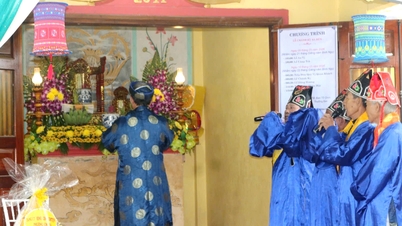
Lac Giao Temple was built in 1928, located at the corner of Phan Boi Chau and Dien Bien Phu streets, Buon Ma Thuot city, Dak Lak province. - Photo: KHA HUNG
Along with other indigenous ethnic groups, the Kinh people settled here very early on. Lac Giao Temple, first built in 1928, is considered an important gathering place and a symbol of the covenant and commitment of Vietnamese people from all over the country who migrated to live in Buon Ma Thuot in the early days.
In the cultural consciousness of the Kinh people, the village communal house is a place of worship for the tutelary deity. The tutelary deity bears the imprint of the historical and cultural process of the inhabitants whenever they settle in a new land. In 1932, the communal house was granted a royal decree by Emperor Bao Dai, bestowing the title of tutelary deity upon Dao Duy Tu.
The bestowal of the title of tutelary deity upon Lac Giao village temple, affirming that the land belonged to the "Imperial Territory," was extremely important at a time when the Hue court and France were vying for influence.
Not to mention that Dao Duy Tu—a figure bestowed the title of "Divine Emperor"—was a cultural icon, a great talent in many fields: politics, military, culture, economics... especially he was instrumental in expanding the country, establishing many new territories, and deserves to be honored by posterity.

Lac Giao Temple was a place that sheltered, hid, and cared for revolutionary soldiers, so people often come here to light incense and remember the fallen soldiers - Photo: KHA HUNG
Besides Lac Giao communal house, Buon Ma Thuot city also has other distinctive architectural relics such as Sac Tu Khai Doan pagoda, one of the places that nurtured the flame of the Buddhist movement fighting for national liberation and reunification.
Buon Ma Thuot is also a city with many ethnic groups living together, including the Kinh people and the two indigenous ethnic groups, the M'Nong and the Ede, with the Ede being the majority. Therefore, when visiting Buon Ma Thuot, you will witness the scene of villages within the city, and the city within the villages. This unique feature creates an attraction for visitors from afar when visiting Buon Ma Thuot city. Many famous ancient villages such as Pan Lam village, Kosia village...
Buon Ma Thuot city is also considered the capital of the Central Highlands coffee kingdom. Coffee plants have brought prosperity to this region. The soil, climate, and topography create the unique flavor of Buon Me coffee—one of the major brands not only in the Central Highlands and Vietnam but also in the region and the world.

Enjoying coffee is like savoring the flavors of the Central Highlands mountains and forests - Photo: AN YEN
Nearly half a century after the country's reunification, Buon Ma Thuot city has undergone many changes. From a small town, it has now become a Class I urban area, the provincial capital of Dak Lak province, and one of the central economic development hubs in the Central Highlands region. Infrastructure has developed, and all aspects of life for the people of Buon Ma Thuot have improved. Tay Nguyen University is currently one of the prestigious regional universities, training tens of thousands of graduates and engineers each year for the Central Highlands provinces and the whole country.
March, the honey-gathering season, is the festival season in Buon Ma Thuot, a gathering place for the cultural essence of the ethnic groups in the highlands, and a hub for unique cultural exchanges between different regions. Following closely behind are well-known festivals such as the Gong Festival, the Elephant Festival, the Coffee Festival, and the Food Festival. Visiting Buon Ma Thuot, strolling around, and admiring the Central Highlands landscape, to experience a city with such distinctive highland characteristics, is a favorite pastime for many.

Buon Ma Thuot coffee - Photo: AN YEN
On a spring day, amidst the vibrant festive atmosphere or quietly admiring the golden sunflowers, immersed in the distinctive aroma of coffee, each of us surely has our own unique way of experiencing this city. But one thing is certain: we all, in our hearts, will one day, carrying our love for Buon Ma Thuot, whisper a promise to each of us: that if we love each other, we should return here, even if only once...
From Night Grass
Source
![[Photo] Prime Minister Pham Minh Chinh receives the Ministers of Foreign Affairs, Defense, and Public Security of China.](https://vphoto.vietnam.vn/thumb/1200x675/vietnam/resource/IMAGE/2026/03/16/1773659638054_ndo_br_dsc-4386-6157-jpg.webp)

![[Photo] The General Secretary works with the Executive Committee of the Hai Phong City Party Committee.](https://vphoto.vietnam.vn/thumb/1200x675/vietnam/resource/IMAGE/2026/03/16/1773629925474_vna-potal-tong-bi-thu-lam-viec-voi-ban-chap-hanh-dang-bo-thanh-pho-hai-phong-8644445-332-jpg.webp)












































Comment (0)