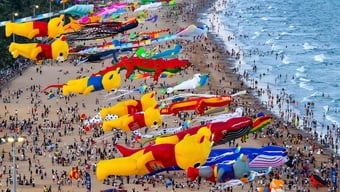
In the afternoon, children fly kites on the long sandy beach.
Before 5 a.m., Le Van Cong's family was already awake. Being a lover of the sea, he often sought out unspoiled, lesser-known places. And Hai Binh beach was his choice for this trip.
Mr. Le Van Cong shared: Unlike the bustling atmosphere of Sam Son or Hai Tien... Hai Binh retains its rustic, pristine beauty along with a fresh, tranquil atmosphere. Waking up early to watch the sunrise, the feeling of a wonderful new day beginning.
After watching the sunrise, the whole family eagerly rushed to the sea for a swim and waited for the boats to come ashore. "The squid here is delicious, probably because it's bought directly from the sea and prepared on the spot, so it tastes much better," Mr. Cong boasted to us.
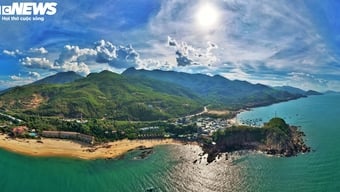
Since the establishment of the two-tiered local government system, Hai Binh ward was formed by consolidating the entire natural area and population of three former wards: Hai Binh, Tinh Hai, and Mai Lam, which belonged to Nghi Son town. Therefore, Hai Binh's coastline has become even longer.

Locals dry their seafood right on the beach.
Initially, they planned to stop here before heading to Bai Dong beach, but in the end, Ms. Ha Thi Thuan's family (Viet Hung ward, Hanoi ) decided to eat and stay here as well. At Hai Phat Hotel (Tan Hai residential area, Hai Binh ward), they could enjoy "vitamin sea" as soon as they opened the door; a few steps across the dike and they could immerse themselves in the seawater. Ms. Thuan's two children, Duc Anh (7 years old) and Mai Anh (4 years old), flew kites right on the sand.
From around 4 pm, the entire embankment becomes bustling. Dozens of makeshift stalls spring up. Ms. Mai Thi Van said: "Since I got married and moved here, every afternoon I go up to the embankment to sell all kinds of drinks: soft drinks, beer, coconut water, sugarcane juice... Initially, I sold to the local people, but later I also sold to some tourist groups."


Speaking of tourism development, there are three guesthouses and hotels right on the dike. Over 20 years ago, the Thanh Binh guesthouse opened, surprising many who couldn't believe tourists would come here. Yet, for decades, every summer, hundreds of art university students have stayed here for months to gather materials and take real-life photos. They live with the locals, and the locals are curious about the easels and palettes the students set up by the sea to paint on the beach. Around 2020, the Tinh Bien guesthouse opened. The number of tourist groups visiting Hai Binh beach has increased significantly, and both guesthouses are handling the demand. Especially since the summer of 2025, when the Hai Phat hotel opened, Hai Binh beach has truly become a tourist destination. They not only stay or swim, but also dine at the hotel. Through social media platforms like TikTok and the Hai Phat Hotel - Nghi Son Facebook page, many young people who enjoy exploring have become curious and come to visit. At this point, Hai Phat Hotel is fully booked on weekends throughout June and July.
According to Ms. Pham Huyen Trang, manager of Hai Phat Hotel, Hai Binh has great potential for tourism development. However, to turn this potential into an advantage and exploit that advantage, more attention from the government and the people is needed.
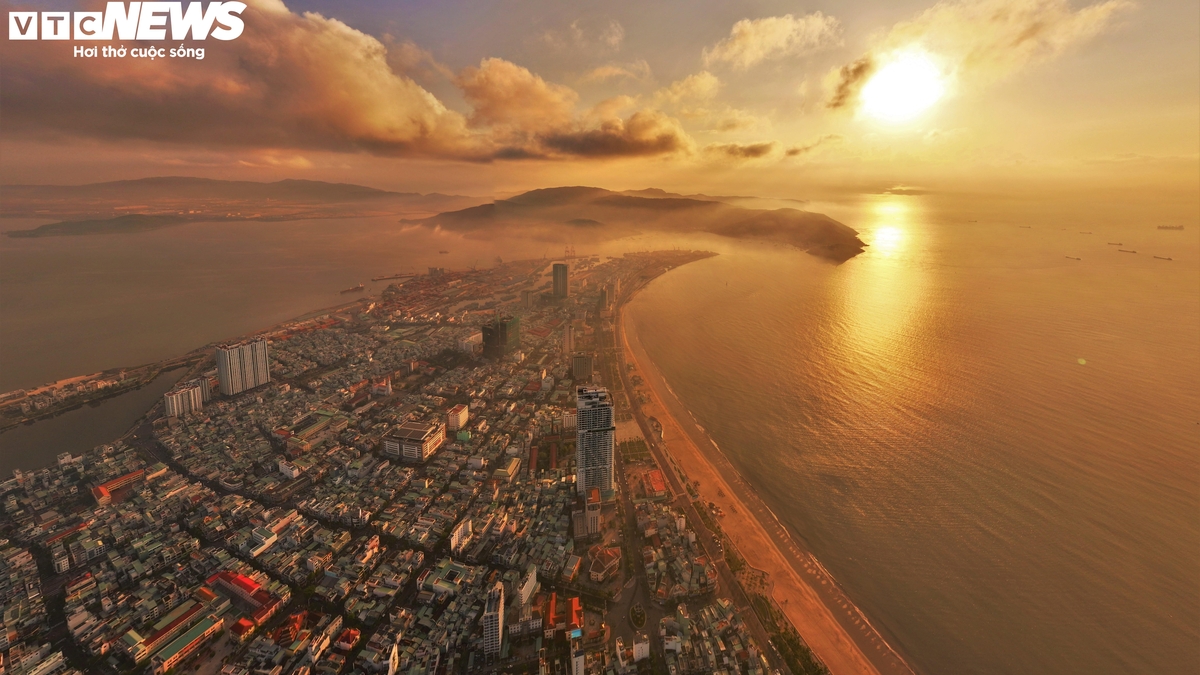
Speaking of Hai Binh beach, it has two main areas: one side features a seawall running along the coast, and the other boasts an impressive rocky reef, making it an ideal spot for taking photos and enjoying the sea breeze. Besides taking pictures at the beach during sunset or sunrise, the rocky reefs along the coast, the long breakwater, and the rows of green pine trees lining the shore are all worthwhile photo opportunities.
Strategically located in the Hon Me fishing grounds, Hai Binh is home to countless species of seafood, most notably the long-bodied, thick-skinned, fragrant, and pure white squid. The people of Hai Binh still sing the folk song, "Husband rows, mother nets, child fishes / Son-in-law casts the net, daughter-in-law baits the hook," to celebrate the happy and peaceful life of families with generations dedicated to squid fishing.
Squid and other seafood are abundant here for another reason: Hai Binh is located right at the mouth of the sea, receiving the flow of the Lach Bang River, which brings a rich amount of plankton, a plentiful and unique food source for various types of seafood. In addition, the Lach Bang estuary, with its water depth of 3-4 meters and the Do Xuyen mountain acting as a barrier against waves and wind, provides a safe anchorage for many boats during storms. These are the favorable conditions for the development of squid fishing among the fishermen of Hai Binh.
According to Mr. Le Van Thuc, owner of Thanh Binh guesthouse, the squid fishing season usually lasts from May to October, so June, July, and October are the peak months for squid fishing, yielding the most catches. For long fishing trips at sea, fishermen must carefully prepare their fishing boats, and make thorough preparations regarding food, charcoal, fuel, and fresh water for daily use.

On the embankment, the shops are getting ready to welcome customers.
Fishermen in Hai Binh catch squid using various methods, such as nets and floats, but primarily by angling, either with rods or by hand. The rods are made from flexible, strong bamboo stalks of a suitable length. The fishing line is a nylon or monofilament line about 10-20 meters long, coiled around a fishing tube. The fishing tube is a hollowed-out piece of round wood used for holding the tube. The hooks are made of barbed steel, about 3cm long, clustered together in groups of 3-5 hooks pointing in different directions. Hand-fishing for squid doesn't use rods; instead, the fishing tube is placed directly on the boat and lowered into the sea. Bait is also very important, and there are two types: real bait and artificial bait. Real bait consists of small fish caught on the hook to lure the squid; artificial bait is more commonly used and skillfully crafted by fishermen from brightly colored fabrics. The traditional method of making squid bait used by the people of Hai Binh is truly unique: "On days when the sea is rough and the water is murky, I use cloth as bait, especially orange, mixed with yellow, green, and red. When the sea is calm, I remember to add more green cloth..." This method is easy to remember, saves effort in finding bait, and allows you to catch many squid.
"Like falling stars bobbing on the water's surface, sitting on the shore and gazing out, it feels like a city on the sea is emerging. That feeling is so pleasant," Ms. Ha Thi Thuan said to us with a smile.


From Hai Binh, it's easy to travel to Bai Dong (Nghi Son ward), or through Tinh Gia ward to visit the Quang Trung temple and the Ba Lang - Do Xuyen fish sauce village, and even closer to Hon Me island... But why hasn't it received attention from the authorities? According to Ms. Pham Huyen Trang: The main reason is that the locality lacks policies to protect the sea area. Tourists are "lucky" to encounter beautiful weather and clean water; "unlucky" to encounter stormy days when the beach is covered in trash. The people are not yet aware of the importance of providing tourism services. Not a single shop or guesthouse rents out life jackets, swimwear, or motorbikes...
Hai Binh Beach - a rough gem that needs time to change and adapt to the needs of tourists.
Text and photos: Kieu Huyen
Source: https://baothanhhoa.vn/ve-dep-cua-vien-ngoc-tho-291492.htm



![[Photo] Prime Minister Le Minh Hung presides over the thematic session on promoting science and technology development and innovation.](https://vphoto.vietnam.vn/thumb/1200x675/vietnam/resource/IMAGE/2026/06/23/1782207872934_ndo_br_dsc-1724-jpg.webp)