

A heritage from centuries past.
According to a recent incomplete statistic (due to ongoing construction), there are approximately 150 Khmer temples in Tra Vinh province, making it one of the areas with the most "golden temple" architectural structures. In addition, Soc Trang, Bac Lieu, and An Giang provinces also have hundreds of other temples, forming a unique architectural complex. Many of these temples are famous, located in urban centers and are popular tourist destinations, while many others are located in rural areas and are less well-known.
But whatever the case, the common feature of these architectural structures is their towering spires pointing towards the sky and a dominant vibrant yellow color that creates an imposing and magnificent appearance. Many of these temples, some hundreds of years old, are not simply spiritual sites associated with Buddha Shakyamuni, but also cultural spaces, living areas, learning centers, and embodies the essence of architecture and art for the Khmer community. To date, many temples have been recognized by the State as National-level Architectural and Artistic Works, such as Ang Pagoda, Hang Pagoda, Roi Pagoda, Met Pagoda, and Siem Can Pagoda…
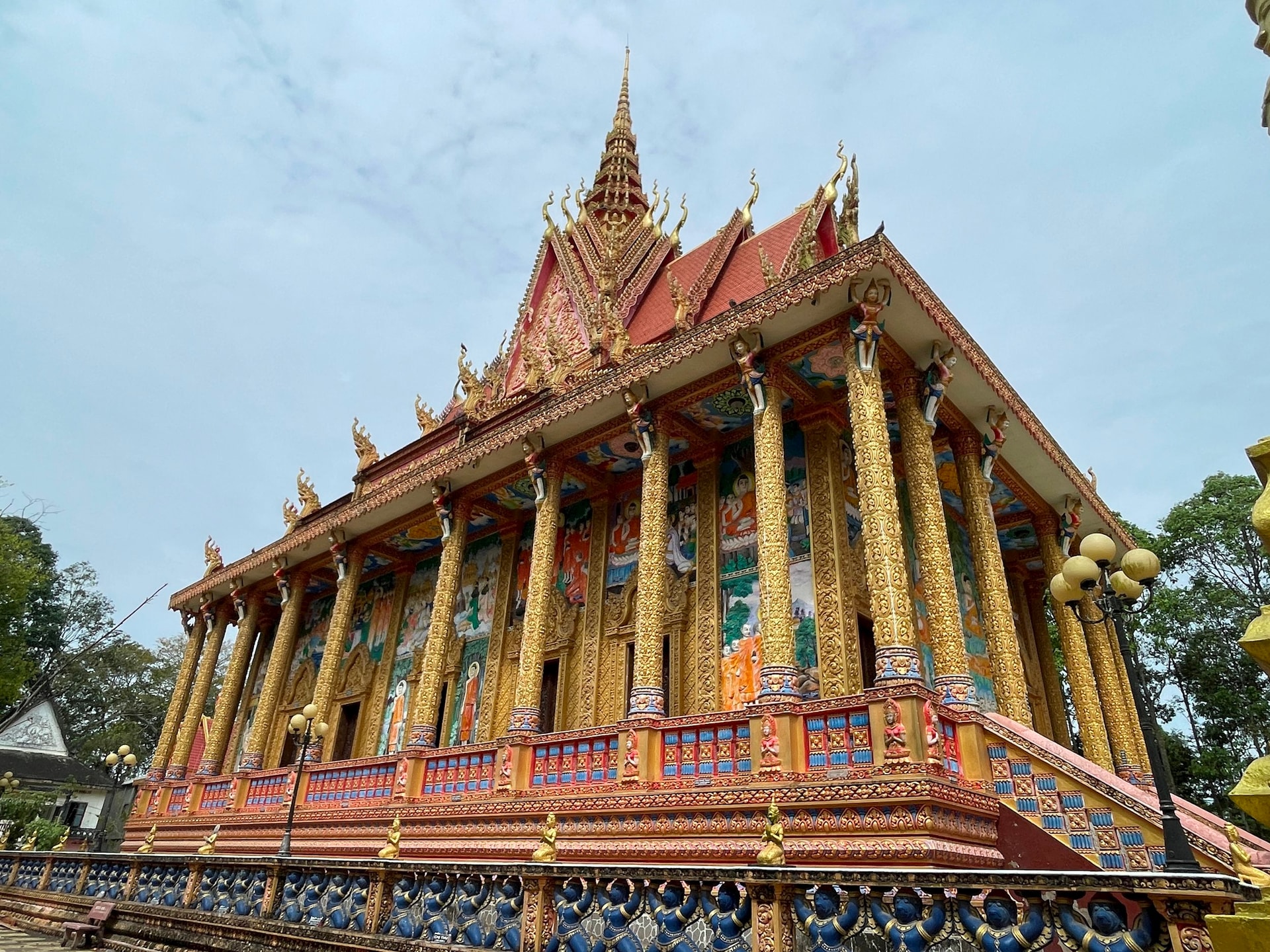
Perhaps the most famous and quintessential example of Khmer architecture is Hang Pagoda (Kompong Chray in Khmer), a more than 350-year-old pagoda located along National Highway 54, passing through Chau Thanh town (Chau Thanh district, Tra Vinh province). The pagoda is only about 5 kilometers from Tra Vinh city, making it well-known to many, including foreign tourists. According to the Khmer people here, Hang Pagoda has undergone numerous renovations due to time and war. Currently, the pagoda is not as large as other pagodas because its current architecture was built and preserved almost intact from around 1977.
The most striking feature of the temple is its deep arched gateway, resembling three caves: two smaller caves and a central main cave. In reality, it's a vaulted wall approximately 12 meters wide, giving the impression of a cave. These cave-like gateways are built extremely sturdily according to the ancient Khmer architectural style. This is also why the locals call it the Cave Temple. Beyond the cave gate are rows of tall, lush ancient trees and gardens, characteristic of most Khmer temples. Next, the main hall of the temple is located in a building with a relatively high foundation, as many locals say that hundreds of years ago, there was a small river in front of the main hall, but it has now been filled in. Although not large in scale, the main hall of the Cave Temple still exudes a majestic and ancient atmosphere thanks to its vibrant golden color and numerous large and small statues of Buddha. The most special feature of the Cave Temple is a workshop producing fine wood carvings by local Khmer artisans. Therefore, the temple also boasts many beautifully carved wooden statues that attract visitors from far and wide.
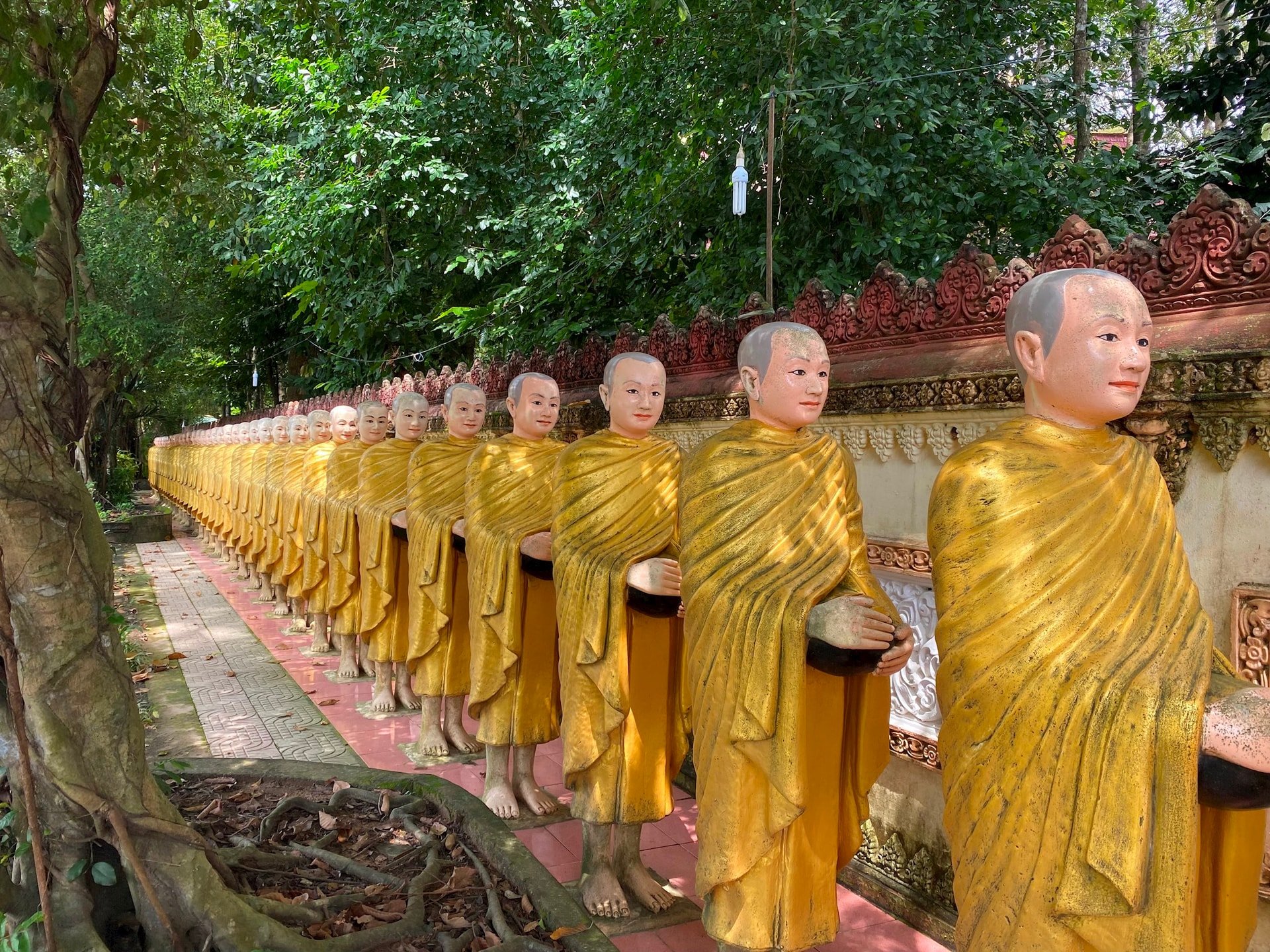
Nearly 10 kilometers away, also in Chau Thanh district (Tra Vinh province), lies a unique and distinctive Khmer temple, KnongSrok Pagoda, situated along National Highway 53 in Hoa Loi commune. The pagoda is notable for its location on Highway 53 and its rows of exquisitely crafted statues of people in the distinctive attire of Buddhist monks going on alms rounds. The statues, predominantly yellow in color and life-sized, with serene expressions, are lined up alongside ancient trees in front of the pagoda gate, creating a peaceful and tranquil atmosphere despite being along the highway. The grounds of KnongSrok Pagoda are quite spacious, including a main hall in a saffron yellow color with tall pointed spires, and statues of Buddha and the nine-headed Naga serpent, a symbol of Khmer culture. Significantly, the pagoda is still under construction, with additional features being added to serve the needs of the Khmer community in the area for daily life, religious practice, and education.
But the most famous and oldest pagoda in Tra Vinh is Ang Pagoda, located in the heart of Tra Vinh city, within the Ao Ba Om historical complex. According to some records, Ang Pagoda has a history of approximately 1,000 years, making it one of the oldest pagodas in the Mekong Delta. However, most of its early history only exists in written records and oral traditions. The basic architecture of Ang Pagoda was mainly built during the reign of King Thieu Tri and has been further renovated and expanded many times to this day. Currently, Ang Pagoda is situated in a large compound with many ancient trees hundreds of years old, serving as "living witnesses" to the pagoda and pond complex. Besides its long history, the architecture of Ang Pagoda is also extremely unique with its dominant yellow color, present throughout the pagoda. In particular, the sculptures, Buddha paintings, and Buddhist stories at Ang Pagoda show an exchange with sculptures from the Indian and Thai communities, reflecting the cultural exchange and understanding of the Khmer people from quite ancient times when the pagoda was built.
Currently, the most significant and distinctive cultural activities of the Khmer community in the Southwestern region of Vietnam are held at the Ang Pagoda and Ao Ba Om Lake complex. Among these, the Ok Bom Bok festival (also known as the Moon Worship Festival) stands out, attracting tens of thousands of visitors from all over. In recent years, Tra Vinh province has even organized a local Culture and Tourism Week coinciding with this festival to showcase the culture and scenic beauty of Ang Pagoda and Ao Ba Om Lake to international tourists. This demonstrates the importance of the pagoda and Khmer culture within the community and the overall tourism of the province.
These "golden pagodas" are not only found in Tra Vinh but also appear in many other localities in the southwestern Mekong Delta region, with a high concentration in Bac Lieu and Soc Trang. In Soc Trang province, many Khmer pagodas with yellow architecture, or interwoven yellow colors, have become prominent tourist destinations known to many people, such as Chen Kieu Pagoda, Doi Pagoda, Som Rong Pagoda, etc.
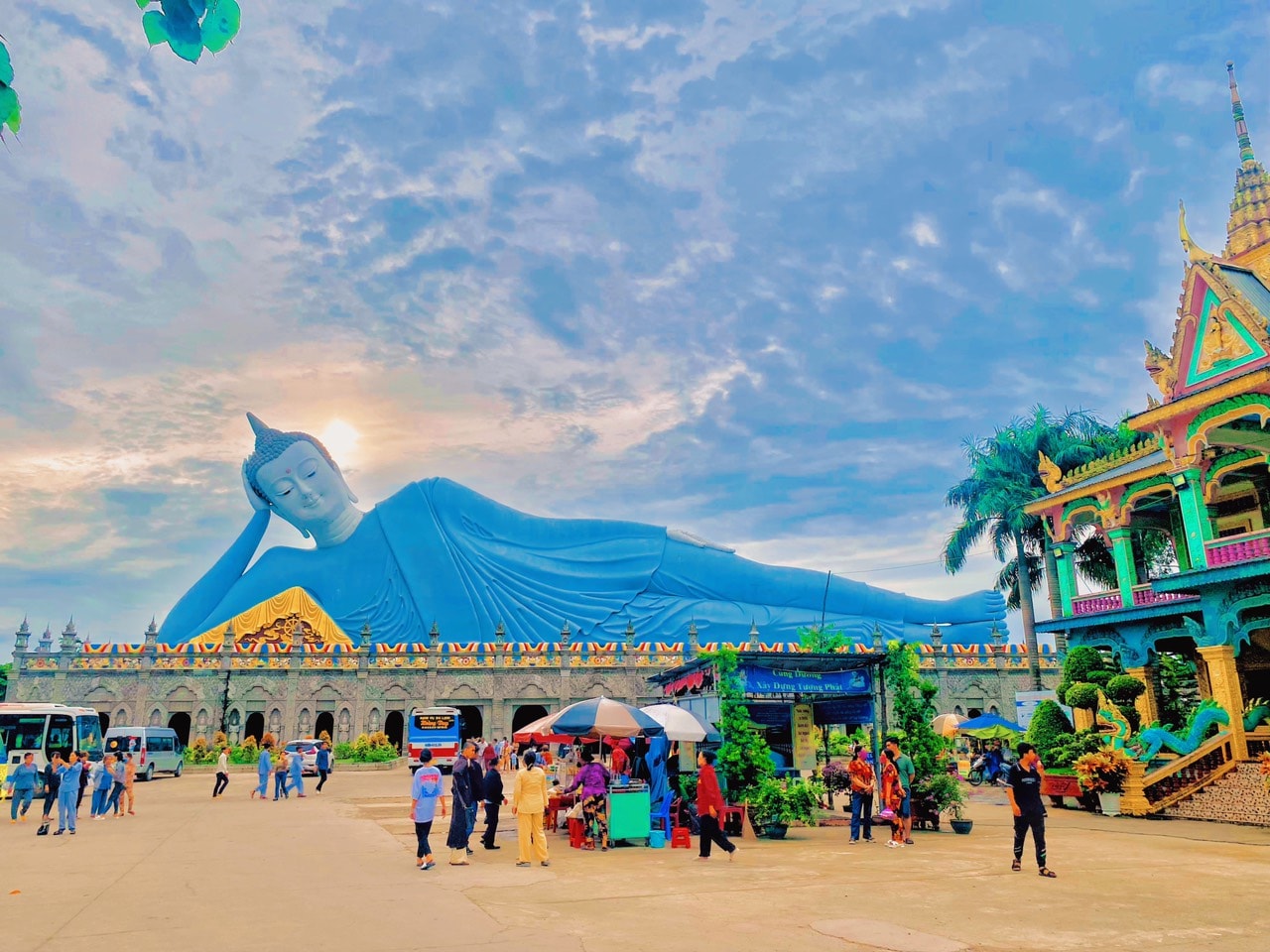
The Som Rong Pagoda, located in the heart of Soc Trang city, is truly a magnificent and unique architectural masterpiece. The pagoda is situated within a large compound with a gate adorned with golden towers, and the main hall is also golden with distinctive pointed spires. However, the most striking feature of the pagoda is the spacious courtyard containing a reclining statue of the Buddha Shakyamuni entering Nirvana, creating a serene and beautiful atmosphere. According to some records, the statue is 63 meters long, 22.5 meters high, and sits atop a 28-meter-high building, leaving anyone standing before it in awe.
Although the statue is turquoise and pale white, the overall dominant color of the Som Rong pagoda complex is a vibrant yellow, especially in the light of sunrise or sunset, making the pagoda even more spectacular. This is perhaps one of the most magnificent architectural works of the Khmer community in the Mekong Delta region.
It can be said that, along with the strong promotion of the internet, Khmer temples in the Southwestern region of Vietnam today are truly cultural spaces and favorite destinations for domestic and international tourists. Fairly speaking, these temple complexes are comparable in scale, architectural uniqueness, and history to any other place in the world.
Preserving traditional values
During our research on Khmer temples in the Southwestern region of Vietnam, we noticed that not only were there famous temples, classified as historical relics or frequently visited by tourists, but also hundreds of other temples with unique features, bearing the distinct mark and identity of the Khmer people in smaller communities. These include sturdy architecture with tall columns and pointed spires reaching towards the sky, along with vibrant, warm colors, with yellow being the most basic. Almost all large Khmer temples have main halls painted yellow, or orange-yellow, or dark yellow… In addition, Khmer artisans also use mixed yellow to create other colors and decorate the temples, motifs, and other parts of the temple to create a harmonious overall picture of color.
Mr. Thach Suon, a decorative sculptor in Chau Thanh town (Chau Thanh district, Tra Vinh province), said that Khmer temples always have yellow as the dominant color because, in Khmer culture, yellow symbolizes prosperity and wisdom. Furthermore, the Khmer people believe that yellow symbolizes the Buddha, along with compassion and wisdom. This is also the color of clothing worn by followers of Theravada Buddhism. Besides the original yellow, Khmer temples are also decorated by mixing yellow to create other colors. For example, orange (a mixture of yellow and red) symbolizes fire and liberation from suffering, while green (a mixture of yellow and blue) symbolizes fertility and continuity.
According to Mr. Thach Suon, besides the colors, Khmer temples, whether large or small, are built according to strict rules, especially the main hall. Accordingly, the main hall is always built in the center of the temple grounds, next to the living quarters, study area, and burial ground for the deceased… The essence of architectural culture is expressed in the main hall, with its length always twice its width, its height always equal to its length, and the first roof level always equal to the temple's body.
Furthermore, the main hall of the temple always faces east because, according to Theravada Buddhist belief, the Buddha Shakyamuni resides in the west, looking east to bestow blessings. Notably, regardless of size, posture, or style, Khmer temples only enshrine a single statue of the Buddha Shakyamuni. Besides the temple's dimensions, elements such as the roof and eaves are always constructed according to the standard triangular shape. According to Khmer beliefs, the triangle represents perfection and stability in nature and life, so the design details within the temple always harmoniously incorporate triangular shapes, whether soaring high or gently sloping like domes.
Besides the architectural forms and colors that reflect culture and spiritual life, an indispensable element in the temple complex is the surrounding trees such as the Dipterocarpus and Shorea species. Most Khmer temples are built at the same time these trees are planted. Therefore, many temples are as old as the ancient trees within them, serving as living witnesses passed down to future generations.
Furthermore, Khmer temples share a prominent common feature: intricate, unique, and vibrant decorative motifs such as Naga serpents, Kenar dancers, and bird-headed human figures, reflecting Buddhist viewpoints and profound philosophies of life. Among these, the nine-headed Naga serpent is often depicted near staircases, walkways, and entrances, symbolizing the warding off of evil spirits and negative energy.
According to Khmer beliefs, the Naga serpent holds profound significance, representing harmony between spirituality and worldly life, humanity and nature, and the interplay between this world and the other. The serpent is also seen as a test for ascetics on their spiritual path, requiring compassion to tame this dangerous creature. Furthermore, Naga serpents are depicted with three, five, or seven heads to symbolize different aspects of community life.
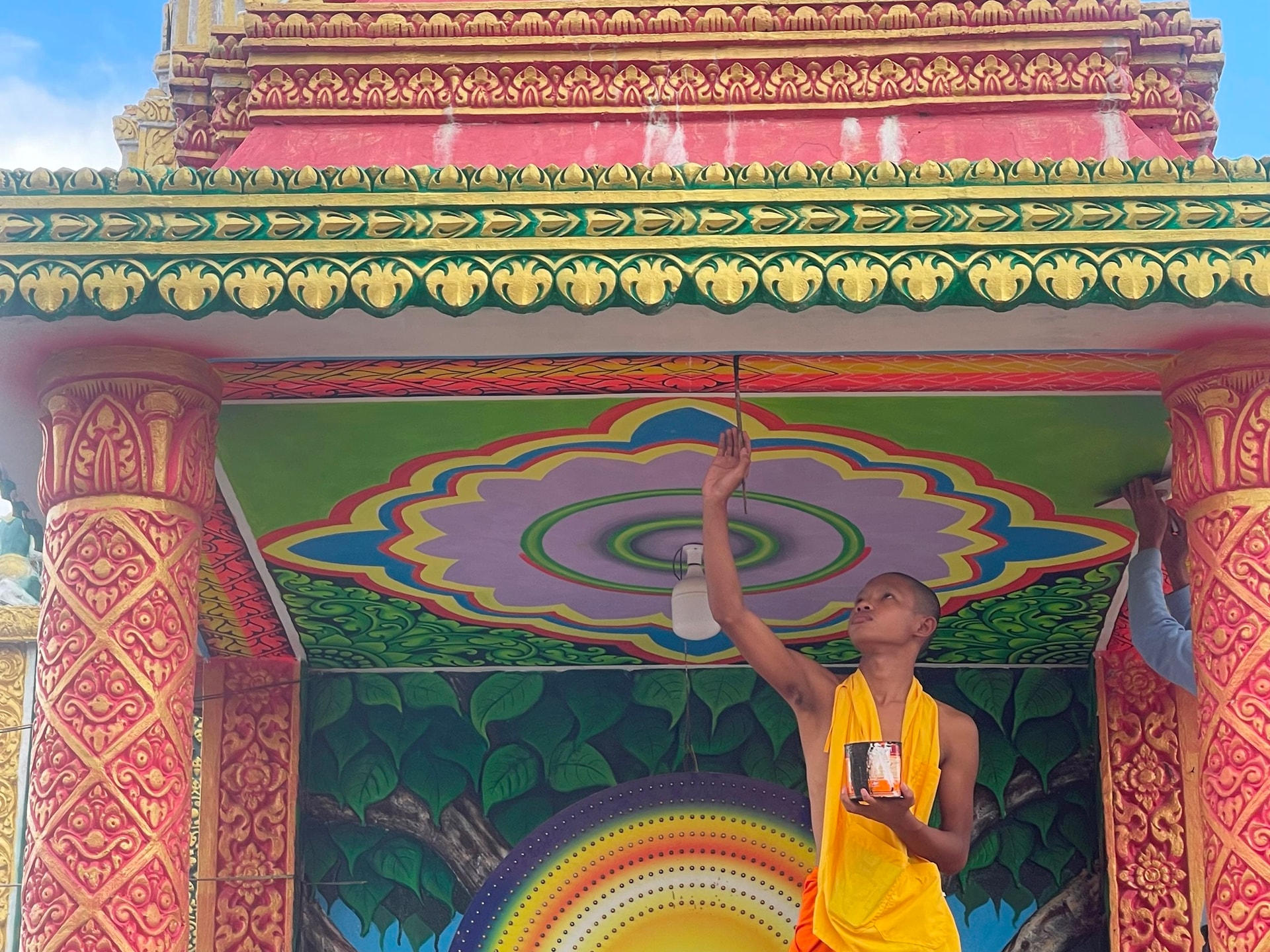
Beyond its architecture and profound worldview, most of the essence of Khmer culture is passed down to future generations within these very temples. Accordingly, in community and religious activities, young Khmer people are taught by their elders and often begin by decorating the old parts of the temple. This is why, upon entering Khmer temples, one often sees a fresh array of colors, as they are regularly renovated.
It can be said that, in the vast, water-filled delta region of the Southwestern Mekong Delta, Khmer temples are truly a highlight, a shining golden milestone in the essence of architecture, art, and culture. They are not only confined to the living space of the Khmer community but also serve as a shared space and destination for people from many other places, contributing to the pride of the Khmer community within the broader cultural landscape of many other ethnic groups.
![[Photo] General Secretary and President To Lam meets with National Assembly delegates from ethnic minorities.](https://vphoto.vietnam.vn/thumb/1200x675/vietnam/resource/IMAGE/2026/04/20/1776696701056_a1-bnd-8331-3342-jpg.webp)


![[Image] National Assembly discusses the implementation of the socio-economic development plan.](https://vphoto.vietnam.vn/thumb/1200x675/vietnam/resource/IMAGE/2026/04/20/1776696707422_ndo_br_img-20260420-185419-jpg.webp)































































Comment (0)