Decoding the name of Dùi Chiêng village
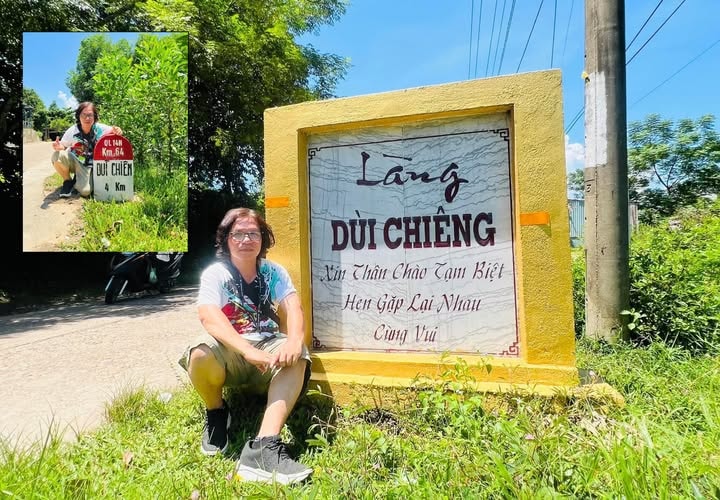
On the road leading to Dùi Chiêng village (Quế Phước commune, Nông Sơn district, former Quảng Nam province), there is a kilometer marker that reads "Dùi Chiên," missing the letter 'g'. For people from Quảng Nam, the pronunciation of "chiên" or "chiêng" is essentially the same, so the spelling isn't the main issue. What's noteworthy is the name "Dùi Chiêng," which is both strange and familiar, sparking curiosity and opening up a journey to trace its cultural origins.
The village of Dùi Chiên has existed in Quảng province from ancient times to the present day. No one knows exactly when the village was founded, and no one has ever explained why it bears such a unique name. The village's name is immortalized in a Quảng folk song: "I am a stranger from afar / I came here to sing and learned that the girl lives in Dùi Chiên / Tomorrow I will return to Bình Yên / I feel sorry for the girls who stayed behind, they have gongs but no mallets."
Ancient songs suggest that the place name Dùi Chiêng is associated with familiar Vietnamese folk musical instruments: the gong and the mallet. But it is precisely this coincidence that opens up a long story about the origin and cultural meaning hidden behind the village's name.
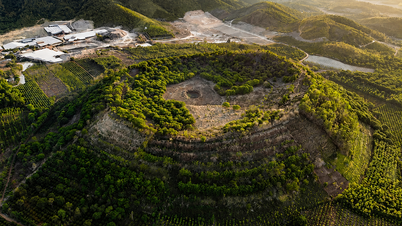
Linguistic researchers have deciphered the two words "Dùi Chiêng" and, surprisingly, they have no connection to the familiar musical instrument as many people mistakenly believe. Instead, it is a phonetic variation of "Juh cheng" in the ancient Cham language. In Cham terminology, "juh" means "circle," and "cheng" refers to a land or enclosed area. Combined, "Juh cheng" describes a residential space with an arc-shaped topography, like a ring or hoop at the foot of a mountain.
The phonetic change from Juh cheng to "Dùi Chiêng" also reflects the Vietnamese adaptation of Cham place names: the Vietnamese added the initial consonant "d-" for easier pronunciation, while lengthening the vowels to suit local spoken language. Thanks to this, the place name has survived for hundreds of years, even though its original Cham meaning has gradually faded from the community's memory.
In fact, the current location of Dùi Chiêng village is exactly as its ancient name, Juh cheng, suggests. The village is nestled against the mountainside, with a winding river in front, like a closed embrace surrounding the village. Satellite imagery also shows that Dùi Chiêng village does not resemble a mallet or a gong. The villagers have traditionally been engaged in agriculture , with no connection to the bronze casting and gong-making craft like Phước Kiều village in Điện Bàn. This comparison further strengthens the hypothesis of the Cham origin of this place name.
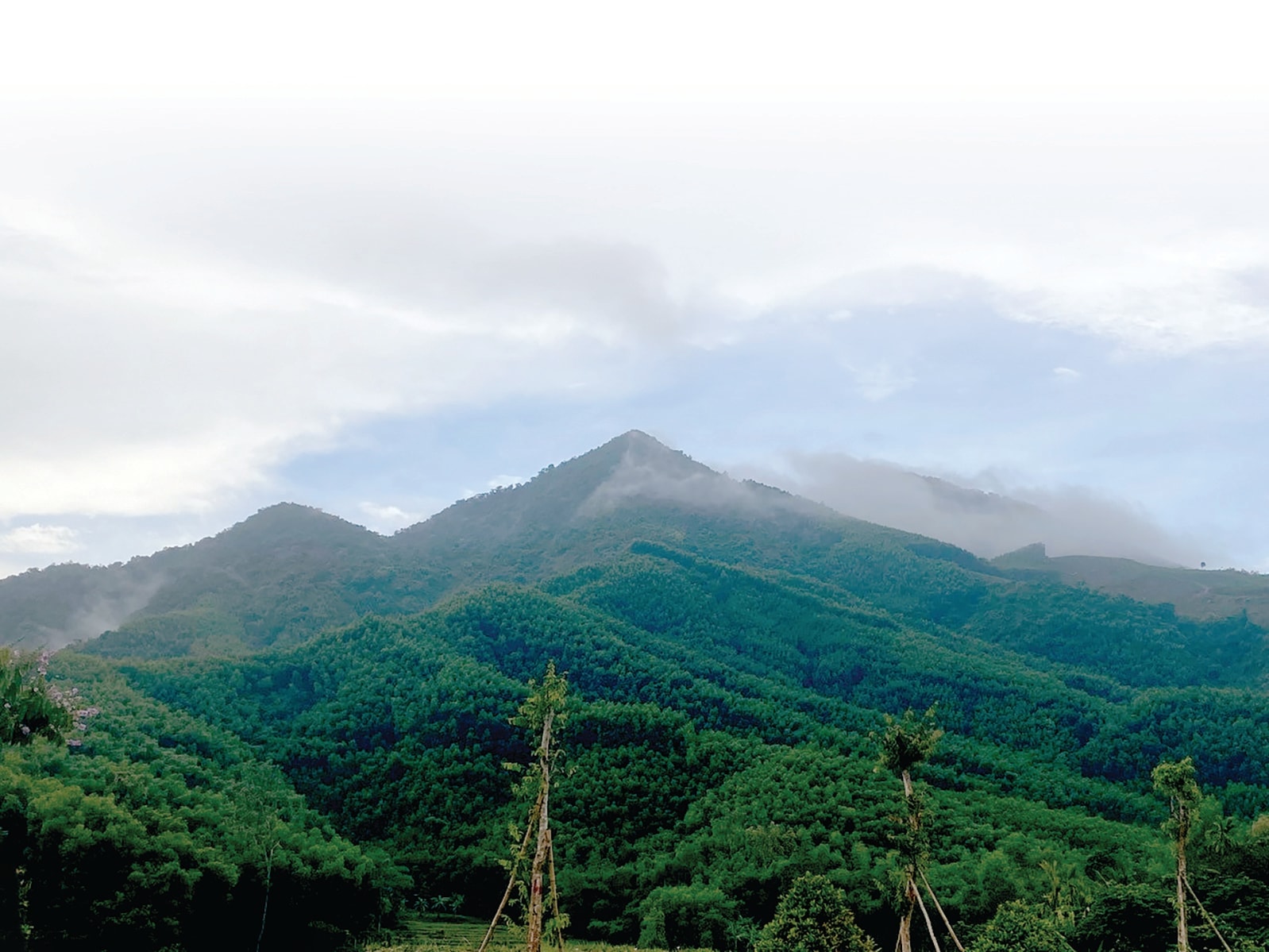
The mountain takes its name from the ancient Cham language.



Not far from Dùi Chiêng is the place name Cà Tang. Similar to Dùi Chiêng, the word "Cà Tang" is sometimes written with the consonant "g" in Quảng Nam, and sometimes without. The Quảng Nam - Đà Nẵng Gazetteer describes it as follows: "Cà Tang: A high mountain like a Great Wall running from southeast to northwest, forming a natural boundary between the two communes of Quế Trung and Quế Ninh in the western part of Quế Sơn district (now Nông Sơn district). Cà Tang is located right on the right bank of the Thu Bồn River and is understood in Vietnamese as 'the wall'."
Meanwhile, poet Tuong Linh used the term "Ca Tan" and shared the same opinion: "Ca Tan Mountain is a branch of the Truong Son mountain range, its shape resembling a majestic, sturdy fortress standing tall from southeast to northwest of the old Trung Phuoc village, now part of Que Trung commune, Que Son district."
However, from an academic perspective, Cà Tang is not a purely Vietnamese word. Researcher Bùi Trọng Ngoãn suggests that the place name "Cà Tang" likely originates from the Cham word "katang," which is a word with multiple meanings. Considering the traditional naming conventions of mountains in Quảng Nam - Đà Nẵng, which often rely on specific shape characteristics (such as Hòn Nghê, Mỏ Diều, Cổ Ngựa, Hải Vân, Thạch Lĩnh…), the explanation based on katang 1 (pen tower) or katang 2 (small basket) seems the most convincing.
If Cà Tang is understood as meaning "small basket," then this could be considered the most convincing metaphorical representation of the rounded mountain shape resembling a basket. It reflects the Cham people's highly associative way of naming things after the surrounding natural landscape.
The landmark has become a museum of cultural memory.
Along both banks of the Thu Bon River, from the upstream down to the My Son and Tra Kieu areas, there exist many place names that seem meaningless in Vietnamese, such as Ty Se, Truom, Kem, Ram, Ri, Lieu, Phuong Ranh, Da La, Cam La… However, when placed in the context of the Cham language, each place name reveals distinct layers of meaning, reflecting the cultural imprint and unique way of perceiving the local inhabitants.
A typical example is the village of Sé, located on the left bank of the Thu Bồn River in Quế Lâm commune, Nông Sơn district. In modern Vietnamese, "sé" hardly suggests any meaning, but in the Cham language, this word is rich in expressive possibilities. It can mean a place name indicating a residence, or it can be a water name associated with water elements such as Sé stream, Sé wharf. Another interpretation comes from chheh/sseh in Cham, meaning "beautiful".
Thus, the place name Sé is not just a geographical symbol, but also a linguistic testament reflecting how the ancient Cham people perceived and named the landscape. Through this, we realize that naming was not simply for the purpose of identifying space, but also expressed an aesthetic perception of the picturesque land along the Thu Bồn River in the past.
It can be said that the examples mentioned above are merely based on folk intuition and observations of natural forms, compared with a few limited documents on the ancient Cham language. To fully understand their value, place names need to be placed within a linguistic and cultural approach, considered as a "museum of memory" preserving traces of the past. These seemingly meaningless syllables in Vietnamese actually reveal an entire system of Champa imprints, through which we can read the history of interaction between the communities that once lived in this land.
Cham echoes in the Quang Nam dialect


In the process of cultural exchange, the Vietnamese transliteration and Vietnamization of Cham place names did not erase their origins, but often helped them survive for a long time. Thanks to this transformation, many place and village names escaped the risk of disappearing along with the decline of the Cham language in Quang Nam. Therefore, today we can still identify clues to trace their origins: a "Dui Chieng" (a type of gong) seemingly associated with a musical instrument but actually derived from "Juh cheng" (a type of gong) has multiple meanings; or "Se" and "Lieu," seemingly meaningless syllables, contain aesthetic perceptions and communal memories.
The names of places and villages in Quang Nam province can be likened to "Cham marks" imprinted on the body of Champa history: both clear and vague, present in everyday language and like distant echoes of a civilization that has faded into the past. Each place name is not only a geographical symbol but also a testament to coexistence and cultural exchange, a precious slice of history.
Therefore, preserving Cham place names is not simply about retaining the names themselves, but also about safeguarding intangible cultural heritage. These small syllables contain the collective memory and perceptions of the ancient inhabitants. If these place names were to disappear completely, the history and culture associated with them would also fade with time. Therefore, this is not just a concern for linguistic researchers, but needs to become a broader program: researching, cataloging, and implementing measures to preserve the system of Cham place names in Quang Nam province.
Preserving place names means preserving the soul of Quang Nam province, a soul woven from layers of community memories, from interaction and transformation, and from cultural bridges that have connected the people here.
many centuries.
Source: https://baodanang.vn/vet-cham-o-xu-quang-3306081.html

![[Photo] General Secretary and President To Lam working with the Technical and Professional Center, Ministry of Public Security](https://vphoto.vietnam.vn/thumb/1200x675/vietnam/resource/IMAGE/2026/07/06/1783318005842_a1-bnd-1129-2263-jpg.webp)