

The journey to the Dien Hong Journalism Award
Despite receiving numerous journalism awards, journalist Tuan Ngoc humbly shares that his award-winning works are partly due to his experiences living among the events and the truly special people in his homeland. In his more than 12 years in the profession, journalist Tuan Ngoc has reaped many joys on the red carpet: winning the C prize in the national writing competition on studying and following the moral example of Ho Chi Minh in 2016; winning the A prize in the Lao Cai Provincial Journalism Competition in 2017; winning the A prize in the Journalism Competition for Sustainable Development in 2018; winning the C prize in the Journalism Competition for the Cause of National Unity in 2022; and winning the C prize in the National Journalism Competition on the National Assembly and People's Councils (Dien Hong Award) in 2023.
Among the memorable experiences of journalist Tuan Ngoc are the arduous and challenging journeys to the most remote and isolated villages in the province. In particular, Tuan Ngoc recounts his unforgettable journey reporting on the recent Dien Hong Award-winning series of articles – the four-part series "The 'Ambassadors' of the People's Hearts in the Highlands and Border Regions."
He shared that: The story began one day in early 2023 when he had the opportunity to interact with a journalist from Hanoi who was working in Lao Cai. During that meal, my friend asked if the Lao Cai Newspaper had submitted an article to the Dien Hong Journalism Award and encouraged me to participate, as it was the first national journalism award organized by the National Assembly Office in coordination with several central ministries and agencies. When I got home, I researched and learned that the Dien Hong Journalism Award is a major journalism award, focusing on the National Assembly, People's Councils, and the contributions of National Assembly and People's Council representatives at all levels. However, due to my busy work schedule, it wasn't until more than a month before the deadline that I focused on thinking about topics, developing an outline, and working with colleagues to create a series of articles titled "The 'Ambassadors' of the People's Hearts in the Highlands and Border Regions."
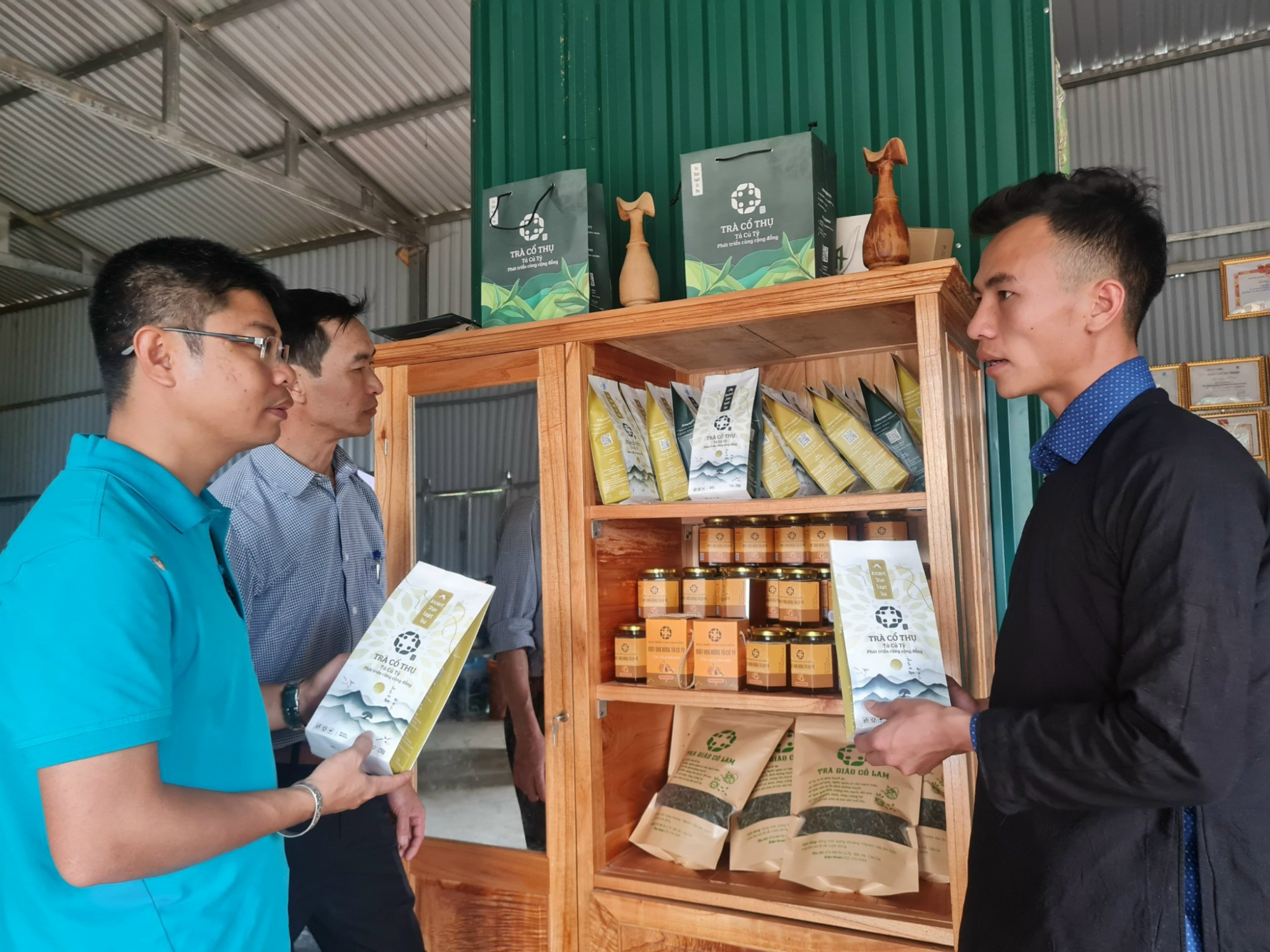
Journalist Tuan Ngoc meets with the subject.
Normally, writing profiles of exemplary individuals in fields such as economics , education, and culture is not too difficult because the achievements are quite clear. However, for People's Council representatives, who act as a bridge, listening to and conveying the voices, thoughts, and aspirations of voters to higher levels during sessions, and simultaneously answering voters' concerns, choosing a subject is difficult, and writing in a way that is engaging and appealing while still truthfully reflecting the representative's performance is even more challenging, causing us much thought and deliberation. Therefore, in each article, there are contents and wording that have to be revised many times.
Our most memorable experience was the journey to meet the delegates featured in each article, a long trip of 70 to 100 km to three border districts of the province. To meet delegate Ly Gia So, a Ha Nhi ethnic minority, Vice Chairman of the People's Council of Y Ty commune, Bat Xat district, on Friday, the reporter only had a short conversation with her before she had to attend a working session with a delegation from the province. After staying overnight in Y Ty, we followed her down to the village on Saturday morning, capturing firsthand images and gathering valuable information for the article. Even the trip to meet delegate Nung Thi Thu, a Nung ethnic minority, Secretary of the Party Committee of Nam Lu commune, and a delegate of the People's Council of Muong Khuong district, was rushed, as despite several attempts to meet her, she was always busy with meetings and local work programs.
For delegate Trang Seo Xa, a Mong ethnic minority member, Secretary of the Youth Union, and delegate to the People's Council of Quan Ho Than commune, Si Ma Cai district, after a journey of over 100 km, we arrived at his farm around 11 am. Our conversation and exchange with Trang Seo Xa took place right in his pear orchard, lasting the entire afternoon. Engrossed in conversation, gathering information, and taking photos, we only hastily left Quan Ho Than around 1 pm. It was truly touching that, despite the late hour, Mr. Giang Sin Cho – Member of the Standing Committee of the District Party Committee and Chairman of the Vietnam Fatherland Front Committee of Si Ma Cai district – waited for us to return to Si Ma Cai market to share lunch.
Although the four-part series "Ambassadors of the People's Hearts in the Highlands and Border Regions" was written hastily, it still managed to be submitted to the Dien Hong Journalism Award on time. The most emotional moment came when we were overwhelmed with joy upon receiving the news from the Organizing Committee that the series had won the C prize. Out of more than 3,300 entries, only 101 outstanding works made it to the final round, and 67 of the best works were awarded prizes. Lao Cai Newspaper was also one of the few provincial newspapers to win the first-ever Dien Hong Journalism Award. This joy gave us renewed energy to continue contributing to our journalistic journey ahead.
The story of the forgotten camera
Having worked with Lao Cai Newspaper for over 12 years, journalist Tran Tuan Ngoc has many unforgettable memories from his reporting journey, but some still move him to this day. Journalist Tuan Ngoc shared: "It was a foggy afternoon in early 2023, covering the mountains and villages of Bat Xat district. I was on a reporting trip to A Lu commune – the most remote and one of the most difficult communes in Bat Xat district – to write about the difficulties in land management and construction there. After interviewing the commune leaders, I went with the commune's land management officer to interview a household, but unfortunately, no one was home. Even so, I decided to take photos of the illegally constructed house for documentation. Even with a modern camera, it was difficult to get satisfactory pictures in the thick fog. To be extra careful, I even used my phone to take more photos in case the camera's memory card malfunctioned and ruined the whole reporting trip."
It was past 2 PM, the weather was bitterly cold and foggy. We hurried to the second subject's house. The fog was so thick that I, being nearsighted, had to wear glasses, and I had to stop every now and then to clear them before continuing. We trudged for nearly ten kilometers through the fog before finally reaching a house. At this point, I took out my camera to take pictures, only to be shocked to find my backpack empty. Where was my camera? Calmly, I realized that in my haste, I had left it among the sacks of rice husks near a house by the roadside. A Hmong woman was working nearby. Although extremely worried, I decided to finish the interview before going back to look for my camera. Otherwise, I wouldn't have enough material for the article, and I wouldn't have time to get back before dark, as there were still nearly 100 kilometers to go.
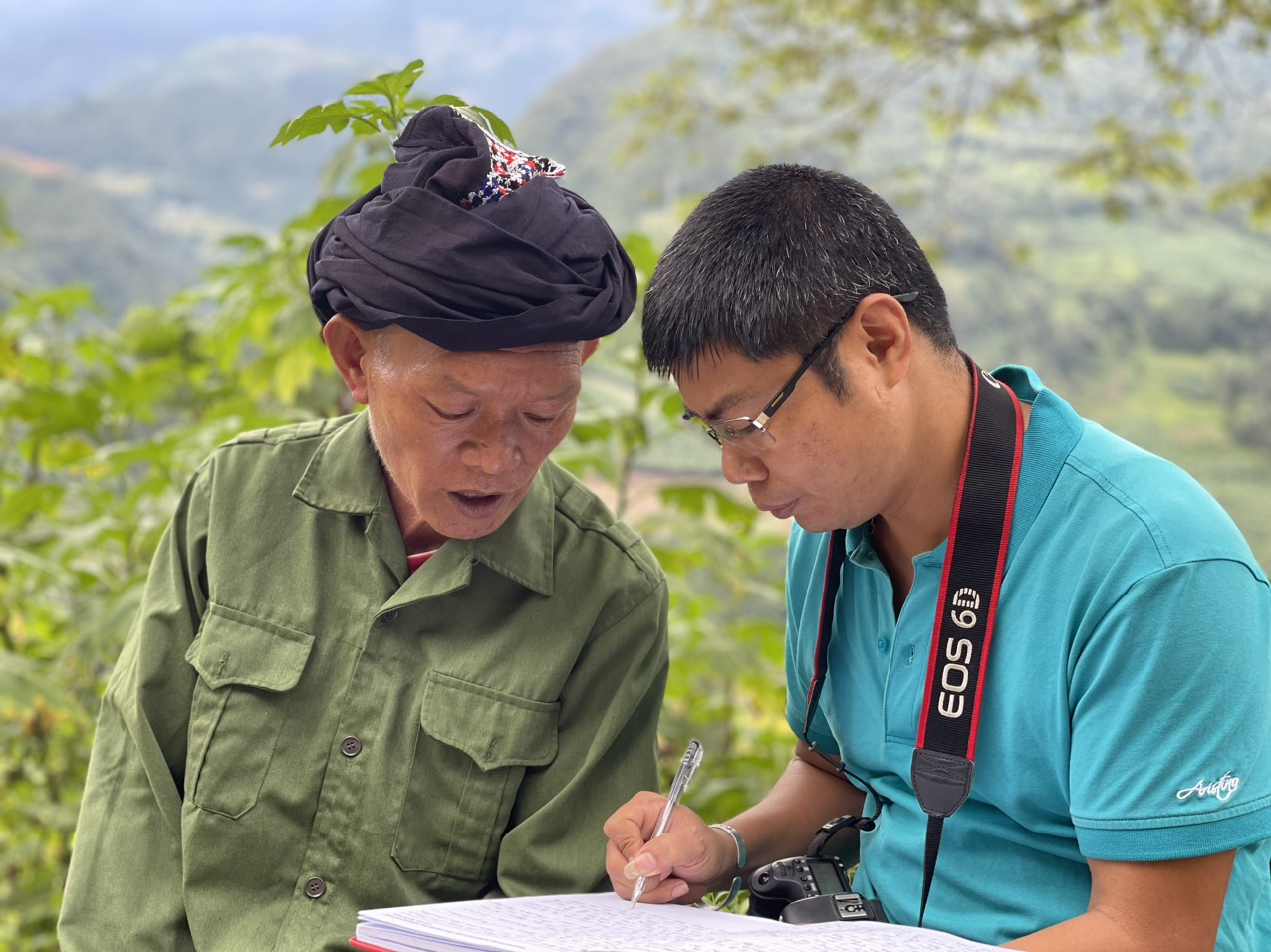
Journalist Tuan Ngoc at work.
My joy was overwhelming when I returned and saw my beloved camera still lying peacefully on the sacks of rice husks by the roadside, still damp with dew. At that moment, the Hmong woman sitting next to the house said, " You left in such a hurry that you forgot your camera. I didn't have a vehicle to chase after you to tell you, so I sat here waiting for you to come back and get it ."
I was surprised by the kind words and actions of the young woman with a gentle, benevolent face and eyes. To me, the camera was invaluable, because besides its value of nearly tens of millions of dong, it contained many documentary images from previous reporting trips. Upon further inquiry, she said her name was Thào Thị Sống, and she lived in Phìn Chải 1 village, A Lù commune. Her family was also struggling, and she had two young children. I only had a little money left in my wallet for gas and nothing to thank her with, but then I remembered I still had a few boxes of biscuits I brought along for the journey and for the children in the highlands, so I took them all out and gave them to her with heartfelt thanks and a promise to visit her home soon.
Even now, I still think about the Hmong woman in Phin Chai 1. If I hadn't met such a kind person, I might not have found my camera in such a remote and desolate place. This experience taught me a valuable lesson; her actions remind me to always remember that no matter the circumstances, no matter how difficult or deprived, I should live for others and never let greed and selfishness overcome the kindness in each person…
May River
Source
![[Photo] General Secretary To Lam attends the inauguration ceremony of Si Pa Phin multi-level boarding school.](/_next/image?url=https%3A%2F%2Fvphoto.vietnam.vn%2Fthumb%2F1200x675%2Fvietnam%2Fresource%2FIMAGE%2F2026%2F01%2F31%2F1769840655651_ndo_br_z7486540481209-f37c7e00a962aec2a061c64b7db569ef-jpg.webp&w=3840&q=75)


![OCOP during Tet season: [Part 3] Ultra-thin rice paper takes off.](/_next/image?url=https%3A%2F%2Fvphoto.vietnam.vn%2Fthumb%2F402x226%2Fvietnam%2Fresource%2FIMAGE%2F2026%2F01%2F28%2F1769562783429_004-194121_651-081010.jpeg&w=3840&q=75)


![OCOP during Tet season: [Part 2] Hoa Thanh incense village glows red.](/_next/image?url=https%3A%2F%2Fvphoto.vietnam.vn%2Fthumb%2F402x226%2Fvietnam%2Fresource%2FIMAGE%2F2026%2F01%2F27%2F1769480573807_505139049_683408031333867_2820052735775418136_n-180643_808-092229.jpeg&w=3840&q=75)



Comment (0)