

The person being referred to is Major General Le Thiet Hung.
Major General Lê Thiết Hùng (1908-1986), whose real name was Lê Văn Nghiệm, was born in Đông Thôn village, Thông Lãng commune (now Hưng Thông commune, Hưng Nguyên district, Nghệ An province) into a family with a tradition of patriotism.
At the age of 15, he left Vietnam to participate in patriotic activities abroad. It was the autumn of 1923, under the guidance of Mr. Vo Trong Dai, that 12 young men from Nghe An province went to Siam (now Thailand). Le Hong Phong and Pham Hong Thai also accompanied them on this trip.
Le Thiet Hung's life was marked by many remarkable events. He was directly admitted to the Vietnam Revolutionary Youth League by leader Nguyen Ai Quoc (1925), sent to study at the Whampoa Military Academy (China), and then assigned to join Chiang Kai-shek's army, where he was promoted to the rank of colonel. During his lifetime, he proudly said: "I am a humble student of Uncle Ho."
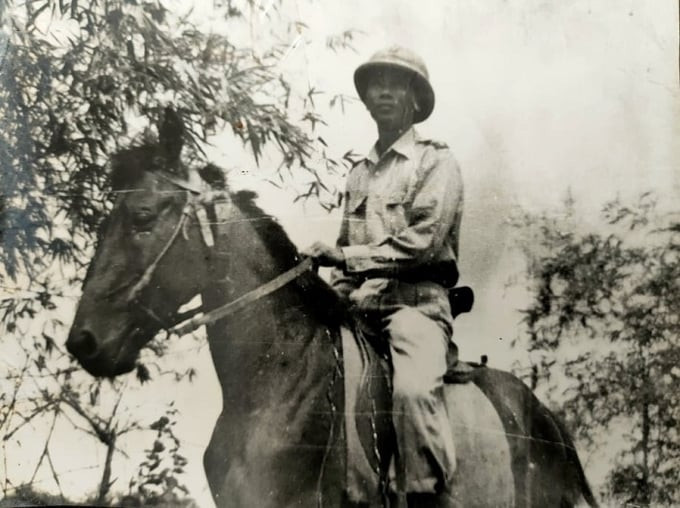
Major General Le Thiet Hung. (Photo: People's Army Newspaper)
Returning to his homeland in 1941, and establishing himself at the headwaters of Pac Bo in Cao Bang province, he used the pseudonym Dinh. Leader Nguyen Ai Quoc instructed him to first study the situation in all aspects before discussing future tasks.
He worked daily with comrades Le Quang Ba, Bang Giang… Major General Le Quang Ba later recounted:
“I thought to myself, Uncle Ho must have had a reason for telling Comrade Hung to stay, because since Comrade Phung Chi Kien's death, only Comrade Hung had been present in Pac Bo, the only one who had received formal, basic, and systematic military training at the Whampoa Military Academy. One afternoon, I and Comrade Le Thiet Hung were sitting and discussing work as usual when Uncle Ho arrived. He told us: “The more the Viet Minh movement develops, the more the enemy will try to counter it... there are now some weapons here... and scattered everywhere... Therefore, Comrade Le Dinh and Comrade Le Quang Ba should discuss how to organize the armed forces. You comrades should make a plan and report it.”
He was assigned by leader Nguyen Ai Quoc to work with Le Quang Ba to form the first armed team of 12 people. That was the Pac Bo guerrilla team.
Journalist Hoang The Dung, former Political Commissar of the Capital Regiment and author of the memoir "Uncle Ho and the Pac Bo Guerrilla Team," assessed that although the Pac Bo guerrilla team only existed for more than two years, it accomplished many great things: controlling bandits, protecting the lives and property of the people, limiting the search and sweep by enemy soldiers, and dividing and attracting a portion of the local officials to the revolutionary side. Six members of the Pac Bo guerrilla team were selected to join the Vietnam Propaganda and Liberation Army.
Amidst the rapid changes in the country, Le Quoc Vong was appointed by President Ho Chi Minh as the first commander of Military Zone 4 (now Military Region 4). One day, while he was inspecting the western part of Military Zone 4 to counter the remnants of French troops from Laos who were threatening to attack, he received a telegram from President Ho Chi Minh summoning him to Hanoi.
Upon arriving in the capital, he learned that the government was organizing a Support Force to replace Chiang Kai-shek's troops and oversee their withdrawal from Vietnam. Simultaneously, according to the Preliminary Agreement (March 6, 1946), 15,000 French troops would officially be present in the North. The Vietnamese Support Force, as stipulated by the government at the time, consisted of 10,000 men, organized into a division according to the organizational structure of the National Army, and was a component of the Vietnamese National Army.
The nickname "ebony tree" is understood literally because of Le Thiet Hung's dark complexion. Figuratively, it represents the message that leader Nguyen Ai Quoc entrusted to him: that operating behind enemy lines, he would remain absolutely loyal, steadfast, and unwavering like an ebony tree.
After completing his command of the "Army Support Team," he returned to serve as the Commander of Zone 4, then as the General Inspector of the Army, Director of the Military Training Department, and Principal of the Tran Quoc Tuan Military Academy.
From 1963, he was entrusted with a new responsibility: Ambassador Extraordinary and Plenipotentiary of the Democratic Republic of Vietnam to the Democratic People's Republic of Korea, Deputy Head of the Central Committee's Foreign Affairs Department... For his significant contributions to the revolutionary cause, Major General Le Thiet Hung was posthumously awarded the Ho Chi Minh Order by the State.
Libra
Source: https://vtcnews.vn/vi-tuong-duoc-bac-ho-dat-biet-danh-cay-go-mun-ar938523.html

![[Photo] General Secretary and President To Lam meets with National Assembly delegates from ethnic minorities.](https://vphoto.vietnam.vn/thumb/1200x675/vietnam/resource/IMAGE/2026/04/20/1776696701056_a1-bnd-8331-3342-jpg.webp)

![[Image] National Assembly discusses the implementation of the socio-economic development plan.](https://vphoto.vietnam.vn/thumb/1200x675/vietnam/resource/IMAGE/2026/04/20/1776696707422_ndo_br_img-20260420-185419-jpg.webp)










































Comment (0)