From fishing boat voyages to the aspiration to protect the sea.
The ship departed from Sa Ky port (Dong Son commune, Quang Ngai province) on an early summer morning. The sea was calm like a mirror, and the sun cast a golden glow on each small wave. From the deck, Ly Son Island gradually emerged from the thin mist, resembling a green mountain rising amidst the vast expanse of sea and sky.

Ly Son Island is located about 15 nautical miles from the mainland and has an area of approximately 10 square kilometers. Photo: LK
I've been to the island many times, but each trip brings a different feeling. Sometimes it's the overwhelming awe at the million-year-old volcanic cliffs standing majestically by the sea. Other times it's the profound silence when standing before the wind-blown tombs facing the ocean. And sometimes it's a feeling of wistfulness when listening to the locals recount their voyages to the Hoang Sa Islands in the past.
In his small house in Tay An Vinh village, Mr. Pham Quang Tuan poured a cup of hot tea, his voice slow and deliberate, drawing listeners back to the distant memories of the island. He said he was a descendant of one of the first families from the mainland to settle and cultivate Ly Son.

Getting to Ly Son Island is very convenient with high-speed ferries running at many times throughout the day. Photo: LK
On the veranda, the sea breeze blew strongly. The sun-tanned man from the coastal region gazed into the distance and recounted the story of Captain Pham Quang Anh – a relative of his family whom King Gia Long had sent to the Paracel Islands in 1815 to explore the sea routes. After many arduous voyages to complete his mission, his fleet encountered a storm, and Captain Pham Quang Anh, along with many militiamen, perished at sea.
From those losses, the people of the island have preserved for hundreds of years the Khao Le The Linh Hoang Sa ceremony as a way to remember the soldiers of yesteryear who braved the seas to Hoang Sa and Truong Sa to plant markers, survey, and defend maritime sovereignty . Amidst the echoing sound of conch shell horns in the sea breeze, paper boats, ancestral tablets, and offerings are respectfully prepared by the people as a tribute to those who sacrificed themselves at sea and never returned.

Mr. Pham Quang Tuan, a descendant of the Hoang Sa Commander Pham Quang Anh, recounts the story of his family lineage. Photo: LK


He recounted that at the age of 16, he followed his father to the Hoang Sa fishing grounds. His life has been intertwined with hundreds of long sea voyages. There were nights when the ship drifted in the middle of the ocean, surrounded only by darkness and the sound of waves crashing against the sides. "The sea is extremely hard, but I can't bear to leave it," he said with a smile.
Now that he's older, he no longer goes as far out to sea as before, only fishing near the shore. What worries him is that the sea no longer has as many fish and shrimp as it used to. But in return, his hometown island is changing every day. "In the past, the island was very deserted. Now there are more tourists , my children and grandchildren have new jobs, and life is more prosperous. What I'm happiest about is that the island has changed but still retains its essence," Mr. Tuan shared.

The Khao Le The Linh Hoang Sa ceremony is one of the distinctive cultural features of Ly Son Island. Photo: LK
Mr. Pham Van Thao, Head of the Culture and Social Affairs Department of the Ly Son Special Economic Zone, shared that the first Vietnamese inhabitants migrated from the Sa Ky estuary to the island to explore and settle around the beginning of the 17th century. The most valuable aspect of Ly Son today is not only its beautiful scenery, but also the depth of its history and culture, which has been preserved intact through many generations. Each village temple, each memorial tomb, and each festival carries a story about the journey of our ancestors in expanding the territory and protecting the sea.
Aspiration from the frontier island
Viewed from above, Ly Son resembles a giant geological museum in the middle of the East Sea. Dormant volcanoes, millions of years old, have created magnificent cliffs, caves, and unique sedimentary formations rarely found elsewhere.
Every evening, the Tò Vò Gate is packed with people waiting for the moment the sun sets over the sea. At Hang Câu, million-year-old volcanic cliffs cast their reflections onto the deep blue water. On Bé Island, the colorful coral reefs are becoming a popular destination for many young tourists every summer.

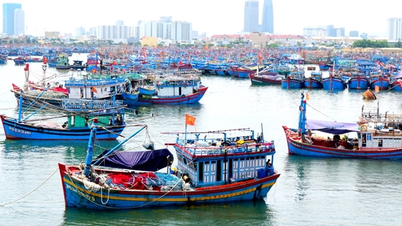
Fishing has been a traditional occupation for the people of Ly Son for generations. Photo: LK
Looking back on the journey over the years, Mr. Nguyen Van Huy, Chairman of the People's Committee of Ly Son Special Economic Zone, believes that the greatest driving force behind the strong transformation of this small island in the middle of the ocean is the people of Ly Son. According to him, the people here have always been hardworking, diligent, and possess a strong aspiration to thrive amidst the sun-drenched and windy sea.
There was a time when life on the island was full of hardships, electricity was unstable, fresh water was scarce, and transportation was difficult. But with the attention of the central government, Quang Ngai province, and the unity of the people, the face of Ly Son today has changed dramatically. What Mr. Huy is most proud of is that the people no longer just wait for support but have proactively transformed themselves, boldly engaging in tourism, developing services, preserving the environment, and promoting the image of their homeland.
Mr. Huy believes that Ly Son has many special advantages for developing island tourism, marine economy, and services. These include not only the pristine beauty of the blue sea and white sand, the remnants of millions-of-years-old volcanoes, and the crystal-clear beaches, but also the cultural and historical depth associated with the Hoang Sa Fleet of the past. The sincerity and hospitality of the local people are also valuable assets for community tourism.




The annual festivals are a long-standing cultural tradition in Ly Son. Photo: LK
However, the head of the Ly Son Special Administrative Region government also firmly asserted that the locality does not choose development at all costs. "The goal is to attract more tourists while keeping the island cleaner and more beautiful; to develop the economy while allowing the people to preserve their way of life, culture, and love for their homeland's sea and islands," he shared.
Besides focusing on the landscape, Ly Son Island pays great attention to preserving traditional cultural values such as the Khao Le The Linh Hoang Sa ceremony, the boat racing festival, historical relics, and customs and practices of the coastal inhabitants.
The speedboat revved its engine, slowly cutting through the waves and leaving the island. Behind it, Ly Son Island gradually shrank amidst the vast sea and sky, its volcanic cliffs still dark in the afternoon sun, and fishing boats lined up, heading out to sea. Amidst the waves and winds, this frontier island silently preserves the memory of Hoang Sa of its ancestors and continues the journey of leading the nation steadily towards the open sea.
Source: https://nongnghiepmoitruong.vn/viet-tiep-hanh-trinh-giu-bien-d813139.html

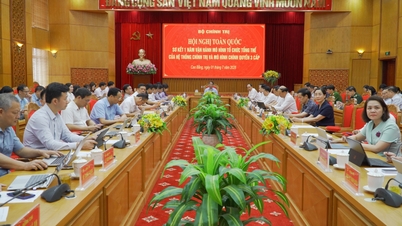
![[Image] National conference summarizing one year of operation of the overall organizational model of the political system, the three-tiered government model.](https://vphoto.vietnam.vn/thumb/1200x675/vietnam/resource/IMAGE/2026/07/01/1782882811691_ndo_br_1-jpg.webp)