


Recently, clam farming in Vinh Long province has faced many difficulties in production. Most worrying is the prolonged clam mortality in some coastal farming areas, causing significant losses in production and economic damage.
At An Thuy Fisheries Cooperative (Tan Thuy commune), the prolonged heatwave has caused damage to approximately 10% of the clam crop, estimated at around 1.3 billion VND. For Phuong Dong Clam Cooperative (Truong Long Hoa ward), a prolonged clam mortality period has occurred since the beginning of April; the estimated damage is about 30% of the crop, resulting in estimated losses of billions of VND for the cooperative.
According to Mr. Dang Xuan Thao, Director of Phuong Dong Clam Farming Cooperative, besides weather conditions and natural environmental fluctuations, the discharge of wastewater by some high-tech shrimp farming households during low tide may be one of the factors affecting the clam farming area. Therefore, the cooperative requests that relevant authorities promptly inspect and assess the water quality in the coastal area; and strengthen the management of wastewater discharge activities so that the cooperative can produce with peace of mind.
Besides damage caused by weather and environmental fluctuations, cooperatives also face difficulties due to the declining natural clam seed supply, forcing them to rely on high-priced and uncontrollable seed sources from outside the province. Furthermore, lengthy procedures for allocating and leasing land for clam farming hinder cooperatives from investing in infrastructure and developing long-term production plans.
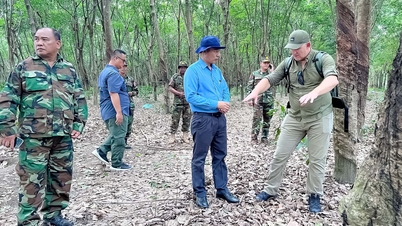
Following a field survey of the farming areas, Pham Minh Truyen, Deputy Director of the Department of Agriculture and Environment of Vinh Long province, said that the authorities will initially focus on clearly identifying the cause of the clam deaths in order to have a scientific basis for proposing appropriate solutions and minimizing losses for farmers in the future.
The Provincial Department of Agriculture and Environment directed specialized units to collect clam, water, and soil samples at various locations, including areas where water is discharged into the clam farming grounds, for comprehensive analysis and assessment of factors affecting the clam farming environment.
Regarding concerns about the potential impact of high-tech shrimp farming, Mr. Truyen stated that the relevant authorities will coordinate with local governments to strengthen propaganda and encourage farmers to properly treat wastewater and limit direct discharge into clam beds while awaiting the results of sample testing and analysis.
Regarding the shortage of clam spat, the Vinh Long provincial agricultural sector is actively calling on businesses to invest in building a local aquaculture seed production center to proactively secure a source of quality spat and reduce dependence on supplies from outside the province. Simultaneously, the sector will provide technical support, send specialists to guide production processes, seed rearing, environmental monitoring, and technology transfer to seed production facilities, contributing to improved seed quality and reduced risks during farming.
Regarding land-related difficulties, Mr. Truyen stated that the department will consider the cooperative's recommendations on land allocation and lease terms that align with the clam farming production cycle. This information will be compiled and submitted to the competent authorities for consideration, creating favorable conditions for units to invest with confidence and ensure long-term production stability.
Vinh Long province has a total clam farming area of approximately 5,400 hectares, with 17 organizations and individuals participating in production. This is one of the important industries in the coastal region, contributing to local economic development, creating livelihoods for people, and protecting the tidal flat ecosystem.
Source: https://baotintuc.vn/kinh-te/vinh-long-khao-sat-go-kho-cho-nghe-nuoi-ngheu-20260508171034933.htm

![[Image] Close-up view of the interchange connecting the two expressways and Long Thanh Airport.](https://vphoto.vietnam.vn/thumb/1200x675/vietnam/resource/IMAGE/2026/05/25/1779703378210_ndo_br_z7863716673926-224453a31600126cce10622af6290afd-4549-jpg.webp)
![[Image] Hanoi's urban life under the challenge of a "scorching hot" environment](https://vphoto.vietnam.vn/thumb/1200x675/vietnam/resource/IMAGE/2026/05/25/1779706979265_nang-nong-t5-2026-minh-duy-7-4636-jpg.webp)












































































Comment (0)