

Vinasoy is expanding its soybean growing areas nationwide, both to secure raw materials and to improve soil quality, aiming for sustainable development.
Soybeans are a familiar crop, playing an important role in agriculture and the environment. Their roots contain numerous nodules that harbor symbiotic nitrogen-fixing bacteria. These bacteria help convert nitrogen (N2) from the air into ammonia (NH3) and its derivatives (nitrogen) that soybean plants can absorb, while also leaving nitrogen in the soil. Therefore, soybeans have excellent soil improvement capabilities and are often likened to a natural nitrogen production factory for the soil.
While soybeans are useful for soil improvement and their seeds are a long-standing source of nutrition for Vietnamese people, farmers have recently shown less enthusiasm for growing them due to lower economic efficiency compared to other crops. According to data from the Southern Institute of Agricultural Science and Technology, the area under soybean cultivation in Vietnam is unstable, with domestic production only meeting about 8-10% of demand. In 2017, the area under soybean cultivation nationwide reached approximately 100,000 hectares, with a yield of about 1.57 tons/ha, resulting in a total production of 157,000 tons.
The shortage of high-quality domestic soybean supply has always been a concern for the leadership of Vinasoy Company - a member of Quang Ngai Sugar Joint Stock Company. They understand that both the company itself and the Vietnamese market need to proactively secure raw materials to maintain and accelerate development, while also demonstrating responsibility to the community and society.
Mr. Huynh Son Hai, CEO of Vinasoy, commented that large-scale agriculture in Vietnam is not easy. Many challenges arise from climate, geography, quality, productivity, farmers' farming practices, as well as the need for linkages and cooperation with stakeholders.
To proactively secure raw materials for production and sustainable business development, in 2013, Vinasoy established the first Vinasoy Soybean Research and Application Center (VSAC) in Vietnam with the goal of conducting in-depth research on soybeans to support sustainable business development. "Establishing the VSAC center was a strategic decision Vinasoy made to address each bottleneck," Mr. Huynh Son Hai emphasized.
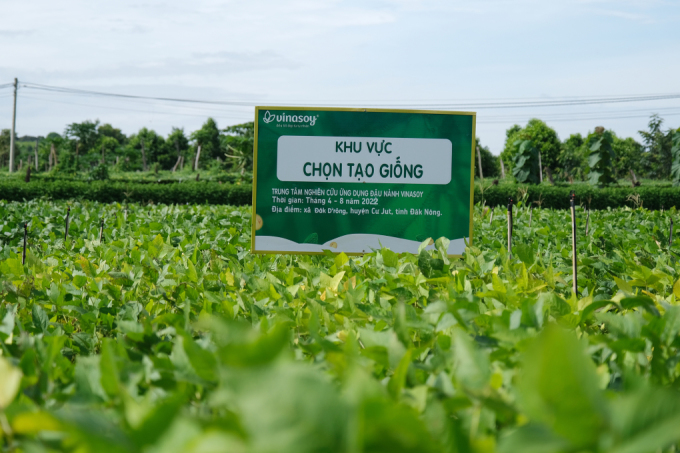
The Central Highlands Soybean Testing Station, part of VSAC, is located in Cu Jut district, Dak Nong province, where 1,533 lines and varieties from the gene bank are being cultivated and evaluated to create improved new varieties. Photo: VNS
The VSAC Center focuses on three main groups of solutions. First, it aims to create breakthroughs in the breeding of new soybean varieties, combined with the collection of a soybean gene bank to preserve valuable natural genetic resources and create breeding materials. The VSAC team also collaborates with leading global agricultural machinery companies such as Kubota to introduce mechanization into soybean cultivation. VSAC is also committed to purchasing all high-quality soybean products and supporting farmers throughout the production process.
VSAC also established the role of soybeans in sustainable crop rotation systems: soybean - peanut - sweet potato in the Central Highlands and two rice crops - one soybean crop in the Red River Delta and the Mekong Delta, thereby supporting farmers to increase their income while promoting more sustainable agricultural practices. In the context of climate change and irrigation water scarcity, the two rice crops - one soybean crop rotation model is a solution for sustainable rice development and large-scale soybean cultivation. This solution is also consistent with the government's policy of sustainable development and greenhouse gas emission reduction.
With the philosophy of "giving back to the land what we take," the VSAC Center has applied science and technology in developing raw material areas and products to revive soybean growing regions in Vietnam, thereby contributing to building sustainable agriculture. "At the same time, we also aim to preserve and enhance the nutritional value of soybean products and other plant-based products, contributing to a healthy and balanced life for everyone," Mr. Huynh Son Hai further shared Vinasoy's commitment to establishing the VSAC center.
With support from government agencies and relevant departments, the cooperation of farmers, and consumer backing, the company has now established four raw material areas in the Red River Delta, Central Vietnam, the Central Highlands, and the Mekong Delta. In these areas, Vietnamese farmers have increased the average soybean yield to 2.5 tons/ha, double the previous yield, while minimizing production costs. The Vinasoy-02 NS soybean variety, a product of VSAC's research and breeding program, has been licensed for circulation by the Department of Crop Production and, under certain conditions, can yield up to over 3 tons/ha.
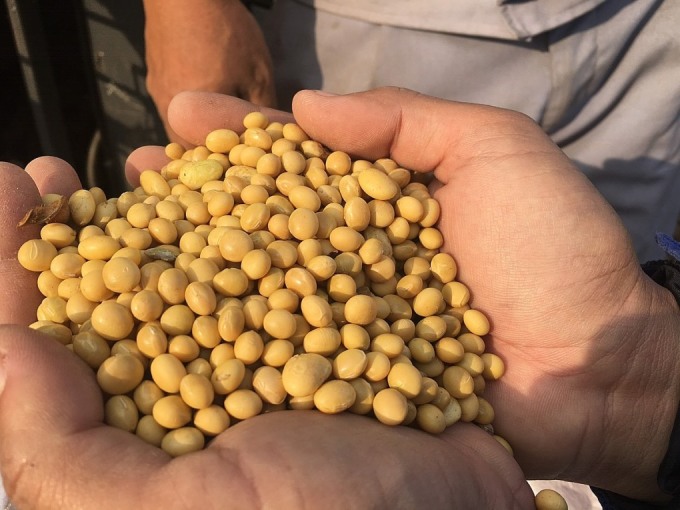
Vinasoy 02-NS soybeans. Photo: VNS
According to Vinasoy representatives, the immense and diverse benefits of soybeans for both long-term health and the environment are among the reasons why the company is steadfast in pursuing its goal of reviving "natural protein fields" in Vietnam.
Numerous studies have shown that soybeans are rich in high-quality protein, polyunsaturated fats, and essential fatty acids. Soybeans also provide many other valuable nutrients such as isoflavones and potassium. They are considered a food source for balancing plant and animal protein in daily meals, thereby helping to reduce the risk of chronic diseases, cardiovascular disease, cancer, weight management, and skin health.
According to Dr. Mark Messina, Director of Soy Nutrition Research at the Global Soy Nutrition Institute (USA), soybeans provide more protein per unit of greenhouse gas emissions than other common foods.
The journey of expanding soybean raw material areas and accompanying the nutritional needs of consumers nationwide has led Vinasoy to a leading position in the industry with an annual production of 390 million liters of soy milk, continuously meeting the needs of Vietnamese consumers and expanding into the global market. According to data from market research company Nielsen, Vinasoy has held the leading position in the ready-to-drink soy milk industry in Vietnam for three consecutive years (2020-2022). Furthermore, according to GlobalData UK, the company is the first and only Vietnamese name in the top 5 largest soy milk companies in the world for five consecutive years from 2018 to 2022.
Anh Duc
Source link


![[Photo] Prime Minister Pham Minh Chinh presides over a meeting on private sector economic development.](/_next/image?url=https%3A%2F%2Fvphoto.vietnam.vn%2Fthumb%2F1200x675%2Fvietnam%2Fresource%2FIMAGE%2F2025%2F12%2F20%2F1766237501876_thiet-ke-chua-co-ten-40-png.webp&w=3840&q=75)

![[Photo] Prime Minister Pham Minh Chinh presides over the conference announcing the establishment of the International Finance Centre in Vietnam.](/_next/image?url=https%3A%2F%2Fvphoto.vietnam.vn%2Fthumb%2F1200x675%2Fvietnam%2Fresource%2FIMAGE%2F2025%2F12%2F21%2F1766309817714_ndo_br_dsc-3400-jpg.webp&w=3840&q=75)
















































































Comment (0)