

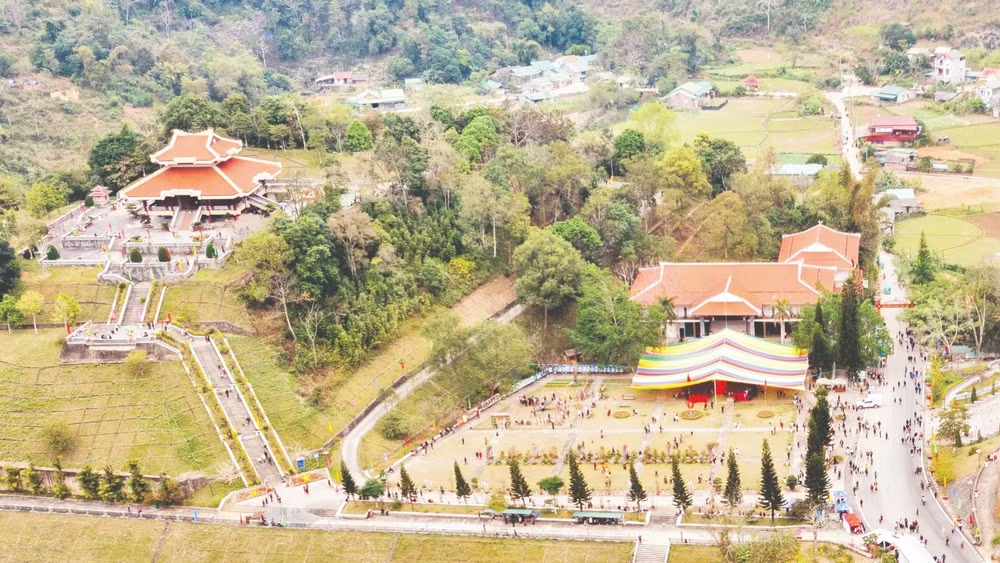
On January 28, 1941, leader Nguyen Ai Quoc returned to Pac Bo to directly lead the revolutionary movement in the country. From here, leader Nguyen Ai Quoc established the first revolutionary base of the entire country, launched the national liberation movement, and marked a decisive turning point in the Vietnamese revolution.
Back to the origins of the revolution
After traversing numerous winding mountain passes and villages nestled on the mountainside, amidst the vast expanse of mountains and forests, the Pac Bo National Special Historical Site emerges in a tranquil and peaceful atmosphere. In the local language, Pac Bo means "mouth of the source"—the starting point of a stream, and also the origin of the nation's revolutionary journey. This site still preserves almost intact the traces associated with the period of activity of leader Nguyen Ai Quoc during his early days back in the homeland. According to tour guide Hoang Thi Quynh's commentary, the journey following in Uncle Ho's footsteps gradually unfolds clearly through each landmark: Milestone 108, the foundation of Mr. Ly Quoc Sung's house, Coc Bo Cave, Nguom Vai Cave, Khuoi Nam hut... The foundation of Mr. Ly Quoc Sung's house is now a historical site, the first place Uncle Ho stopped when he returned to the country via Milestone 108. From here, he and his revolutionary comrades moved to live and work in Coc Bo Cave (meaning "headwaters") from February 8, 1941, to mid-March 1941.
Eighty-five years have passed since "Uncle Ho has returned to the Fatherland," and this journey is being continued by the Party Committee, government, and people of Cao Bang province through many creative and practical approaches. Cao Bang's initiation of a series of activities commemorating the 85th anniversary of President Ho Chi Minh's return to the country is both an expression of historical gratitude and a journey back to the roots of the revolution, contributing to nurturing ideals for the younger generation and widely disseminating the enduring values of Ho Chi Minh's thought, morality, and style in contemporary social life. Along with diverse and in-depth propaganda activities, creative media products, and moving documentary films, a prominent highlight is the establishment of the Ho Chi Minh Cultural Space in Truong Ha commune, becoming a "red address" connecting traditional education , historical experiences, and cultural tourism. According to Comrade Hoang Hong Dieu, Deputy Head of the Standing Committee of the Propaganda and Mass Mobilization Department of the Cao Bang Provincial Party Committee, with the support and experience from Ho Chi Minh City, this space will integrate the display of documents, images, and artifacts about President Ho Chi Minh's journey back to the country; at the same time, it will apply digital technology and virtual reality technology; and organize experiential activities and traditional education for students and tourists.
Cao Bang is gradually transforming the journey of following in Uncle Ho's footsteps into a tradition-building and development initiative for the new era. To achieve this goal, Comrade Hoang Hong Dieu added: The province will continue to incorporate the values of the commemorative activities into regular traditional education, political activities, mass mobilization work, and socio-cultural life; focus on building and effectively promoting the Ho Chi Minh Cultural Space in Cao Bang; develop a digital learning materials system and experiential education models such as "Following in Uncle Ho's footsteps to the source," thereby raising awareness and fostering revolutionary ideals for cadres, Party members, and all strata of the people.
A journey of innovation and aspiration for progress.
By integrating values from its revolutionary roots with current demands, Cao Bang is embarking on a new path of development: building a more prosperous and beautiful homeland through a spirit of innovation and a strong aspiration for progress. Contributing to the realization of this aspiration, the Provincial Party Committee has focused on leading and directing the concretization of the Resolution of the 14th National Party Congress and the Resolution of the 16th Provincial Party Congress, linking it with the implementation of resolutions, directives, and conclusions of the Central Committee and the tasks for 2026, in accordance with local realities. In the first quarter of 2026, the economy will continue to maintain its growth momentum; some sectors will achieve relatively good results compared to the same period in 2025, especially industrial production, tourism, services, and domestic revenue collection. Total tourism revenue in the first quarter of 2026 is expected to reach 704 billion VND, an increase of 56.4% compared to the same period.
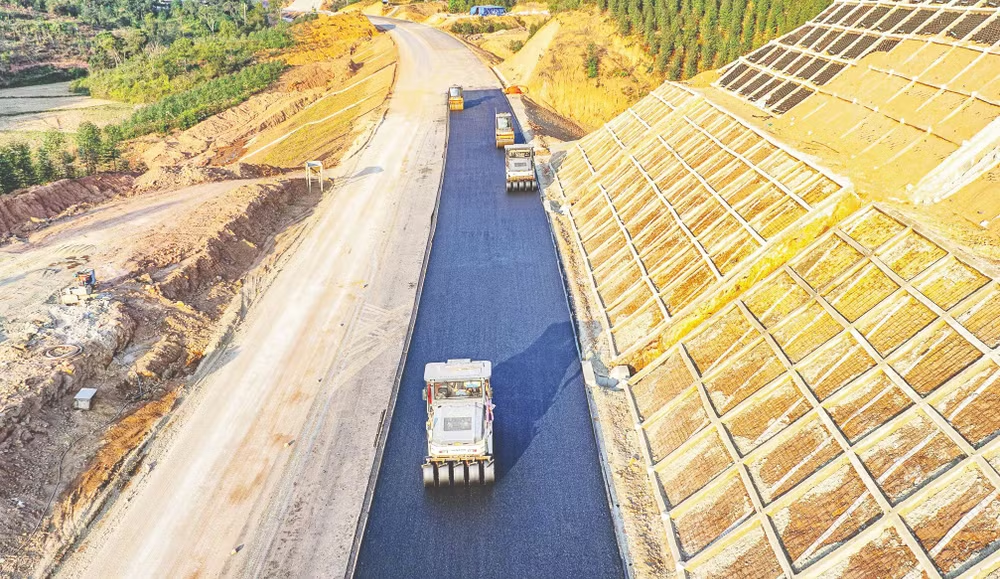
The clearest evidence of this new pace of development is the expansion of roads to even the most remote and isolated villages. Comrade Truong The Vinh, Deputy Chief of the Provincial People's Committee Office, informed that Cao Bang is accelerating the implementation of strategic transportation projects, including the Dong Dang-Tra Linh and Bac Kan-Cao Bang expressways. The province is preparing to invest in connecting routes between the expressways and the city center, international border gates, key tourist areas, and special national historical sites. At the grassroots level, the province is focusing on the goal of solidifying commune roads, aiming for asphalt or concrete paving of at least 85% of the total length of commune roads; and renovating, upgrading, and developing the system of bridges over rivers and streams (expected to be completed in the second quarter of 2026).
Cao Bang places high expectations on digital transformation, innovation, and improving the quality of its staff, especially at the grassroots level. According to Ms. Hoang Thi Hue, Deputy Head of the Cao Bang Provincial Party Committee's Organization Department: Cao Bang currently has 14,347 commune-level officials, civil servants, and public employees, of which over 96% are ethnic minorities. Thanks to their understanding of the local area, closeness to the people, and connection with the people, the grassroots staff are gradually adapting to the demands of modern governance, applying digital technology in administration, and serving the people more effectively.
Commune-level officials are simultaneously responsible for many areas of work, with an ever-increasing workload and increasingly demanding tasks, while infrastructure, resources, and human resources remain limited. Comrade Nong Van Thuan, Deputy Secretary of the Party Committee of Lung Nam commune, shared: Lung Nam is a particularly difficult border commune with 100% of its population being ethnic minorities. The natural conditions are harsh, with frequent water shortages during the dry season. Local officials are constantly striving to find ways to develop the economy and persistently mobilize the people to overcome difficulties. In remote hamlets far from the commune center, officials still travel along mountain roads to each family to disseminate policies, assist with administrative procedures, and provide guidance on production techniques. Despite the many hardships, local officials remain committed to the community, hoping for a better life for the people.
From the source of the ancient Pac Bo stream, new roads are opening to remote villages, bringing a brighter appearance with spacious houses and the persistent footsteps of grassroots officials who stay close to the people and the villages. In this land that bears the mark of the early years of the revolution, the spirit of overcoming difficulties and the aspiration to rise up are still being continued through these very simple things.
Source: https://nhandan.vn/vung-vang-theo-chan-bac-post963129.html
![[Photo] General Secretary and President To Lam presides over a working session with the Central Policy and Strategy Committee on the development of the materials industry.](https://vphoto.vietnam.vn/thumb/1200x675/vietnam/resource/IMAGE/2026/05/21/1779359935432_a3-bnd-3129-1412-jpg.webp)



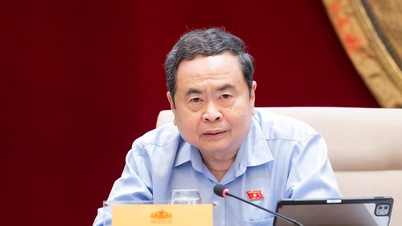
![[Photo] National Assembly Chairman Tran Thanh Man working with the Standing Committee of the Law and Justice Committee](https://vphoto.vietnam.vn/thumb/1200x675/vietnam/resource/IMAGE/2026/05/21/1779378929214_ndo_br_1-4610-jpg.webp)













![[Infographic] Stock market on May 21st: VN-Index falls 16.34 points, market liquidity decreases.](https://vphoto.vietnam.vn/thumb/402x226/vietnam/resource/IMAGE/2026/05/21/1779379204295_screenshot-2026-05-21-220948-jpg.webp)
![[Video] Hanoi plans to select two communes with 700,000 inhabitants to pilot the socialist model.](https://vphoto.vietnam.vn/thumb/402x226/vietnam/resource/IMAGE/2026/05/21/1779373741887_z7851174239346-8a83e741648b3fa19f4e711ad18c6234-jpg.webp)
















































Comment (0)