

Thousands of years ago, this area was a lush green grassland, with trees, lakes, and rivers that nurtured large animals such as hippos and elephants. It was also home to prehistoric communities, including 15 women and children whose remains were discovered by archaeologists buried in a stone shelter. They subsisted on fishing and raising sheep and goats.
"We started with these two skeletons because they were so well preserved – the skin, ligaments, and tissues were still intact," said Savino di Lernia, co-author of the study.
This is the first time archaeologists have sequenced the entire genome from human remains in such a hot and arid environment, according to di Lernia, associate professor of African archaeology and ethnography at Sapienza University, Rome.
Genomic analysis revealed a major surprise: the inhabitants of the verdant Sahara were a previously unknown population, living in isolation for extended periods and possibly having resided in the region for tens of thousands of years.
Excavations of the Takarkori stone shelter, a site only accessible by four-wheel drive, began in 2003. Two female mummies were among the first discoveries.
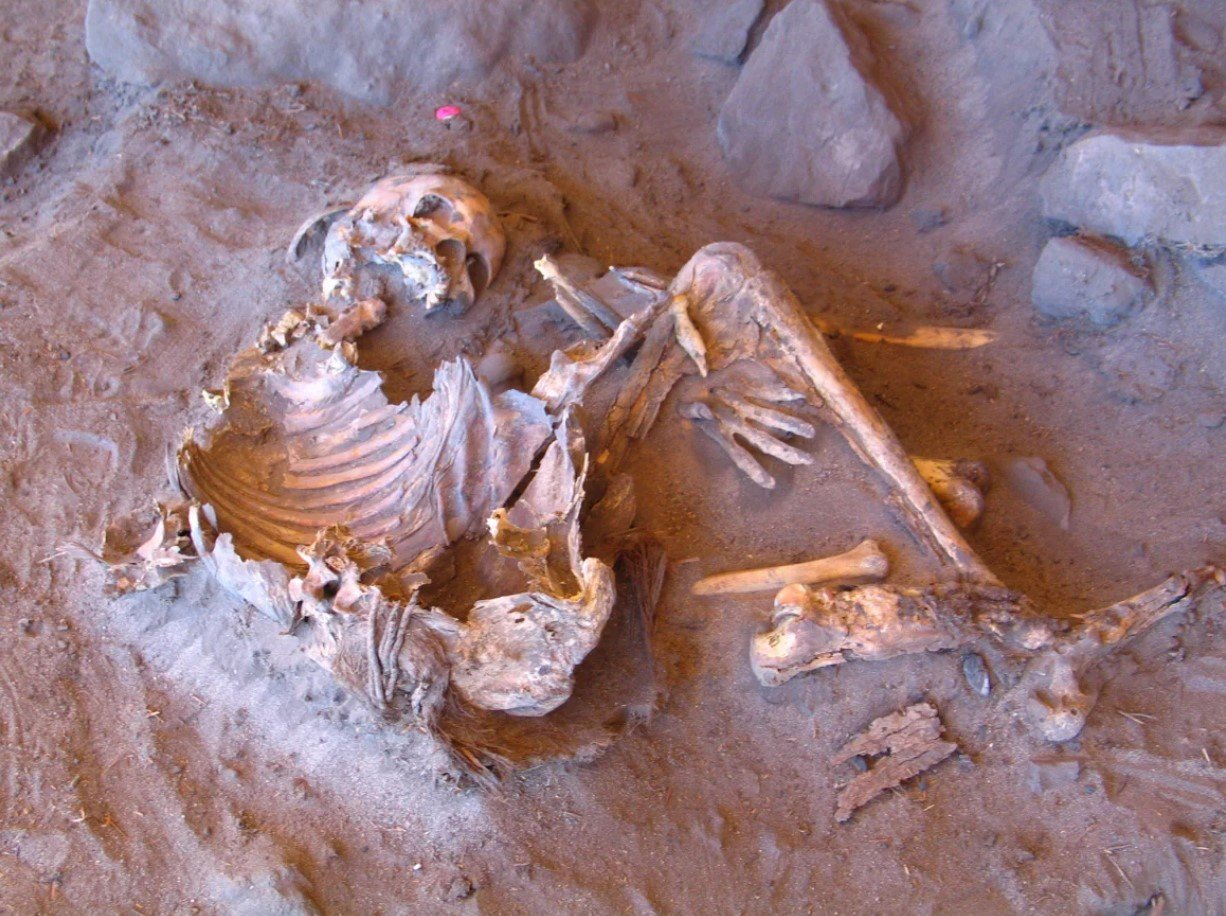
The mummified remains of two 7,000-year-old women were found in the Takarkori rock cave. (Image: Archaeological Mission in the Sahara/Sapienza University of Rome)
The small community that once lived there may have migrated here with the first wave of human migration out of Africa more than 50,000 years ago. Harald Ringbauer, co-author of the study, said it is rare to find such an isolated genetic lineage, especially when compared to Europe, where there is much stronger genetic mixing.
This genetic isolation suggests that the Sahara at that time was not a migration corridor between sub-Saharan Africa and North Africa, despite relatively favorable living conditions. Previously, researchers speculated that the Saharan inhabitants were migratory cattle herders from the Near East – the birthplace of agriculture.
However, new research refutes this hypothesis, showing that the Takarkori group shows no signs of genetic mixing with outside communities. Instead, cattle grazing may have been introduced through cultural exchange, through interaction with other groups that had domesticated animals.
Their genetic lineage traces ancestry from the Pleistocene epoch, which ended around 11,000 years ago. Louise Humphrey, a researcher at the Natural History Museum in London, agrees with this finding. She says the DNA of the two cattle-herding women buried at Takarkori around 7,000 years ago suggests they belonged to a previously unknown ancient North African lineage.
Ha Trang (according to Archaeological Mission in the Sahara, CNN)
Source: https://www.congluan.vn/xac-uop-tiet-lo-bi-mat-ve-qua-khu-cua-sa-mac-sahara-post341357.html
![[Photo] Prime Minister Pham Minh Chinh presides over a meeting on private sector economic development.](/_next/image?url=https%3A%2F%2Fvphoto.vietnam.vn%2Fthumb%2F1200x675%2Fvietnam%2Fresource%2FIMAGE%2F2025%2F12%2F20%2F1766237501876_thiet-ke-chua-co-ten-40-png.webp&w=3840&q=75)

























































































Comment (0)