

Farmer linkages are the foundation for technology transfer.
The An Giang Agricultural Extension Center recently held a workshop to summarize the "Large-Scale Farming Project to Meet Raw Material Needs and Respond to Climate Change" for the period 2022-2025. The workshop provided an opportunity to review the nearly four years of implementing the model, assess the achievements, difficulties, and limitations, and draw lessons learned to serve as a basis for proposing and implementing activities in the next phase.
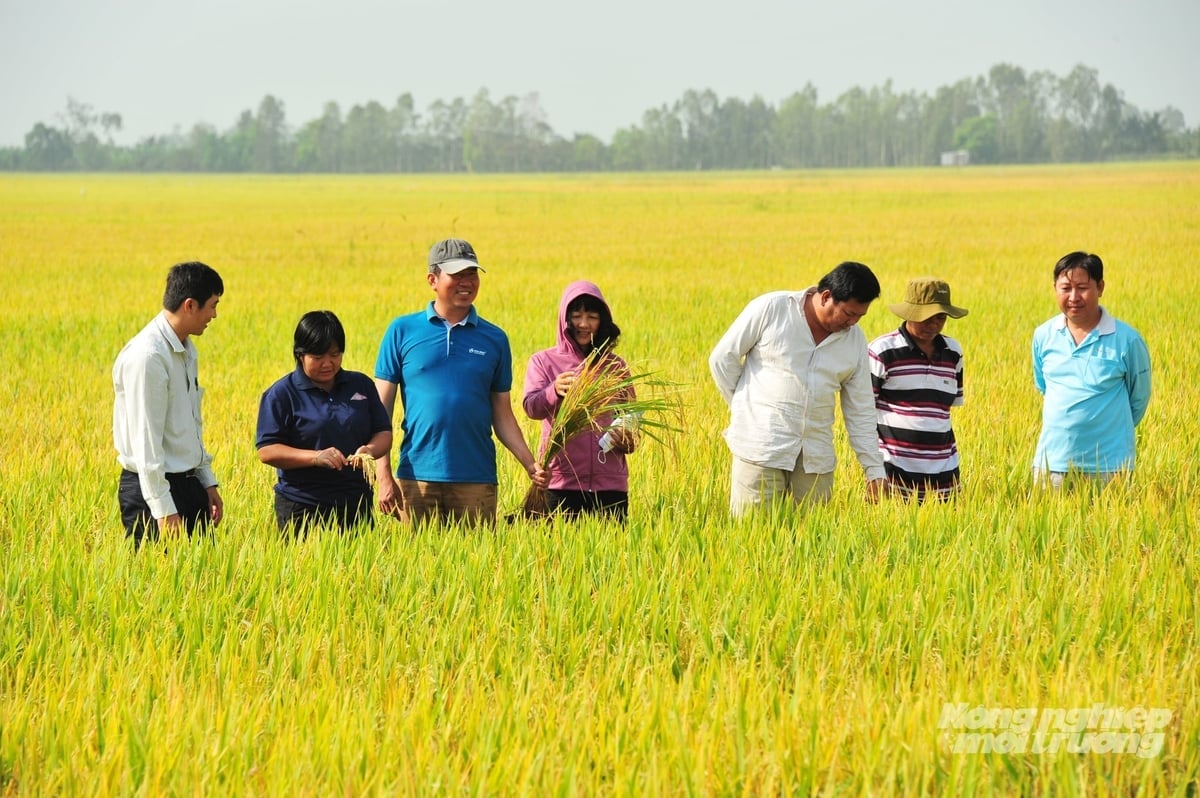
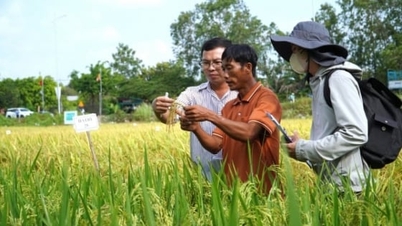
Leaders of the An Giang Agricultural Extension Center, along with farmers and cooperatives, visited fields to assess rice growth in high-quality, low-emission rice production areas in An Giang. Photo: Le Hoang Vu.
The Mekong Delta is the country's key rice-producing region, contributing over 50% of the national rice production and over 95% of Vietnam's rice exports annually. An Giang province alone has over 624,000 hectares of rice-growing land, with a planted area of 1.344 million hectares in 2024, yielding approximately 8.78 million tons.
However, current rice production still faces many challenges such as fragmentation, high input costs, overuse of chemical fertilizers and pesticides, large greenhouse gas emissions, and unstable output. It is estimated that producing 1.5 tons of rice emits approximately 1 ton of CO₂e. This highlights the urgent need to shift production methods towards sustainability, low emissions, and adaptation to climate change.
Ms. Huynh Dao Nguyen, Director of the An Giang Agricultural Extension Center, stated that the key role of linkages in the project's implementation is to help farmers apply technical advancements, especially technologies for rice production. To achieve this, farmers must first be linked together. This forms the basis for the synchronized implementation of technical solutions, thereby yielding tangible results.
From the very beginning of the project's implementation in 2022, the project's objectives were clearly defined: to reduce production costs by 20-30% and increase economic efficiency by 30-50% for rice farmers. This was coupled with linking businesses to consume the produce and transferring advanced technical and technological inputs to cooperatives and farmers.
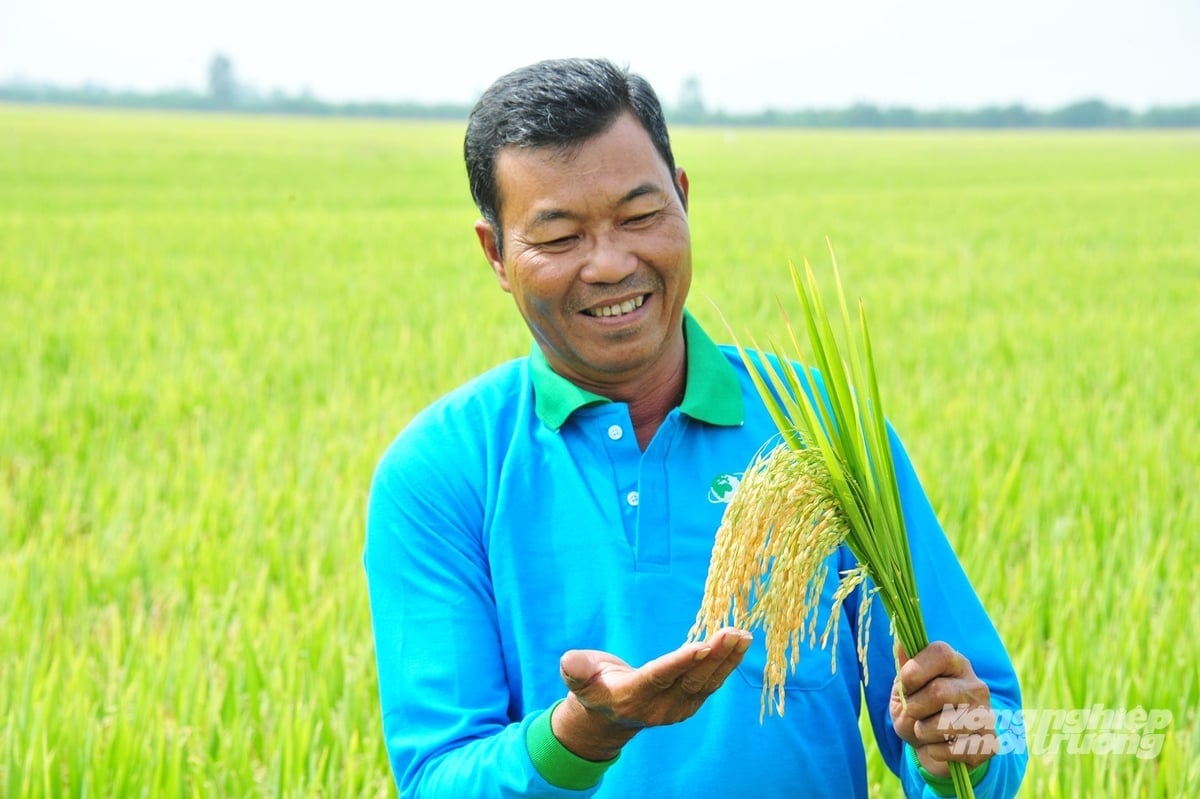
Farmers in An Giang are delighted beside their rice fields laden with grain, a testament to the effectiveness of high-quality rice cultivation processes that reduce costs and increase profits. Photo: Le Hoang Vu.
The application of synchronized technology has resulted in a significant reduction in costs.
The project was implemented across a total area of over 5,582 hectares with 73 large fields, attracting 2,027 farming households. The area and number of fields have gradually increased over the years, reflecting the farmers' trust and the increasingly improved production organization capacity of the cooperatives.
The formation of large-scale rice fields of 50 hectares or more has helped overcome fragmented production, creating conditions for the synchronized application of technical processes, mechanization, and digital transformation in rice production. The project also flexibly adjusts its scale each year, focusing on improving quality and efficiency rather than chasing quantity.
One of the highlights of the project is the synchronized application of technical advancements in rice production. 100% of the area uses certified first-grade rice varieties such as Dai Thom 8, OM18, ST25… meeting the requirements of the market and consuming businesses.
Sowing density is gradually being reduced according to a schedule, from less than 100kg/ha in the 2022-2024 period to about 70kg/ha in 2025. Many cooperatives have adopted machine sowing, row sowing, and drone sowing, which helps save seeds, reduce labor, and increase uniformity in the fields.
Thanks to the application of the "1 must, 5 reductions" process, the amount of chemical fertilizers is reduced by 15-20%, the number of pesticide sprayings is reduced by an average of 2 times/season, but rice yield remains stable, or even slightly increases. This is clear evidence of the economic and environmental benefits that the model brings.
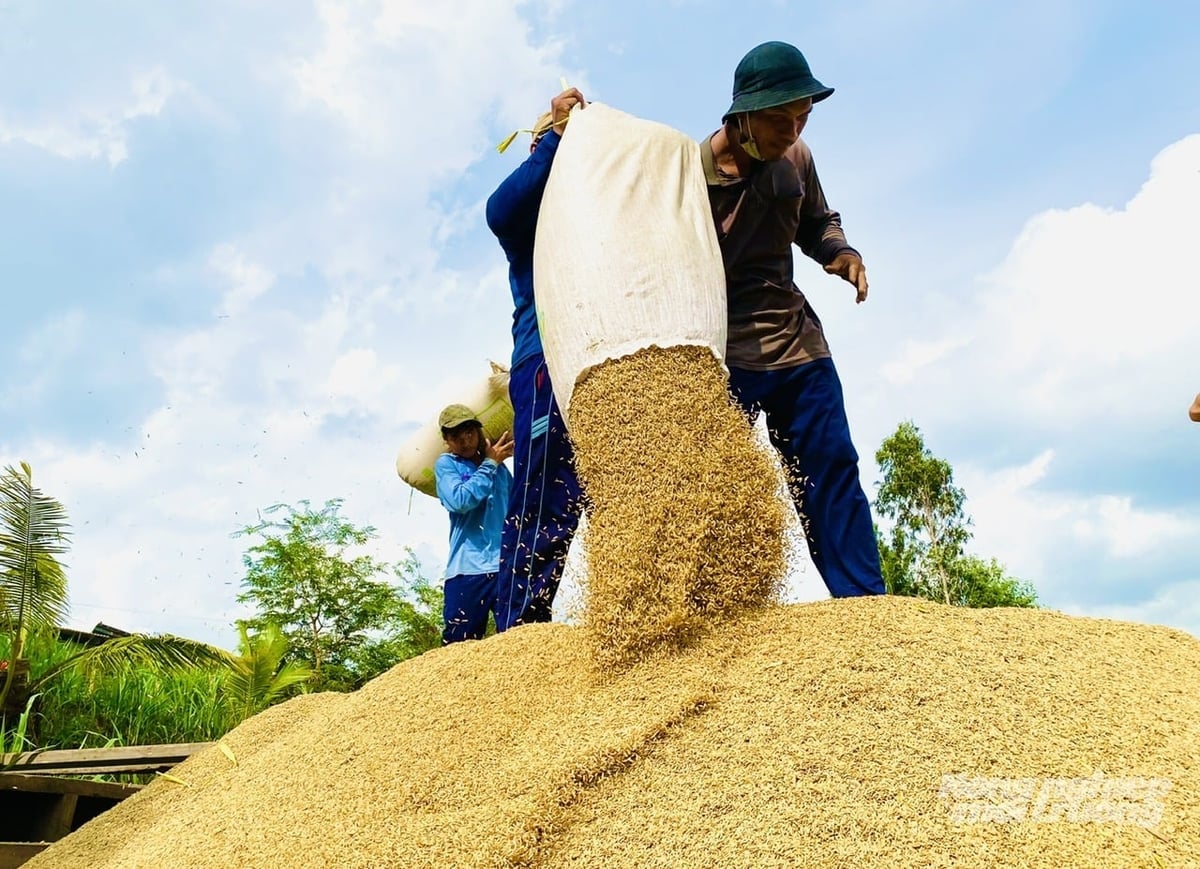
Mechanized rice harvesting ensures grain quality and reduces post-harvest losses in the production-consumption linkage model. Photo: Le Hoang Vu.
The project also boldly incorporates high technology into production. Smart pest monitoring stations help to automatically track pests, provide early warnings, and support farmers in timely pest control. By 2025, alternating wet-dry (AWD) sensors will be introduced into water management, contributing to water conservation and reduced methane emissions.
In water-dependent areas such as the West of Hau River and the Long Xuyen Quadrangle, AWD (Alternating Wet and Dry) has proven remarkably effective. Despite challenges in some areas like U Minh Thuong, the implementation of alternating wet and dry water management has initially raised farmers' awareness of water-saving management, laying the groundwork for future expansion.
Consumption linkages are a central theme of the Project. During the 2022-2025 period, the linked area reached 4,556 hectares, accounting for over 81% of the total implemented area. Many large enterprises such as Tan Long Group, Trung An, Loc Troi… participated in purchasing and signing contracts with cooperatives, helping farmers feel secure in their production.
Mr. Nguyen Van Hoa, Director of Tan Thanh Agricultural Cooperative (Group 2, Khanh Tan Hamlet, Giang Thanh Commune, An Giang Province) shared: "Previously, farmers produced on a small scale, each working independently, and the output was very unstable. By participating in large-scale farming, the cooperative organized production, applied new techniques, and signed contracts with businesses. Rice prices are more stable, costs are reduced, and members' profits have increased significantly."
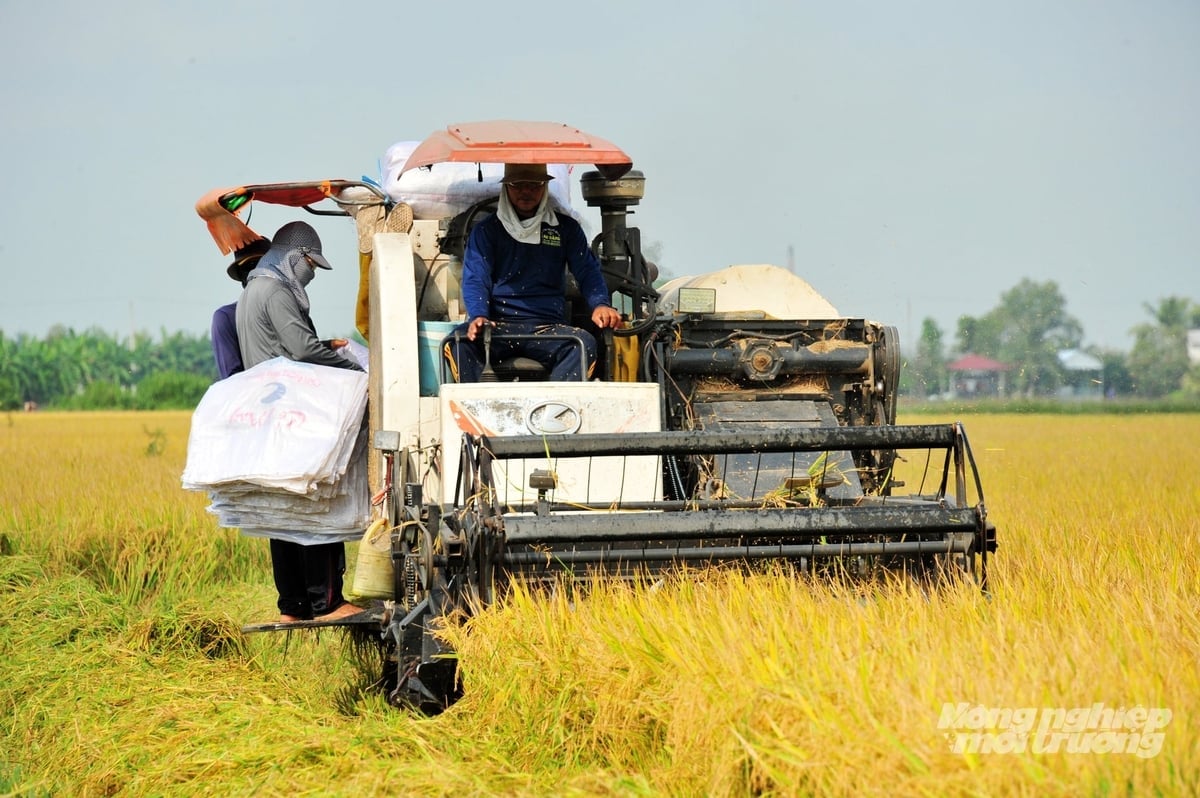
Combine harvesters operate in high-quality rice fields in An Giang. Photo: Le Hoang Vu.
With the results achieved, the "Large-Scale Rice Field" Project in An Giang is considered a suitable production organization model in the current context, contributing to reducing costs, increasing the value of rice grains, reducing emissions, and adapting to climate change. More importantly, the Project has created a solid foundation for the formation of a large raw material area, meeting the requirements of domestic and international markets, aiming for the sustainable development of the rice industry in An Giang province and the entire Mekong Delta region.
Source: https://nongnghiepmoitruong.vn/xay-dung-73-canh-dong-lua-lon-phuc-vu-xuat-khau-d791099.html
















![OCOP during Tet season: [Article 4] Elevating local products](https://vphoto.vietnam.vn/thumb/402x226/vietnam/resource/IMAGE/2026/01/29/1769652810578_2935-z6982071462129_649e82db06fb2f2ea701388b1f5f5b0b-173322_176-185229-202804_457.jpeg)












































Comment (0)