

 |
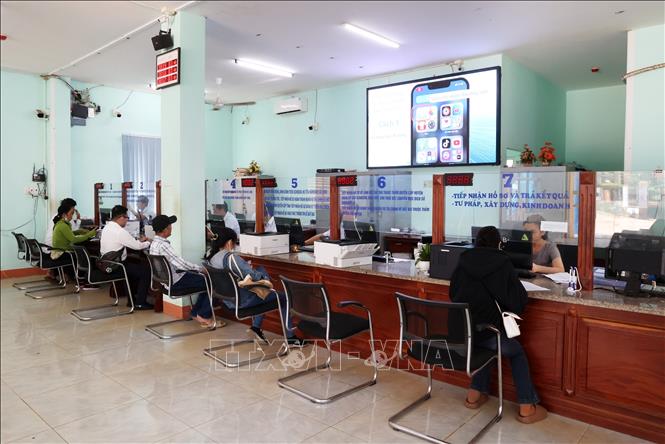
| Evaluating officials and civil servants in a substantive manner. (Illustrative image: VNA) |
Amendments to the law are related to the reorganization of the administrative apparatus.
According to the Ministry of Interior , the purpose of this revision of the Law on Cadres and Civil Servants is to focus on strongly reforming personnel work in conjunction with reorganizing the entire political system's apparatus to be "Lean - Streamlined - Strong - Efficient - Effective - Effective" as required by Resolution No. 18-NQ/TW and Conclusion No. 50-KL/TW dated February 28, 2023, of the Politburo on continuing to implement Resolution No. 18-NQ/TW.
Building a merit-based public service and a mechanism for managing officials and civil servants according to job positions; building a team of officials and civil servants, especially leading and managerial officials and heads of departments, who possess sufficient competence, qualities, and prestige to match their responsibilities; building a state administration that serves the people, is professional, rule-of-law, modern, effective, and efficient.
Strongly innovate the recruitment, training, development, appointment, rotation, transfer, and evaluation of cadres and civil servants in a substantive manner, "for the sake of finding the right people, based on concrete, measurable results." Develop mechanisms to encourage and protect cadres and civil servants with innovative thinking, who dare to think, dare to act, dare to innovate, and dare to take responsibility for the common good, based on clearly defined cases of cadres and civil servants who dare to think, dare to act, and dare to innovate for the common good; and protect those with potential risks or errors from an early stage, as soon as a plan is in place.
Promoting comprehensive digitalization and digital transformation in the management of officials and civil servants to meet the requirements of building an e- government and a digital government through the development and improvement of the legal framework for digital platforms and a nationwide unified set of tools for state management and law enforcement regarding the management of officials and civil servants.
Addressing existing shortcomings and obstacles in the management and utilization of officials and civil servants; promptly removing "bottlenecks" in the management of human resources in the public sector, creating momentum for development.
Promote decentralization and delegation of power, increase autonomy and accountability.
The guiding principle in this revised Law on Cadres and Civil Servants ensures the direct and comprehensive leadership of the Party over cadre work and the management of the cadre workforce within the political system. It promptly and fully institutionalizes the Party's guidelines and policies as outlined in the 13th National Congress documents and other resolutions, directives, and conclusions of the Party, resolutions of the National Assembly, and practical issues arising from the development of the cadre and civil servant workforce, meeting the requirements of building and perfecting the socialist rule of law state of Vietnam in the new era.
Ensuring the consistency, stability, and uniformity of the legal system; the uniformity and consistency between the provisions of the Law on Cadres and Civil Servants and other specialized laws; the continuity and development of existing regulations; and selectively referencing international experiences suitable to Vietnam's conditions.
Promote decentralization and delegation of authority, increasing autonomy and accountability for ministries, sectors, and localities in managing the quantity and quality of cadres and civil servants within their jurisdiction. Linking the delegation of authority with clearly defined responsibilities aims to foster initiative, creativity, and enhance the role of leaders in the management of cadres and civil servants.
According to the Ministry of Interior, the necessity of drafting the Law on Cadres and Civil Servants (amended) is based on the documents of the 13th National Congress of the Communist Party of Vietnam, which identified one of the three strategic breakthroughs as "Developing human resources, especially high-quality human resources; prioritizing the development of human resources for leadership, management and key sectors on the basis of improving and creating a strong, comprehensive, and fundamental transformation in the quality of education and training, linked with mechanisms for recruiting, utilizing, and rewarding talent, promoting research, transfer, application and strong development of science and technology, and innovation."
The 10-year socio-economic development strategy for 2021-2030 has identified the direction, tasks, and solutions for socio-economic development as "Rapidly building a modern administrative system based on a team of highly professional, creative, ethically sound, and politically steadfast officials and civil servants who serve the people and businesses"; “Building a highly professional and creative team of officials, civil servants, and public employees based on a competitive recruitment mechanism, remuneration, and promotion system; possessing good moral character and firm political conviction. Clearly defining and emphasizing the responsibility of leaders; establishing mechanisms to encourage and inspire dedication to the country, creating motivation and pressure for all officials, civil servants, and public employees to best fulfill their assigned tasks and serve the people diligently; establishing mechanisms to protect officials who are innovative, creative, daring to think, daring to act, daring to make breakthroughs, and daring to take responsibility for the common good. Fundamentally reforming the salary system for officials, civil servants, and public employees.”
Resolution No. 27-NQ/TW6 sets the goal of “Focusing on the comprehensive development and improvement of the quality of human resources to meet the requirements of the national administration; strongly reforming the civil service and public official system; perfecting the system of job title standards, job positions, professional standards, and criteria for evaluating cadres, civil servants, and public employees based on the results of assigned tasks with specific products and the satisfaction of citizens and businesses”; at the same time, it sets out the solution of “Continuing to promote administrative reform, focusing on improving the quality of the contingent of cadres, civil servants, and public employees with three main pillars: organizational structure; public service and civil servants; e-government and digital transformation”.
The amended Law on Cadres and Civil Servants continues to inherit and develop a number of provisions that have proven effective in practice over the past period, based on the results of the review of the implementation of the current Law on Cadres and Civil Servants.
In addition, the Law on Cadres and Civil Servants (amended) amends and supplements several regulations on: Unifying the civil service from the central level to the provincial, district, and commune levels; Innovating the mechanism for managing cadres and civil servants according to job positions;完善 regulations on the rights and obligations of cadres and civil servants and the things they are not allowed to do; ethics and culture of public service;完善 regulations to innovate the method of managing cadres and civil servants in accordance with the requirements of promoting digital transformation and building a digital government, ensuring increased modernity, openness, transparency, and efficiency in state management activities;完善 regulations on the management of cadres and civil servants to ensure consistency and uniformity with the regulations of the Party and to ensure consistency with the legal system.
Source: https://huengaynay.vn/chinh-polit-xa-hoi/xay-dung-du-an-luat-can-bo-cong-chuc-sua-doi-tren-tinh-than-doi-moi-thuc-chat-152062.html


![[Photo] Prime Minister Pham Minh Chinh presides over a meeting on private sector economic development.](/_next/image?url=https%3A%2F%2Fvphoto.vietnam.vn%2Fthumb%2F1200x675%2Fvietnam%2Fresource%2FIMAGE%2F2025%2F12%2F20%2F1766237501876_thiet-ke-chua-co-ten-40-png.webp&w=3840&q=75)














































































Comment (0)