

 |
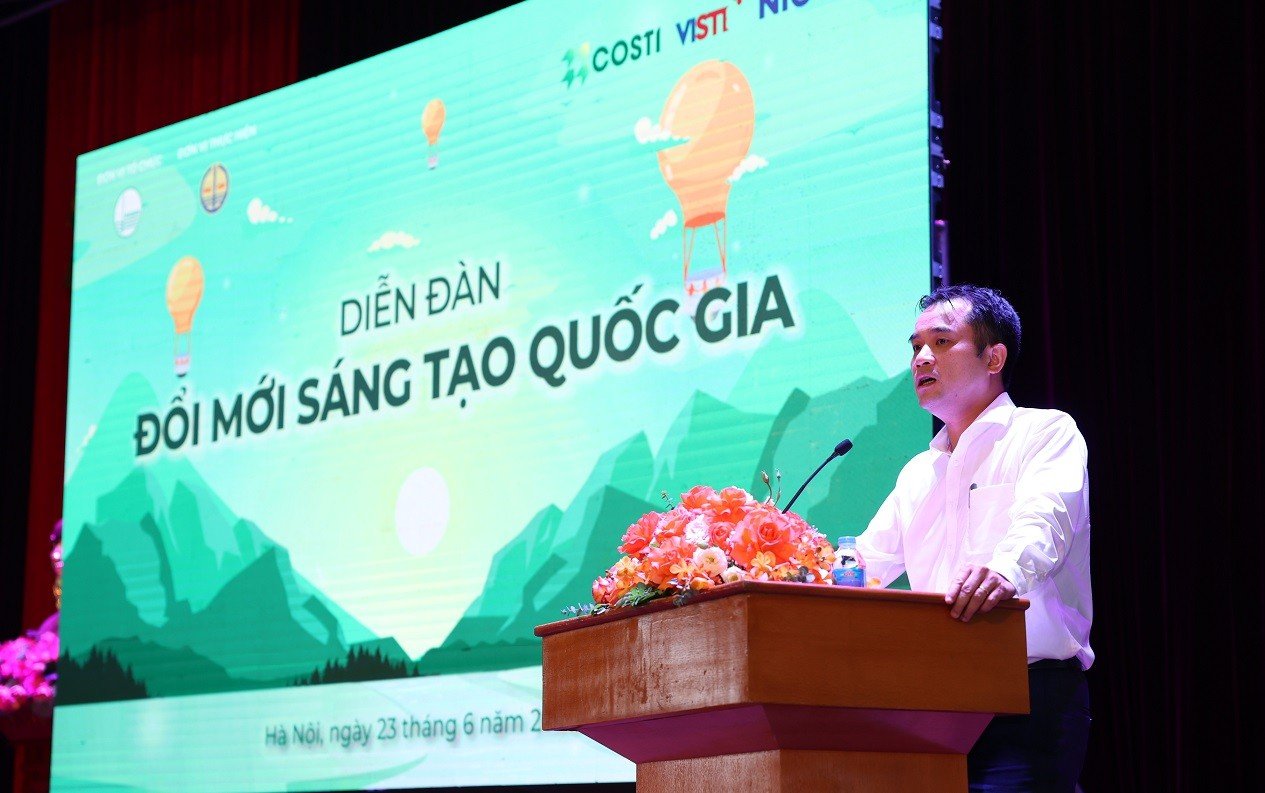
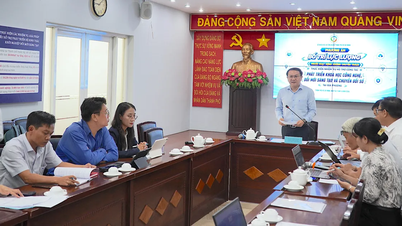
| Mr. Truong Ngoc Kiem, Director of the Center for Knowledge Transfer and Entrepreneurship Support at Vietnam National University, Hanoi, delivered the opening remarks at the Forum. (Source: Vietnam National University, Hanoi) |
In his opening remarks at the Forum, Truong Ngoc Kiem, Director of the Center for Knowledge Transfer and Entrepreneurship Support at Vietnam National University, Hanoi, stated that the National Innovation Forum was organized to connect scientists, experts, policymakers, and the business community interested in science and technology and innovation nationwide.
The National Innovation Forum is held annually to provide an overview of the current state of innovation in Vietnam; analyze achievements and limitations, draw lessons learned, and seek effective solutions to develop the innovation system in Vietnam; and create a space to strengthen connections between the components of the innovation ecosystem.
At the same time, we must raise awareness and promote the spirit of innovation to spread, becoming an inspiration for all citizens, transforming creativity into an unlimited resource, leading the country to sustainable development so that innovation truly becomes a new growth engine, making Vietnam a prosperous nation by 2045.
According to Vice Director of Vietnam National University, Hanoi, Pham Bao Son, the science and technology development strategy for the period 2021-2030 affirms that the development of science and technology, along with education and training, is a top national priority and a key driving force for the rapid and sustainable development of the country.
Science and technology must play a leading role in creating breakthroughs in productive forces, innovating growth models, enhancing the competitiveness of the economy , and accelerating the process of industrialization and modernization of the country.
 |
| According to Vice Director of Vietnam National University, Hanoi, Pham Bao Son, science and technology must play a leading role in creating breakthroughs in productive forces, innovating growth models, and enhancing the competitiveness of the economy... (Source: Vietnam National University, Hanoi) |
"To fulfill its national responsibility, and in its position as a leading, multidisciplinary, high-quality, and top-tier training and scientific research center in the country, on par with the region, playing a leading and core role in the Vietnamese higher education system, VNU always considers science, technology and innovation activities as the foundation and driving force for VNU's development. This is also affirmed in VNU's Science, Technology and Innovation Strategy for the period 2021-2030."
Science, technology, and innovation activities are widely implemented in all member universities, research institutes, and centers to create cutting-edge products with high applicability, meeting the high demands of society.
"Vietnam National University, Hanoi (VNU) possesses a leading high-quality workforce in science, technology, and innovation in Vietnam, with 2,634 scientific staff, 34 research groups, 210 laboratories, and 1,610 science and technology products. The faculty, scientists, and students of VNU have many ideas and science and technology products capable of solving social problems, with practical applications, transferability, and commercialization potential," Deputy Director Pham Bao Son informed.
However, Mr. Son acknowledged that, in practice, there is still a gap between trained human resources and the market; some lecturers lack the motivation for innovation; and the link between universities and businesses is not yet sustainable or commensurate with the potential and strengths of VNU, as well as the actual needs of businesses.
At the Forum, many experts discussed and shared policies between research institutes, universities, and businesses to promote innovative science and technology products linked to practical social needs, thereby boosting the country's economic development.
According to Associate Professor Dr. Nguyen Dac Hung – Faculty of Economics, Hung Yen University of Technology and Education, in the current Industry 4.0 revolution, startups have the potential for rapid growth, creating new jobs, enhancing national competitiveness, and boosting economic growth. However, they urgently need more favorable conditions in terms of preferential credit mechanisms to invest in development.
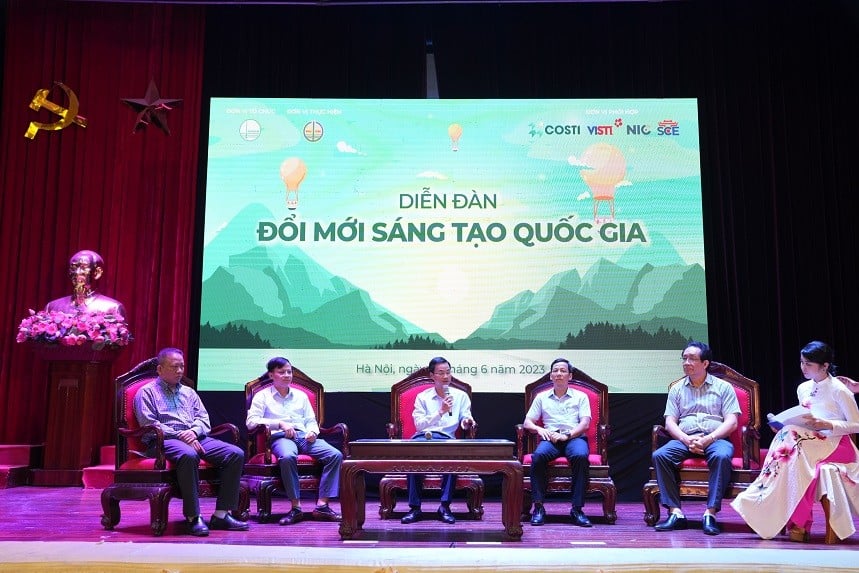 |
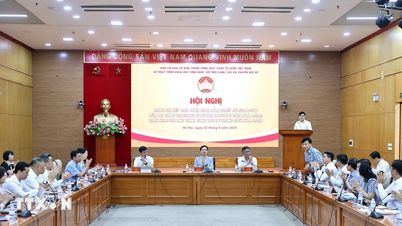
| Speakers participating in the discussion at the Forum. (Source: VNU Hanoi) |
Acknowledging that current training programs at universities do not meet practical needs, Dr. Hoang Quang Phong believes that the IT workforce must possess self-learning abilities and be equipped with the skills to access practical knowledge.
The IT workforce should be streamlined within schools to categorize students for internships and practical training at businesses and organizations, focusing on specialization and concentration. However, we must face the reality in Vietnam: currently, only 17.3% of businesses are considered to operate in high-tech fields. Nevertheless, the Fourth Industrial Revolution can offer many opportunities for rapid growth for small, even micro-sized, businesses if they have good and feasible ideas and strategies.
Dr. Vu Thi Mai Oanh, an expert from the Union of Science and Technology Associations of Ho Chi Minh City, believes that to avoid falling behind developed countries, the digital economy and foundational industries of the Fourth Industrial Revolution must be prioritized. This should not only be a matter of political will but also the participation of the entire society to prioritize resources for innovation. The slower Vietnam is in applying scientific and technological advancements to production and daily life, the greater the risk of falling behind.
To enhance the role of universities and colleges in the startup ecosystem, Dr. Tran Thanh Xuyen and Le Van Trung, working at Hau Giang Community College, argue that the link between schools and businesses must be considered a condition for ensuring the survival and development of both sides.
Strong universities are the source of knowledge and technology for society, providing abundant creative ideas for startup projects, and contributing to the increase of assets and intellectual capacity for businesses. To achieve this, training programs must be regularly updated, with a focus on strengthening subjects related to entrepreneurship.
According to a report by the National Innovation Center (NIC), innovation brings positive impacts to the national economy, contributing up to 95% to the competitiveness of the economy, 66% of the value of innovation will impact people's lives; and 65% of universities and research institutes will participate in innovation activities. It can be said that innovation through science and technology is the key to helping Vietnam overcome the middle-income trap and quickly escape dependence on low technology and natural resources. Therefore, Vietnam is increasingly perfecting the factors that effectively promote innovation. The practical experience of major economies around the world shows that transformations in science and technology and innovation directly change the face of the economy. Therefore, innovation is one of the important indicators and a central guiding principle for the development of each nation. Innovation refers not only to research and development (R&D) activities associated with training and research institutions, or the process of interacting with, using, and creating technology in practice, linked to the role of businesses, but also to related institutions including policy systems, financial institutions, markets, human resources, infrastructure, communication, and other conditions to achieve the goal of improving productivity, product and service quality, perfecting workforce skills, and maximizing socio-economic development efficiency. |
Source





![[Image] Shipbuilders exposed to steel and record-breaking heat.](https://vphoto.vietnam.vn/thumb/1200x675/vietnam/resource/IMAGE/2026/06/04/1780545781745_ndo_br_img-5402-4683-jpg.webp)














































![[Video] Sunset at Lap An Lagoon – Where the sun sets over the fishing nets](https://vphoto.vietnam.vn/thumb/1200x675/vietnam/resource/IMAGE/2026/05/31/1780192137701_beach-landscape-sea-water-nature-grass-745871-pxhere-com.jpeg)






































Comment (0)