


At the National Conference on the Implementation of Resolution 79 on State-Owned Economic Development and Resolution 80 on the Development of Vietnamese Culture (February 25, 2026), General Secretary and President To Lam clearly stated: "Developing the cultural industry so that culture is both the spiritual foundation, the economic resource, and the soft power of the nation." Thus, the development of the cultural industry is no longer solely a matter of art or entertainment, but has become a national development orientation, building the country in a "new development era" with a growth model shifting strongly from extensive to intensive, from exploiting resources to exploiting knowledge, creativity, and cultural soft power.
In the context of globalization, digital transformation, and the creative economy, as the cultural industry develops and culture increasingly becomes a strategic competitive resource, architecture is recognized as a core creative industry, a tool for organizing social life, a foundation of the creative economy, and a means of building national identity.
Architecture - the spatial foundation of the cultural industry
No cultural industry can thrive without suitable architectural spaces. In the past, village communal houses with their courtyards and ponds were the venues for village festivals, traditional opera performances, and water puppetry. In modern times, the film industry needs film studios and urban settings, natural and architectural heritage sites, or distinctive modern architectural structures. Performing arts require squares, theaters, sports stadiums, and public spaces. The night-time economy needs pedestrian streets, waterfronts, and riverbanks. Cultural tourism needs heritage neighborhoods, iconic buildings, and unique landscapes. Creative design needs innovation centers, community workspaces, and creative urban ecosystems. All of this demonstrates that architecture is the physical infrastructure of the cultural industry.
Looking at the world , the most successful cities today are those that know how to harness the power of architecture and cultural spaces. Paris (France) has become the "City of Light," a global symbol not only because of its rich cultural and historical heritage but also thanks to its urban design and distinctive architectural heritage. Bilbao in Spain, once a declining industrial city, has strongly revived thanks to its strategy of developing cultural architecture, with architect Frank Gehry's Guggenheim Museum as a global icon. Singapore builds its national brand based on green cities, futuristic architecture, and high-quality public spaces. South Korea, with Seoul as its center, has developed its creative industries through urban regeneration, restoring the Cheonggyecheon stream and transforming the entertainment industry (K-pop, K-drama, and film) as a tool of soft power communication, bringing the image of South Korea to the world.
For Vietnam, this is a particularly important issue. A country with a history spanning thousands of years, a diverse culture, and unique landscapes has the full potential to develop the cultural industry into a key economic sector. However, achieving this requires proactive governance, distinctive architecture, attractive cultural spaces, and cities that are globally competitive.
According to UNESCO's approach, architecture belongs to the group of creative industries. The core value of architecture lies not only in materials or construction costs but also in creative thinking, knowledge, identity, and the ability to organize living spaces. This means that architecture can directly create significant economic value. A good urban plan can increase land value and urban quality for hundreds of years. An iconic building can create a national brand and attract millions of tourists. A creative neighborhood can become a center for startups and the knowledge economy. An attractive public space can boost commerce, tourism, and the night-time economy.
Following the 14th National Congress of the Communist Party of Vietnam, the country entered a new era of development, accelerating the transformation of its growth model towards a green economy, digital economy, and creative economy. In this context, architecture is no longer merely an "auxiliary industry to construction" but must become a cultural economic sector with high added value. This also demands a fundamental change in societal perception of the architectural profession. Architects are not just designers of houses, but creators of cultural spaces, organizers of community life, and shapers of urban futures.
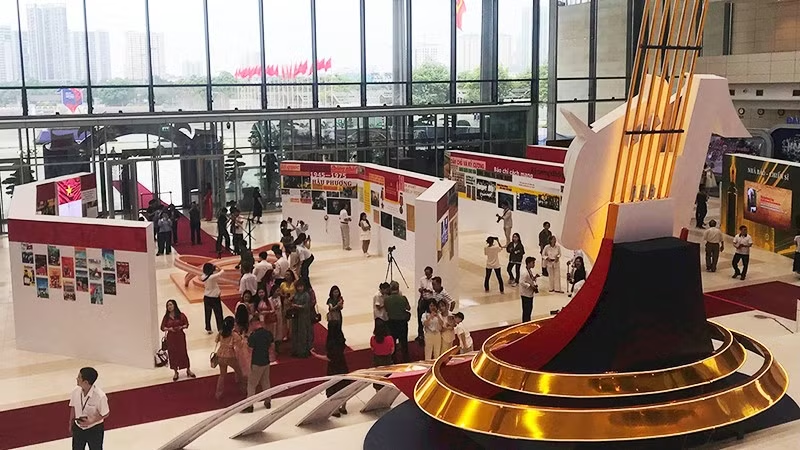
From "architecture design" to "building national soft power"
A nation that wants to successfully develop its cultural industry must have a clear visual identity. National identity cannot be conveyed solely through slogans; it must be expressed through spaces, landscapes, and architecture… This is not just a matter of architecture, but a national strategy.
An architectural style that loses its identity will make a city anonymous, emotionally impoverished, and uncompetitive internationally. Conversely, an architectural style that blends tradition with modernity will create a unique appeal. Vietnam has a great advantage: tropical architecture; village culture; riverside urban structures; diverse natural landscapes; rich natural, cultural, and historical heritage; and abundant indigenous knowledge of climate and materials.
In today's global competitive environment, cultural soft power often has a more lasting impact than economic power. Architecture, therefore, will be an important tool for enhancing a nation's standing.
One of Vietnam's biggest challenges today is that many developing cities lack identity and cultural depth. Many are caught in a cycle of real estate development, concrete construction, and short-term growth. As a result, public spaces are diminishing, heritage sites are encroached upon, natural landscapes are destroyed, many cities become similar, and the quality of urban life is declining.
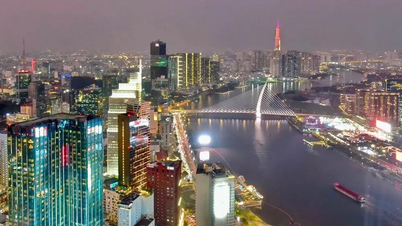
In line with the spirit of the 14th National Congress Resolution of the Communist Party of Vietnam, sustainable development in Vietnam requires a shift from a "rapidly growing urban model" to a "cultural and creative urban model." In this model, architecture plays a central role: transforming old industrial zones into creative spaces, restoring urban waterways, developing squares and public spaces, connecting heritage with modern life, creating cultural corridors, and building new urban symbols. The area around Hoan Kiem Lake in Hanoi is a prime example. It is not only a cultural and historical landscape but also, in essence, a "cultural industrial center" of the capital, a convergence point for tourism, street art, urban memory, pedestrian spaces, cultural commerce, and national historical symbols. If properly planned and managed, spaces like Ho Guom Lake, Ho Tay Lake, and the Red River in Hanoi, or heritage cities like Hue, Hoi An, and Da Lat, could become cultural and industrial centers of Vietnam with international competitiveness and global reach.
The biggest challenge facing Vietnamese architecture today is not a lack of talent, but a lack of a long-term development philosophy. A fundamental shift in development thinking is necessary: Architecture should not only create buildings but also create a quality of life, centered on people, based on culture, limited by ecology, and serving the community as its goal. This is the condition for the sustainable development of the cultural industry, rather than merely commercial entertainment activities.
In conclusion
Developing the cultural industry is not only a cultural goal but also a national development strategy in the era of creative economy and soft power competition. In this strategy, architecture plays a particularly important role because it is the intersection of culture and economy, tradition and modernity, art and technology, national identity and global integration.
And then, architecture will no longer be just the design and construction of buildings, but must become the spatial foundation of the cultural industry; a driving force for urban regeneration, preservation, and enhancement of heritage; a tool for improving the quality of life, a means of building a national brand; a resource for the creative economy, and an expression of Vietnam's soft power.
Source: https://nhandan.vn/xay-nen-mong-kien-truc-cho-cong-nghiep-van-hoa-post961324.html

![[Image] Hanoi's urban life under the challenge of a "scorching hot" environment](https://vphoto.vietnam.vn/thumb/1200x675/vietnam/resource/IMAGE/2026/05/25/1779706979265_nang-nong-t5-2026-minh-duy-7-4636-jpg.webp)



![[Image] Close-up view of the interchange connecting the two expressways and Long Thanh Airport.](https://vphoto.vietnam.vn/thumb/1200x675/vietnam/resource/IMAGE/2026/05/25/1779703378210_ndo_br_z7863716673926-224453a31600126cce10622af6290afd-4549-jpg.webp)












































































Comment (0)