

SGGP
On October 9-10, attending a meeting of the International Monetary Fund (IMF) and the World Bank (WB) in Morocco, financial leaders assessed that the global economy is in a state of profound upheaval due to the consequences of the Covid-19 pandemic and conflicts, most recently the situation in the Middle East.
The Israeli-Hamas conflict, with hundreds killed on each side, is increasing the likelihood of a wider conflict in the Middle East. For central banks, the dilemma is whether the current situation is likely to lead to new inflationary pressures, given that the Middle East is not only home to major oil producers like Iran and Saudi Arabia but also has vital shipping lanes through the Suez Gulf.
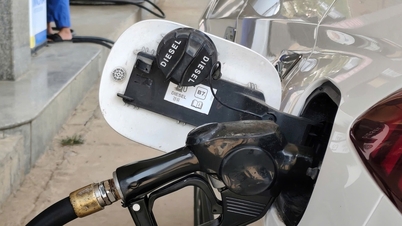
Officials at the US Federal Reserve (FED) have cited recent high energy prices as a potential risk to the outlook for declining inflation. In related developments, on October 9-10, Brent crude oil prices rose 4.18% to $88.76 per barrel; US WTI crude oil prices increased 5.1% to $87.02 per barrel.
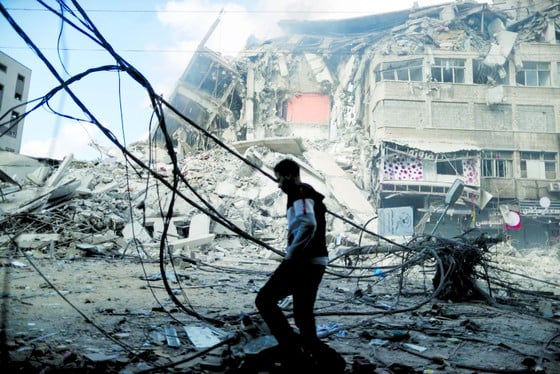 |
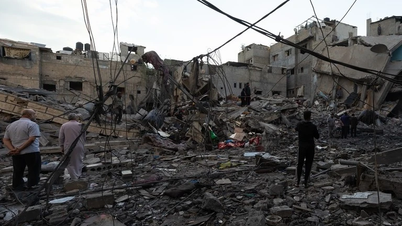
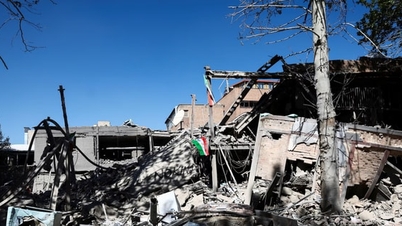
Scenes of devastation in the Gaza Strip |
The US is supporting Israel, and President Joe Biden has assured that the US will release its oil reserves to cool prices if oil prices rise above 10%-12% in order to control inflation in the US. In addition, due to high risks, investors are turning to gold to preserve capital, causing the price of gold to rise 1.1% on October 9th, from $1,849.51 per ounce to $1,863.70 per ounce. According to Karim Basta, chief economist at III Capital Management, the conflict in the Middle East poses risks of higher oil prices and risks to inflation and growth prospects.
Beyond its economic concerns, the United Nations World Food Programme (WFP) issued a statement on October 8 expressing “deep concern” about the impact of the conflict between Israel and Hamas on people struggling to obtain essential food supplies.
The WFP also expressed concern about the quality of goods in food stores and the negative impact of power outages in the Gaza Strip, which continues to face chronic electricity shortages. Referring to Gaza, the statement assessed that although most stores in affected areas of Palestine currently maintain a month's worth of food supplies, there is a risk of "rapid depletion as people buy up food out of fear of prolonged conflict."
The WFP affirmed that it is preparing sufficient food supplies for distribution to displaced people and those living in temporary shelters, and called on "all parties to adhere to the principles of humanitarian law."
- More than 800 Israelis were killed and at least 100 people (of various nationalities) were kidnapped after Hamas forces attacked areas in Israel.
According to Israeli Defense Minister Yoav Gallant, Israel is completely encircling the Gaza Strip. The area, home to 2.3 million people, currently has no electricity, food, water, or gas. The Israeli army has recalled 300,000 soldiers from its reserves in the past 48 hours.
- Thailand is coordinating with several other countries to try to rescue its citizens abducted by Hamas.
- The European Union held an emergency meeting of foreign ministers on October 10th regarding the situation in Israel and the Gaza Strip.
Source


![[Photo] General Secretary and President To Lam presides over a meeting with the Central Organizing Committee.](https://vphoto.vietnam.vn/thumb/1200x675/vietnam/resource/IMAGE/2026/06/03/1780482764658_a1-bnd-4741-3342-jpg.webp)
![[Photo] Secretary of the National Assembly Party Committee, Chairman of the National Assembly presides over the meeting of the Standing Committee and Executive Committee of the National Assembly Party Committee.](https://vphoto.vietnam.vn/thumb/1200x675/vietnam/resource/IMAGE/2026/06/03/1780480353201_ndo_br_bnd-2585-jpg.webp)


















![[Photo] General Secretary and President To Lam attends the 14th Congress of the Vietnam Trade Union](https://vphoto.vietnam.vn/thumb/1200x675/vietnam/resource/IMAGE/2026/06/04/1780543339765_anh-man-hinh-2026-06-04-luc-10-22-07.png)





















![[Video] Sunset at Lap An Lagoon – Where the sun sets over the fishing nets](https://vphoto.vietnam.vn/thumb/1200x675/vietnam/resource/IMAGE/2026/05/31/1780192137701_beach-landscape-sea-water-nature-grass-745871-pxhere-com.jpeg)




![[Photo] General Secretary and President To Lam attends the 14th Congress of the Vietnam Trade Union](https://vphoto.vietnam.vn/thumb/402x226/vietnam/resource/IMAGE/2026/06/04/1780543339765_anh-man-hinh-2026-06-04-luc-10-22-07.png)

























Comment (0)