Announced at the G20 summit in India in September 2023, the ambitious international infrastructure initiative connecting India, the Middle East, and Europe (IMEC Economic Corridor) is seen as both a potential alternative and a direct competitor to China's Belt and Road Initiative (BRI).
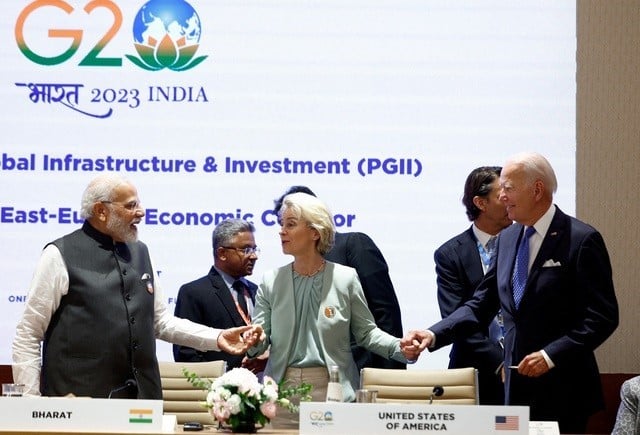 |
| The leaders of India, the EU, and the US at the G20 summit on September 9. (Source: Reuters) |
An ambitious American initiative.
Reportedly, the idea of an India-Middle East-Europe Economic Corridor emerged after US President Joe Biden's visit to Saudi Arabia in July 2022. During the visit, President Biden emphasized the need for deeper regional economic integration.
In the memorandum of understanding to coordinate the implementation of this initiative, Saudi Arabia, the EU, India, the UAE, France, Germany, Italy, and the United States committed to supporting cooperation to establish the IMEC – an economic corridor expected to stimulate economic development through enhanced connectivity and economic integration between Asia, the Arabian Gulf, and Europe.
IMEC is designed with two separate transport corridors, one by land and one by sea. The eastern corridor connects India with the Persian Gulf, and the northern corridor connects the Persian Gulf with Europe.
The IMEC corridor is expected to include a railway line which, once completed, will provide a low-cost cross-border rail-to-rail transport network to complement existing road and sea transport routes – enabling the transport of goods and services to and from India, the UAE, Saudi Arabia, Jordan, Israel, and Europe.
Assessing the IMEC project as having enormous potential, independent global market expert Mikhail Belyaev believes that behind this project is a full-scale effort by the US to keep a region from gradually slipping out of its orbit.
Alexey Kupriyanov, an expert from the Primakov Institute of World Economy and International Relations (IMEMO) of the Russian Academy of Sciences, assesses that the new US effort aims to create an Eurasian belt as a direct competitor to, and alternative to, China's Belt and Road Initiative in the region.
However, since Israel launched attacks on Gaza in retaliation for the October 7 raid by Hamas militants, the region has been in a state of instability, with this fighting becoming the most dangerous of the five wars in Gaza.
Chintamani Mahapatra, founder of the Kalinga Indo-Pacific Institute in New Delhi, said: “We are now facing the risk of this conflict spreading to a wider area, and that is a real challenge for IMEC. In the context of this conflict, there is a risk that the entire idea of IMEC is gradually disappearing.”



The Israel-Hamas conflict serves as a reminder that the IMEC project involves traversing some of the most unstable regions in the Middle East. Analysts suggest that this conflict is a "wake-up call" about the scale of the challenges IMEC will face.
Michael Kugelman, director of the South Asia Institute at the Wilson Center in Washington, commented, “This new war is a wake-up call about how difficult it will be to build new corridors. It’s not just about financial challenges, but also about stability and diplomatic cooperation. The war painfully demonstrates that these elements remain elusive.”
"When the dust settles in West Asia," IMEC will thrive.
When IMEC was announced, Washington's efforts to normalize relations between Saudi Arabia and Israel were progressing, and there was much hope that this would change the long-standing rivalry in the Middle East. A reliable link between Saudi Arabia and Israel was a crucial element of the project.
An agreement between Israel and Saudi Arabia would follow the US-brokered Abraham Accords, which saw Israel establish diplomatic relations with three Arab nations in 2020.
Manoj Joshi, an expert at the Observer Research Foundation (ORF) in New Delhi, stated: “This project was undertaken on the assumption that there would be peace and stability in the region. But even without wider conflict in the coming days and months, the future remains uncertain.”
Joshi pointed out that the project requires billions of dollars in investment, “It involves building 2,000-3,000 km of railway. With the region currently experiencing political instability, the question is, who will invest?”
Analysts suggest that the Western-backed IMEC corridor is not merely intended as a trade route; it has geopolitical motives. The project is seen as a "counterbalance" to China, a country with growing influence in the Middle East.
Expert Kugelman believes the project also aimed to build trust and "political capital" for the normalization of relations between Israel and Saudi Arabia. But "that plan is now 'frozen,' although it could be completed in the future," Kugelman said.
According to this expert, Saudi Arabia and Israel have strong strategic incentives to normalize relations, but for Riyadh, the political cost while Israel is conducting a military campaign in the Gaza Strip is too high.
Meanwhile, New Delhi claims that the ongoing Israel-Hamas conflict will not affect plans for the trade corridor. India, a developing economy, will be one of the main beneficiaries of the proposed route. Indian Prime Minister Narendra Modi has described IMEC as “the cornerstone of world trade for the next hundred years.”



Speaking at the G20 Finance Ministers' meeting in Morocco last week, Indian Finance Minister Nirmala Sitharaman pledged: “IMEC is about the long term. While short-term disruptions may cause us concern and worry, we will continue to cooperate with all stakeholders.”
For New Delhi, the new trade route will reduce shipping costs and accelerate access to markets in the Middle East and Europe. India's relations with countries such as Saudi Arabia, the UAE, Egypt, and Israel have warmed considerably in recent years. Trade with these countries is increasing, while the EU is its third-largest trading partner.
As the Israel-Hamas conflict unfolded, New Delhi reached out to both Israel and Palestine. To demonstrate solidarity with Israel, Prime Minister Modi condemned the Hamas attack as a terrorist act. India also reiterated its long-standing support for the establishment of an independent Palestinian state and sent humanitarian aid to Gaza.
However, even if New Delhi can achieve a balance in its relations with Arab countries and Israel, the future of the project still depends on how relationships between countries in the region will be formed.
Expert Chintamani Mahapatra said: “IMEC will not be buried; I will not write an obituary for it. When the dust settles on West Asia, it may flourish. But in the context of the current intense conflict, it is unlikely to offer a cooperative and positive proposal to the countries involved.”
Source


![[Photo] Prime Minister Le Minh Hung presides over the thematic session on promoting science and technology development and innovation.](https://vphoto.vietnam.vn/thumb/1200x675/vietnam/resource/IMAGE/2026/06/23/1782207872934_ndo_br_dsc-1724-jpg.webp)