

The "4-in-1" model includes: on-site application submission, on-site assessment, on-site approval, and on-site results delivery. This model allows citizens to submit their applications only once at the commune-level Public Administrative Service Center and have them processed immediately if they fall under the commune's jurisdiction. Assessment and approval are conducted at the Center, shortening waiting times. Results are delivered directly at the Center or via public postal services, depending on the citizen's needs.

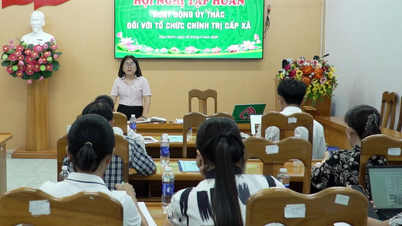
In Kim Bon commune, a mountainous area, immediately after its operation began, the People's Committee of the commune quickly reorganized its structure and personnel, and put the Commune Public Administrative Service Center into operation according to a new model. At the same time, the commune focused on reviewing and fully equipping the center with necessary facilities and information technology infrastructure, ensuring the necessary conditions for its operation. The commune equipped the center with a queue number dispenser, a queue number display screen, QR code boards for administrative procedures, a scanner, and especially upgraded the internet connection and Wi-Fi router to facilitate citizens when carrying out administrative procedures, allowing them to look up information or access the National Public Service Portal to submit applications online.
From October 2025, the Kim Bon Commune Public Administrative Service Center will implement the "4-in-1" model in receiving and resolving administrative procedures. The Commune People's Committee will establish a "4-in-1" process for procedures related to authentication: authentication of copies, authentication of signatures, authentication of loan applications, authentication of civil status records; marriage registration procedures for citizens in the area without requiring verification; registration of new births, deaths, issuance of copies of civil status records, etc. These are simple procedures, with a large volume, and do not require verification at multiple levels, so the Commune People's Committee prioritizes their inclusion in the process.
Mr. Ha Van Giap, Deputy Director of the Kim Bon Commune Public Administrative Service Center, said: "Previously, many documents had to be sent to leaders for signing or reviewed by other departments, which took a lot of time. Now, with procedures included in the '4-in-1' list, the entire process is handled in a closed loop right at the center, without the need to transfer documents to other departments as before. This helps shorten processing time and greatly facilitates people when they come to resolve administrative procedures."

By implementing the "4-in-1" process, Chiềng Sinh ward has invested in a comprehensive system of facilities and IT infrastructure to meet the requirements for processing documents and procedures online; at the same time, it has closely coordinated with the ward police in searching and verifying the population database, ensuring that the information declared by citizens is accurate, correct, and complete.
Regarding human resources, the People's Committee of Chieng Sinh ward has assigned a dedicated judicial officer to appraise documents on-site, submit them for signing, stamping, and delivering the results. Mr. Lo Phong Nam, Chairman of the People's Committee of Chieng Sinh ward, shared: Since implementing the "4-in-1" process, the productivity of handling administrative procedures at the ward's Public Administrative Service Center has significantly improved. The center receives and processes about 50 notarization applications per day, sometimes up to 70 applications. Thanks to the application of the "4-in-1" process, processing time has been shortened, with each application taking only 10-15 minutes to complete.

For Muong Gion commune, the "4-in-1" model, identified by the Commune Public Administrative Service Center, is one of the key solutions to improve service efficiency. The entire process of administrative procedures included in the "4-in-1" list is handled directly at the Center. Officials at the Center are instructed on the reception process, proactively utilizing electronic data, and absolutely do not require citizens to present or submit documents that have already been integrated into VNeID or the system. As a result, administrative procedures are resolved quickly and conveniently.
Ms. Lo Thi Nhung, from Bo Xanh village, Muong Gion commune, said: "The center publicly displays the scan codes for administrative procedures, helping people understand the steps involved in the procedures they are interested in beforehand. In addition, officials are assigned to assist people when they come to complete the procedures. Thanks to this, the process of receiving and resolving procedures is quick and convenient. We are very satisfied with the innovation in the service methods of the commune government."
It can be affirmed that the "4-in-1" model has contributed to overcoming delays, buck-passing, avoidance, and reducing inconvenience, harassment, and negative practices in the process of resolving administrative procedures for citizens and businesses. All task assignment files are processed on software, helping to assess the level of task completion of each department and individual. When delays occur, it is easy to trace and identify responsibility. This, in turn, enhances the accountability of officials and civil servants in the departments and units assigned to handle administrative procedures.
With the motto "fast - open - transparent - serving the people," the "4-in-1" model is a breakthrough in the transformation towards a service-oriented spirit of local government at both levels. This creates a strong shift in mindset, awareness, and work style, contributing to the acceleration of administrative procedure reform and the building of a government that is close to and serves the people.
Source: https://baosonla.vn/cai-cach-hanh-chinh/-4-tai-cho-trong-cai-cach-thu-tuc-hanh-chinh-Nelgh3oDg.html
![[Image] Close-up view of the interchange connecting the two expressways and Long Thanh Airport.](https://vphoto.vietnam.vn/thumb/1200x675/vietnam/resource/IMAGE/2026/05/25/1779703378210_ndo_br_z7863716673926-224453a31600126cce10622af6290afd-4549-jpg.webp)

![[Image] Hanoi's urban life under the challenge of a "scorching hot" environment](https://vphoto.vietnam.vn/thumb/1200x675/vietnam/resource/IMAGE/2026/05/25/1779706979265_nang-nong-t5-2026-minh-duy-7-4636-jpg.webp)















































































Comment (0)