

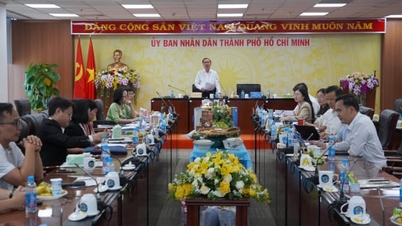
At the scientific conference on solutions to promote AI application in energy management held on December 17th, the picture of the carbon credit market in Ho Chi Minh City was painted with vibrant colors.
The race to "green" is becoming increasingly fierce.
Ms. Nguyen Thi Kim Ngoc, Deputy Director of the Ho Chi Minh City Department of Industry and Trade, stated that in the context of Vietnam's efforts to fulfill its Net Zero commitment by 2050, the pressure for green transformation on the business community is irreversible.
In reality, regulations on the use of clean energy and the reduction of greenhouse gas emissions are no longer just slogans but have been codified into law through concrete actions. Ho Chi Minh City, as the economic powerhouse, is witnessing a strong shift in production thinking.
Statistics show that, in just a few years of development, approximately 600 businesses in the city have officially joined the carbon credit market. This is an impressive number, reflecting the urgent need for greenhouse gas inventory and the development of emission reduction roadmaps. However, the challenge is how to achieve this goal with the lowest cost and highest efficiency? The answer is gradually being found in technology, especially Artificial Intelligence (AI).

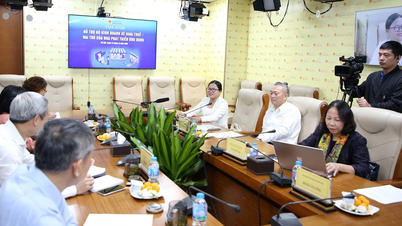
Delegates exchange views on the sidelines of the workshop (Photo: Ngoc Minh).
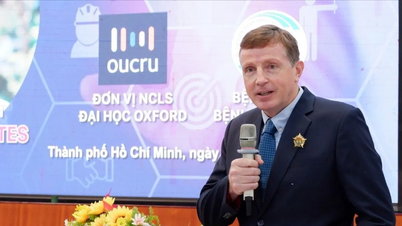
In the digital age, "dual transformation"—a combination of digital transformation and green transformation—is becoming an inevitable trend. Dr. Le Cong Luong, Deputy Secretary General of the Vietnam Union of Science and Technology Associations , noted that AI is no longer limited to superficial applications but has become a strategic tool in energy management.
According to Dr. Luong, AI's ability to process big data opens up unprecedented opportunities. Specifically, this technology helps businesses accurately forecast energy demand and supply, thereby minimizing losses during system operation. More importantly, AI supports the efficient integration of renewable energy sources into the power grid, helping businesses meet the stringent inventory requirements under Decree 06/2022/ND-CP and Decision 13/2024/QD-TTg.
"Promoting AI applications in the energy sector is not simply a technological issue, but an economic one. It's a driving force for businesses to enhance their competitiveness, save operating costs, and integrate more deeply into the global supply chain – where green standards are becoming mandatory technical barriers," Dr. Luong emphasized.

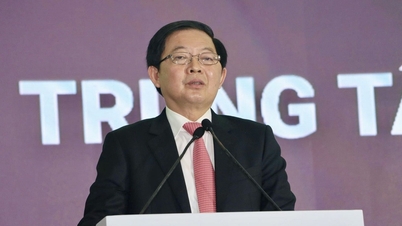
Dr. Le Cong Luong, Deputy Secretary General of the Vietnam Union of Science and Technology Associations, speaks at the workshop (Photo: Ngoc Minh).
Solving the cost and emission hotspot problem.
Delving into practical applications, experts at the workshop shared many successful models. Notably, these included the use of AI in aeration control in factory wastewater treatment systems, and the application of AI in monitoring N2O emissions in urban wastewater treatment.
Mr. Ta Quang Kien, Director of the Center for Quality Certification and Business Development, further analyzed the role of data. According to him, AI and digital platforms allow businesses to promptly identify major emission "hot spots." Instead of waiting for delayed periodic reports, managers can implement immediate adjustments to optimize energy consumption.
Furthermore, in the circular economy model, AI plays a crucial role in promoting the reuse and recycling of waste and the utilization of by-products. This helps reduce indirect emissions, conserve resources, and lessen pressure on the environment.
"It can be affirmed that AI is not just a supporting tool but a core foundation of the emission reduction process. Investing in the right direction in technology will help businesses proactively adapt to the potentially lucrative yet challenging carbon market, while simultaneously realizing their commitment to long-term sustainable development," Mr. Kien concluded.
Source: https://dantri.com.vn/kinh-doanh/600-doanh-nghiep-tphcm-dung-ai-san-tin-chi-carbon-huong-toi-net-zero-20251217220053331.htm


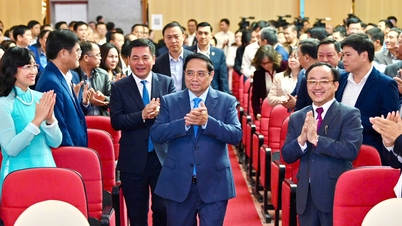
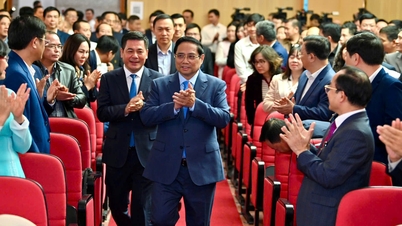
![[Photo] Prime Minister Pham Minh Chinh attends the Conference on the Implementation of Tasks for 2026 of the Industry and Trade Sector](/_next/image?url=https%3A%2F%2Fvphoto.vietnam.vn%2Fthumb%2F1200x675%2Fvietnam%2Fresource%2FIMAGE%2F2025%2F12%2F19%2F1766159500458_ndo_br_shared31-jpg.webp&w=3840&q=75)















































































Comment (0)