

Five public universities and four private schools achieved revenues of 1 trillion VND or more, with several other schools approaching this level.
At the beginning of the 2023-2024 academic year, most universities publicly disclosed their 2022 finances through the three-part disclosure report as stipulated by the Ministry of Education and Training , annual reports, or admissions plans.
Nine universities have trillion-VND revenue, an increase of four compared to the 2020 figures reported by the Ministry of Education and Training. These include five public universities: Hanoi University of Science and Technology, Ho Chi Minh City University of Economics, Ton Duc Thang University, National Economics University, and Can Tho University. The four private universities are Van Lang University,FPT University , Nguyen Tat Thanh University, and Ho Chi Minh City University of Technology.
Among these nine higher education institutions, Van Lang University had the largest total revenue with 1,758 billion VND. Next was the University of Economics Ho Chi Minh City with over 1,443 billion VND.
FPT University achieved nearly 1.3 trillion VND last year. The National Economics University has not yet released official figures but estimates it will reach 1.061 trillion VND. Last year, the university achieved over 1.087 trillion VND.
Many universities have revenues approaching one trillion VND, including Ho Chi Minh City University of Medicine and Pharmacy (985 billion VND), Hoa Sen University (over 918 billion VND), Hong Bang International University (886 billion VND), Ho Chi Minh City University of Technology and Education (785 billion VND), Hanoi University of Industry (over 751 billion VND), and Foreign Trade University (over 750 billion VND).
Universities' revenue comes from four sources: budget, tuition and fees, scientific research and technology transfer, and other sources (funding from businesses, philanthropists, etc.). A common feature of universities is that tuition fees contribute the largest proportion of total revenue.
At Ton Duc Thang University, tuition fees account for approximately 90.3% of total revenue. This figure is 79.5% at Hanoi University of Science and Technology and 66.6% at Ho Chi Minh City University of Economics.
For private schools, this rate is even higher due to the lack of government funding. For example, at Nguyen Tat Thanh University, tuition fees account for 98.2%.
High overall revenue enables universities to develop their faculty, infrastructure, and facilities, increase faculty income, and improve the quality of training and research.
Regarding lecturers' income, according to the Ministry of Education and Training's report for the period 2018-2021, the percentage of lecturers earning over 200 million VND per year increased from 19.4% to 31.34%, and those earning 300 million VND or more increased from 0.75% to 5.97%.
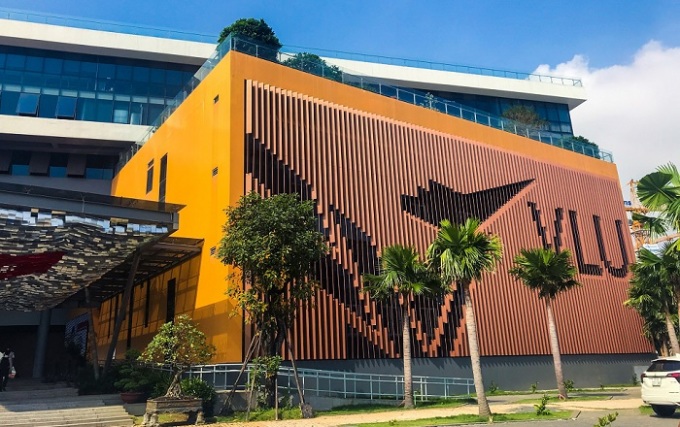
A view of the Van Lang University campus. Photo: Van Lang University Facebook page.
"High revenue for universities is a very good thing. However, if that high revenue is largely dependent on tuition fees and is due to continuous tuition fee increases, it's a bad sign," observed Dr. Le Viet Khuyen, Vice President of the Association of Vietnamese Universities and Colleges.
Reporting at a conference on university autonomy in April, a team of World Bank experts presented figures on household contributions to higher education after surveying several universities.
The results show that in 2017, the state budget accounted for 24% of the total revenue of the surveyed public schools; student contributions (tuition fees) accounted for 57%. However, by 2021, tuition fees accounted for up to 77%, while the state budget only accounted for 9%.
Public universities are increasingly reliant on tuition fees for revenue, given the low budget allocated to higher education (approximately 0.27% of GDP in 2020). This contrasts sharply with countries that have developed higher education systems.
Furthermore, in countries like the United States and New Zealand, many schools generate substantial revenue from social activities, businesses, philanthropists, scientific research, and technology transfer.
"It would be a positive sign if universities' revenue from this activity increased," Mr. Khuyen said.
This expert also argued that universities should not arbitrarily increase tuition fees solely for revenue, but should base them on the average income of the population, avoiding creating inequality in access to higher education for students from disadvantaged backgrounds.
Mr. Khuyen emphasized that improving quality is not solely about having more money, but also about leveraging combined strengths, from the school's governance mechanisms to the efficient allocation of budgets.
As of August 2022, 141 out of 232 universities nationwide met the criteria for autonomy as stipulated in the Law on Higher Education. Depending on the level of autonomy, these universities experience partial or complete cuts in budget investment, resulting in tuition fees accounting for 50-90% of total revenue.
Source link
![[Image] A night of light, many layers of message](https://vphoto.vietnam.vn/thumb/1200x675/vietnam/resource/IMAGE/2026/03/10/1773158812907_hoa-nhac9-jpg.webp)











































































































Comment (0)