

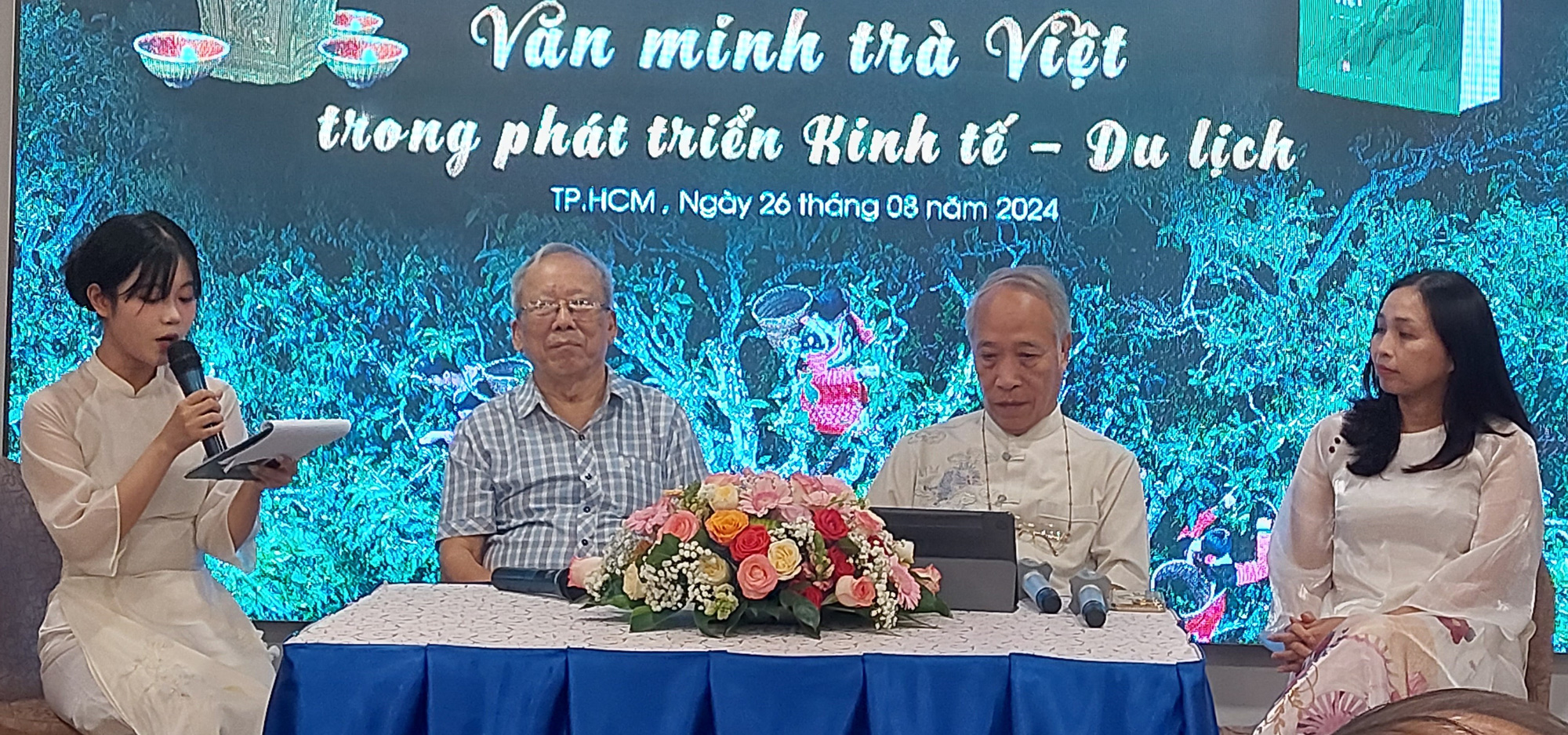
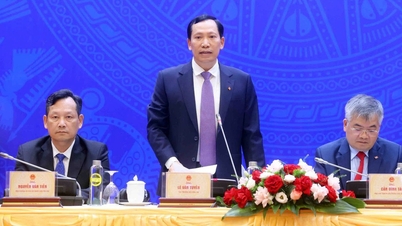
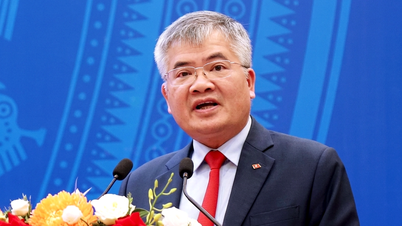
Guests participating in the seminar "Vietnamese Tea Civilization in Economic and Tourism Development" - Photo: HOANG LE
The seminar took place in Ho Chi Minh City on August 26th. Over approximately three hours, the guests raised numerous issues surrounding Vietnamese tea: from its origins and economics to, especially, its cultural and tourism aspects.
At times, the atmosphere of the seminar heated up with debates as viewpoints on Vietnamese tea differed. However, ultimately, these opinions all aimed at finding ways to elevate the millennia-old culture of Vietnamese tea.
Vietnam is the cradle of tea in the world.
Researcher Trinh Quang Dung once again provides many details in his book, "Vietnamese Tea Civilization ," to affirm that Vietnam is the first cradle of tea cultivation in the world.
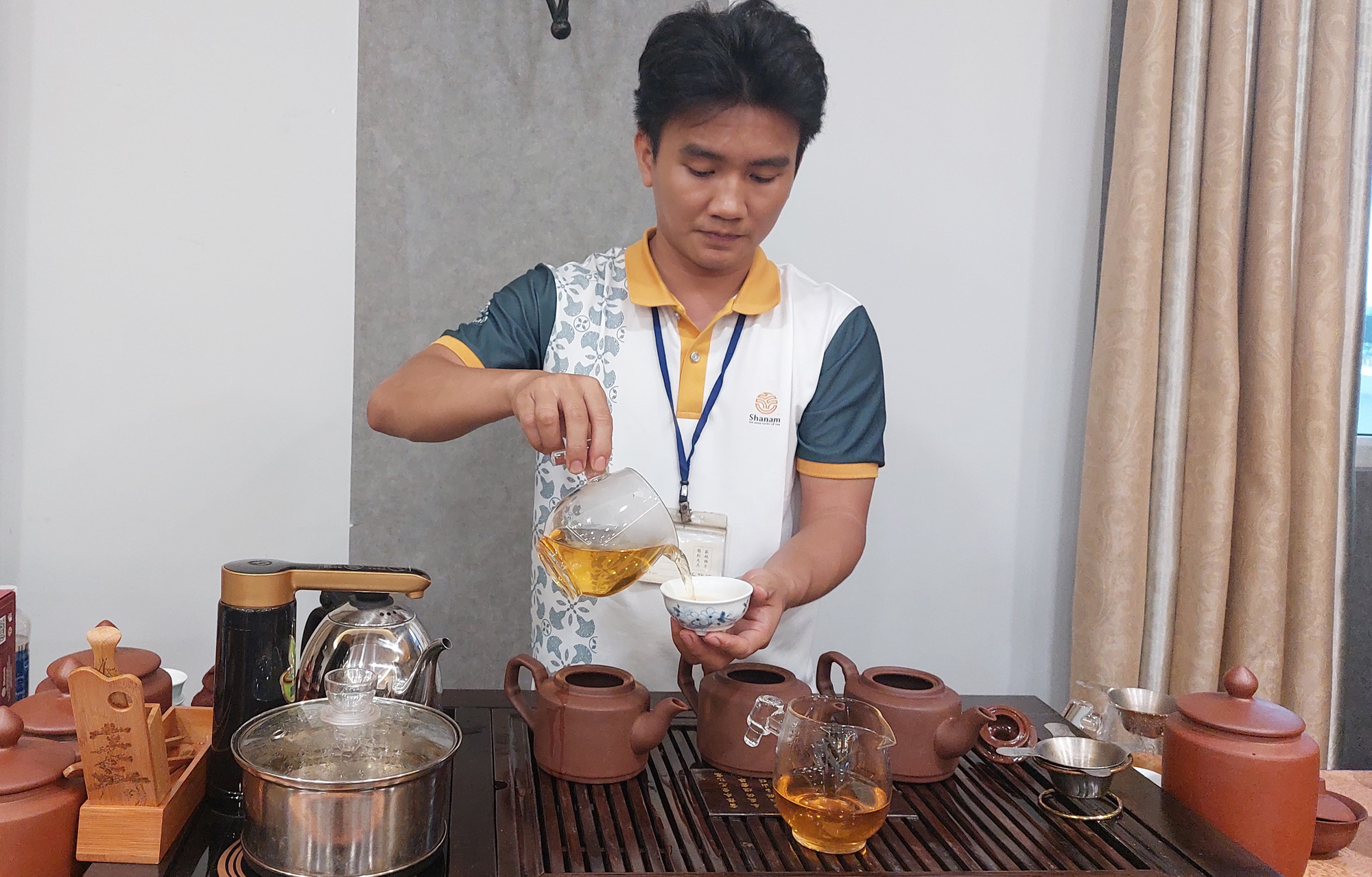
Preparing Vietnamese tea - Photo: HOANG LE
Regarding the precious ancient tea trees, Mr. Pham Vu Khanh, representing a tea company in the northern mountainous region, stated that Vietnam accounts for two-thirds of the world's tea plantation area, with a total of 20,000 hectares of ancient tea forests, potentially yielding hundreds of thousands of tons of tea.
This provides a good foundation for promoting the export of traditional teas, bringing high economic efficiency. And beyond the economic aspect, Vietnamese tea also carries a strong cultural imprint.
"Why is Chinese tea so expensive, and its taste doesn't suit Vietnamese palates, yet somehow everyone who goes to a tea shop buys it as a gift?"
"When tourists buy tea, they are buying the culture of their country," shared Ms. Nguyen Thi Tham, director of a tea company.
She recounted, "If China has tea kungfu, and Japan has the tea ceremony, then what is Vietnamese tea? I spent two years searching for the answer."
Ultimately, I think there's no need for a specific name because it's a thousand-year-old, repeated habit of the Vietnamese people. People may not see it, but everyone feels it in their hearts."
Ms. Tham continued with another example: "Our company once opened a free tea shop with the aim of seeing what people in the capital thought about Vietnamese tea. I thought the customers would mostly be elderly people. But the reality was completely the opposite."
Young people are the ones who come in the most. I realize that they all have a deep-seated understanding of Vietnamese tea culture, but they've forgotten it. When it's brought back to them, they'll remember. That's the seed of culture. As long as they're Vietnamese, they'll know about Vietnamese tea."
Vietnamese tea has not received enough attention.
Tea culture is the essence of our nation; how can we spread this culture to everyone?
Mr. Trinh Quang Dung happily said: "Initially, the organizing committee suggested adding bottled water to serve everyone."
I suggest we completely replace bottled water with tea. Drinking tea is a sophisticated choice. Scientific analyses also prove that drinking tea is beneficial to health, so why shouldn't we drink it?
According to Mr. Dung, in addition to the tea itself being of higher quality, the tea utensils also need to be given attention.
"We need a competitive strategy to ensure Vietnamese tea, consumed using Vietnamese teaware, competes with imported teaware."
Tea sets must bear the imprint of Vietnamese culture and history.
Regarding tourism development, modern homestays could be built on the vast and beautiful tea hills. I've seen this kind of thing many times in several provinces and cities," he suggested.
Mr. Dung recounted that in 2022, when he went to China, he saw a 200-meter-long banner that read: "The 21st Century - The Century of Chinese Tea."
In other countries, they promote their tea in such a way, while in Vietnam's agricultural development plan, tea is not given a prominent position, ranking behind rice, corn, and potatoes, which is regrettable.
"Let's do a calculation: 1 kg of rice sells for 20,000 dong. Meanwhile, 1 kg of tea sells for millions of dong, and even rare, antique teas can fetch tens of millions of dong per kg."
"Yet tea plants still haven't received the attention they deserve," he stated frankly.
"Vietnamese Tea Civilization in Economic and Tourism Development" is the first seminar in a series of seminars on tea organized by the Vietnam Culinary Culture Association in collaboration with tea businesses.
The seminar featured speakers and researchers Trinh Quang Dung - author of the book "Vietnamese Tea Civilization" ; Professor Nguyen Duy Thinh - former head of the Food Technology Department at Hanoi University of Science and Technology, a long-time expert in consulting and installing equipment in the tea industry; and Ms. Nguyen Thi Tham - director of Tay Bac Tea and Specialty Products Co., Ltd.
Four more seminars are planned, exploring different aspects of tea such as spreading Vietnamese tea culture abroad, the uses of tea, tea and European pastries, and the art of tea ceremony.
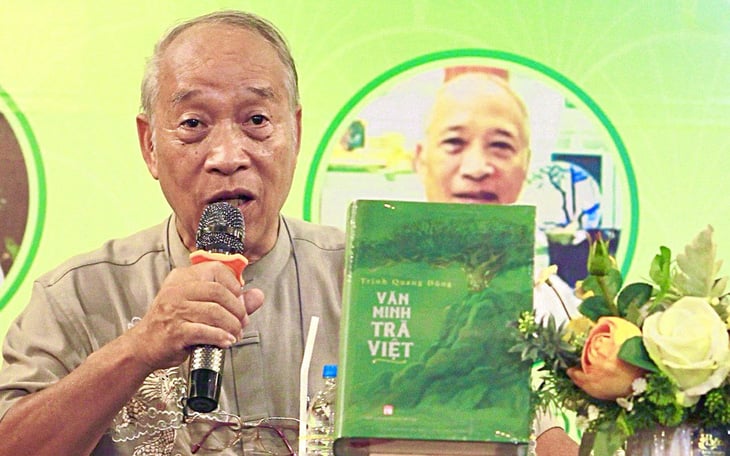 A Thousand Years of Vietnamese Tea Civilization
Source: https://tuoitre.vn/ai-cung-uong-tra-nhung-may-ai-hieu-van-hoa-tra-viet-20240826205743406.htm

![[Image] Nearly 125,000 Hanoi students completed the Literature exam for the 10th grade entrance exam.](https://vphoto.vietnam.vn/thumb/1200x675/vietnam/resource/IMAGE/2026/05/30/1780117233041_ndo_br_thiet-ke-chua-co-ten-2-png.webp)









































































Comment (0)