

Using cameras and sensors, AI-controlled drones outperform human pilots as they navigate obstacle courses at high speeds.
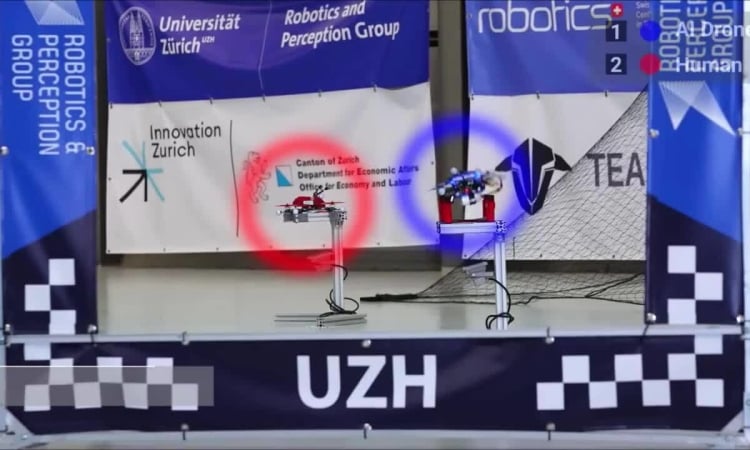
AI-controlled drones race against human-controlled drones. Video : UZH
The Swift automated system beat three professional drone pilots in 15 out of 25 races on a circuitous track filled with curves and obstacles designed by a professional drone racer, Science Alert reported on August 31. The system combines AI algorithms with a camera and multiple integrated sensors to detect the surrounding environment and the drone's movement.
Swift was designed by Elia Kaufmann, a robotics engineer at the University of Zurich, and researchers at Intel Labs. They aimed for a system that wouldn't rely on input data from external moving cameras, unlike previous autonomous racing drones.
"Reaching professional pilot status with autonomous drones is a challenge because it needs to fly within its physical limits, while estimating speed and position on the track using only the sensors it has," the research team said.
Pilots wear special goggles that provide a "first-person" perspective (as if sitting inside the drone) through a camera mounted on the drone. The drone can reach speeds of 100 km/h.
Similarly, Swift has a built-in camera and inertial sensor to measure the drone's acceleration and rotation. This data is then analyzed by two AI algorithms to determine the drone's position relative to obstacles and issue corresponding control commands.
Despite losing 40% of the races, Swift beat the pilot on numerous occasions and achieved the fastest race time ever recorded, half a second faster than the best human time.
"Overall, on average across the entire race, the autonomous drone achieved the highest average speed, found the shortest route, and successfully maintained its operational state close to its limits throughout the race," Kaufmann and his colleagues stated.
According to Guido de Croon, a robotics researcher at Delft University of Technology in the Netherlands, Swift's real innovation lies in its second-generation artificial neural network, which utilizes deep reinforcement learning. Swift isn't the first drone system capable of flying over obstacles, but it does so with exceptional precision. The new research was published in the journal Nature.
Thu Thao (According to Science Alert )
Source link






















![[INFOGRAPHIC] Ugreen FineTrack 2 Soccer Design](https://vphoto.vietnam.vn/thumb/402x226/vietnam/resource/IMAGE/2026/05/25/1779680273219_info-bongdinhvi-a-thumb-jpg.webp)
















































































Comment (0)