

According to GearRice , AMD's Zen 4C architecture targets the ultrabook market. With two new CPUs, the Ryzen 5 7545U and Ryzen 3 7440U, AMD promises to leverage the full advantages of Intel's big.LITTLE technology without any drawbacks.

The new architecture will be fully compatible with AMD's future mobile gaming devices.
AMD also revealed that this new architecture has been implemented in the Asus ROG Ally Z1, which launched a few weeks ago. It will be fully compatible with the Ryzen-powered mobile gaming PCs that AMD will introduce in the future.
The biggest advantage of this architecture lies in the Zen 4C core, which is 35% smaller than the Zen 4 core. According to AMD, these new cores deliver the same number of instructions per cycle (IPC) but reduce power consumption to below 15W. Their smaller size also allows for more instructions on the integrated circuit.
Zen 4 cores perform better with power consumption above 20W, offering higher peak frequencies and optimization for single-threaded tasks. AMD claims the two cores are identical in instruction sets, caches, and even latency.
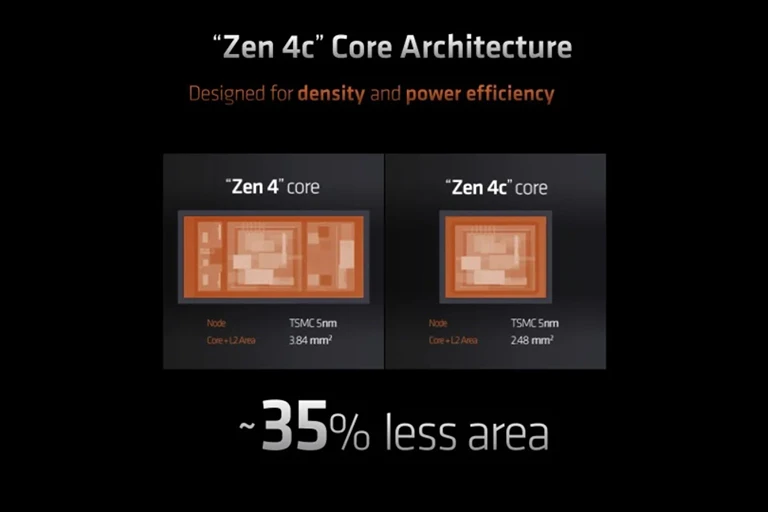
The Zen 4C is smaller than the Zen 4.
The appearance of Zen 4C shows that AMD's target is Intel's hybrid processor architecture – the company introduced high-performance cores combined with low-power cores starting with the 12th generation Core CPUs (Alder Lake), with fundamental differences between the two types of cores.
With Zen 4C, AMD doesn't differentiate between the two types of cores, as both offer the same level of performance at the same frequency. Furthermore, unlike Intel and Thread Director, AMD uses only the operating system's scheduler to automatically assign a specific task to a specific core.
Currently, AMD is integrating this new architecture into its ultrabook processors, the Ryzen 5 7545U and Ryzen 3 7440U, and it's highly likely the company will roll it out to its remaining products in 2024.
Source link















































































































Comment (0)