

According to Mr. Le Minh Son, Director of the Ca Mau Provincial Museum, the province's biggest challenge lies not in a lack of resources but in its ability to transform heritage values into experiential products that meet public needs.
The provincial museum, which houses and displays artifacts and documents reflecting the history of the formation and development of the southernmost region, is considered the local "treasure trove of memories." However, its exhibition space is not truly attractive, and it lacks a large-scale antique exhibition area. Many valuable artifacts remain in storage and have not been widely showcased. The application of technology in exhibitions is still limited compared to modern museum trends.
Mr. Do Van Nghiep, Chairman of the History Club of the Provincial Museum, shared: "Promoting historical knowledge through relics and artifacts is of great importance, contributing to bringing new awareness and a new vision to present and future generations. Therefore, the Provincial Museum needs to be comprehensively renovated to become a place where the past is told in a vivid and accessible way."
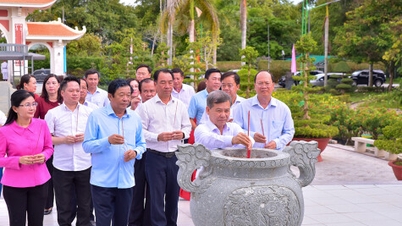
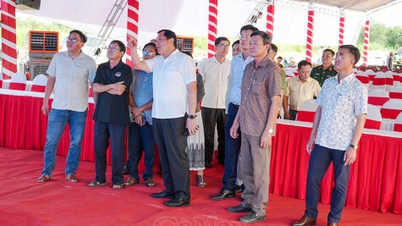
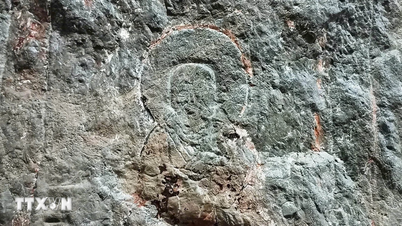
 Provincial leaders visited the cluster of reliefs at the Temple of the 10 heroic martyrs of the Hon Khoai uprising.
According to experts, in the context of the booming development of experiential tourism , historical sites should not only be exhibition spaces but also become cultural and historical educational spaces where tourists can interact, explore, and gain a deeper understanding of local identity.
Journalist, artist, and Master of Arts Nguyen Kim Phien, Director of the UNESCO Center for the Preservation of Vietnamese Fine Arts and Cultural Heritage, emphasized that historical sites wishing to attract visitors need to innovate their display methods, enhance experiential activities and historical education, especially targeting students.
Lack of connectivity and promotion hinders tourism development.
Many historical and cultural relics in the province have not been effectively exploited for tourism development. These include: the National Historical Monument of the Wire House and Hong Anh Bookstore (An Xuyen ward), the Provincial Party Committee Base at Xeo Duoc (Phu My commune), the Lung La - Nha The Provincial Party Committee Base (Luong The Tran commune), the evidence of American-puppet regime crimes at the Hai Yen - Binh Hung Special Zone (Phu Tan commune), and the Memorial Area of Folk Artist Nguyen Long Phi (Uncle Ba Phi, Khanh Hung commune)... These are all valuable sites, but the number of visitors remains limited.
Many locals say that tourists visiting Ca Mau mainly focus on popular eco-tourism destinations such as Dat Mui, Hon Da Bac, and wind farms, while historical and cultural sites are less well-known. Furthermore, some sites lack stable opening hours, and information is limited, making them difficult to access even for locals.
Along with limited promotion and introduction efforts, monotonous exhibition content, and a lack of interaction that fails to meet the increasingly sophisticated experiential needs of tourists, the historical sites in Ca Mau are scattered, with many located far from the center, and the transportation and service infrastructure is not yet developed synchronously. The linking of these sites into tour routes has not been effective, resulting in the resources not being transformed into an attractive itinerary.
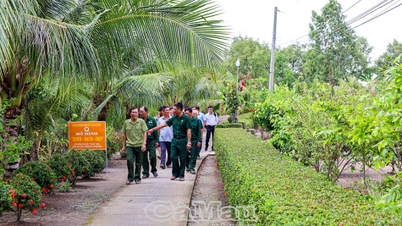
 Armed forces personnel visited and learned about the history of the Hai Yen - Binh Hung Special Zone (Phu Tan commune).
Furthermore, investment resources for the restoration and expansion of historical sites are modest. The application of technology in exhibitions and promotion has not met requirements, directly affecting the accessibility for tourists. In addition, the human resources serving at the sites are limited, not adequately and professionally staffed, leading to infrequent visitor receptions...
If properly planned and organized, these historical sites could become important "pieces" in the province's tourism landscape. According to Mr. Le Minh Son, first and foremost, a change in perception and approach is needed: heritage is not only an object of preservation but also a resource for development. When the perspective changes, the approach must also change, from preservation to responsible exploitation.
Therefore, the current difficulties need to be resolved soon so that cultural and historical relics in Ca Mau can truly become attractive destinations, contributing to the promotion of tourism and socio-economic development of the locality.
Hoang Vu
Lesson 2: Unlocking and Spreading Values
Source: https://baocamau.vn/danh-thuc-di-san-a127580.html
![[Photo] The courage of new recruits of Brigade 144 on the training ground.](https://vphoto.vietnam.vn/thumb/1200x675/vietnam/resource/IMAGE/2026/05/27/1779881651341_anh-man-hinh-2026-05-27-luc-18-32-52.png)

![[Photo] The heat at the fireworks display site on the opening night of the Da Nang International Fireworks Festival 2026](https://vphoto.vietnam.vn/thumb/1200x675/vietnam/resource/IMAGE/2026/05/27/1779889741485_ndo_br_z7872039145157-fecaba5112f39e8352544099d7ef4738-5140-jpg.webp)





































![[Photo] The courage of new recruits of Brigade 144 on the training ground.](https://vphoto.vietnam.vn/thumb/402x226/vietnam/resource/IMAGE/2026/05/27/1779881651341_anh-man-hinh-2026-05-27-luc-18-32-52.png)


















Comment (0)