

 |
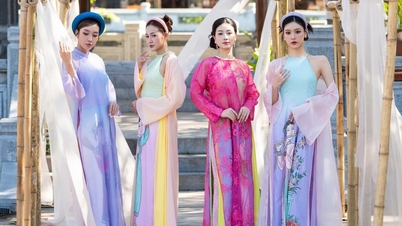
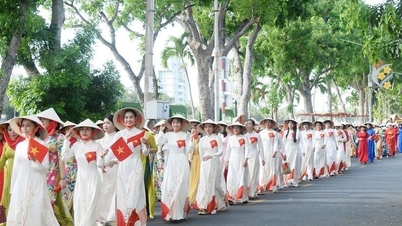
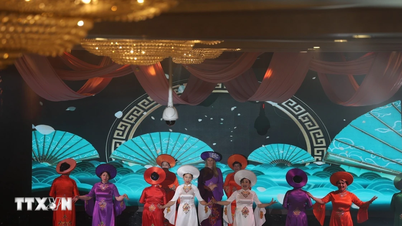
| The children of Lam Ty Ni school are dressed up in their beautiful ao dai (traditional Vietnamese dress). |
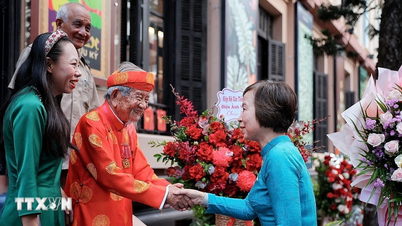
One spring morning, the garden of the Song Huong Ancient Pottery Museum, facing the Perfume River, was more vibrant than usual as it welcomed 50 six-year-old children dressed in traditional ao dai. The meeting was organized to meet the practical learning needs of the students. At Lam Ty Ni Kindergarten, the project-based learning method is implemented throughout.
Recently, the two senior classes, Understanding and Tolerance, participated in the projects "Nhat Binh Tells Stories" and "The Beauty of Hue in the Ao Dai." Through these projects, many questions arose from the students regarding the history, structure, and meaning of traditional clothing.
Sharing about this activity, Ms. Ho Thi Ngoc Huyen said: “After each project, the children have the opportunity to meet with experts to summarize and answer questions. Based on suggestions from the school's management board, the children discussed and arranged for today's meeting. The exchange took place in a friendly atmosphere, creating conditions for the children to ask questions and express their thoughts.”
From the very beginning, the atmosphere was lively. Amidst the children's enthusiasm, Mrs. Thai Kim Lan cheerfully said, "Remember to ask me only easy questions!" But following that witty remark came a series of questions, natural yet insightful.
“Why does the ao dai have two panels?”, “Where did the ao dai originate?”, “The Nhat Binh ao dai dates back to 1807, right?”, “Why are there standing collars and round collars?”…
The questions reflect the students' observation and interest in traditional clothing.
In response to the students' questions, Ms. Thai Kim Lan explained that the ao dai (Vietnamese traditional dress) originated during the time of Lord Nguyen Phuc Khoat around 1740, when this garment was shaped based on the physique and daily needs of the Vietnamese people.
She also explained the five-panel ao dai, which consists of two front panels, two back panels, and a small inner panel. Accordingly, the two front panels symbolize the parents, the two back panels symbolize the parents of the spouse, and the remaining panel is for the wearer themselves, representing family unity.
The five buttons represent five moral qualities: humanity, propriety, righteousness, wisdom, and trustworthiness. These elements contribute to the cultural value of the ao dai in Vietnamese life.
Beyond its symbolic meaning, Ms. Lan also explained the practicality of the ao dai. The two-panel design with slits on both sides allows the wearer to move and work easily, making it suitable for daily life. From carrying water and selling goods to farming, the ao dai ensures flexibility without losing its graceful appearance.
Throughout the meeting, the children listened attentively, occasionally discussing with each other the points that had just been answered.
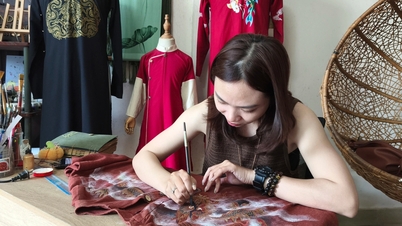
Sharing her thoughts on her dedication to cultural research, Ms. Thai Kim Lan said that from a young age, her family taught her about the way of life and the importance of preserving traditions. This has also motivated her to continue researching and passing on cultural values to future generations.
To conclude the heartwarming conversation, the children presented the grandmother with a special gift: a traditional Vietnamese dress (áo dài) made entirely of paper by themselves. From drawing the outline based on the wearer's figure to gluing scraps of paper to create the design, they recreated the áo dài in their own unique way. The circles symbolized the sky, the squares symbolized the earth, and they also demonstrated their environmental awareness through the reuse of materials.
Upon receiving the gift, Mrs. Lan couldn't hide her emotion. She shared: "What surprised me was that the children, despite their young age, had such inquisitive questions, even those related to history. However, for children, the important thing isn't memorizing knowledge, but feeling it."
According to her, when a child wears an ao dai (traditional Vietnamese dress), the first thing that remains is the feeling of softness, the gentle sound of their footsteps, the tenderness, and familiarity. These experiences are the initial foundation for forming a sense of cultural identity.
"Encouraging children to wear the ao dai (traditional Vietnamese dress) from preschool age is very meaningful. When the love for the ao dai begins voluntarily, from the sensations of the senses, children will naturally see it as a part of themselves when they grow up, rather than something imposed upon them," she said.
The gathering concluded in a warm atmosphere. The young women in their traditional ao dai dresses left the garden, carrying with them their first understandings and experiences of a familiar cultural value.
Source: https://huengaynay.vn/van-hoa-nghe-thuat/ao-dai-trong-mat-tre-tho-164399.html

![[Photo] The heat at the fireworks display site on the opening night of the Da Nang International Fireworks Festival 2026](https://vphoto.vietnam.vn/thumb/1200x675/vietnam/resource/IMAGE/2026/05/27/1779889741485_ndo_br_z7872039145157-fecaba5112f39e8352544099d7ef4738-5140-jpg.webp)
![[Photo] The courage of new recruits of Brigade 144 on the training ground.](https://vphoto.vietnam.vn/thumb/1200x675/vietnam/resource/IMAGE/2026/05/27/1779881651341_anh-man-hinh-2026-05-27-luc-18-32-52.png)





































![[Photo] The courage of new recruits of Brigade 144 on the training ground.](https://vphoto.vietnam.vn/thumb/402x226/vietnam/resource/IMAGE/2026/05/27/1779881651341_anh-man-hinh-2026-05-27-luc-18-32-52.png)





















Comment (0)