


According to the law, the State will implement market regulation measures if real estate prices increase by more than 20% within a three-month period or in cases of exceptional market fluctuations. These regulation measures are specifically stipulated in the 2024 Law on Real Estate Business and its implementing decree.
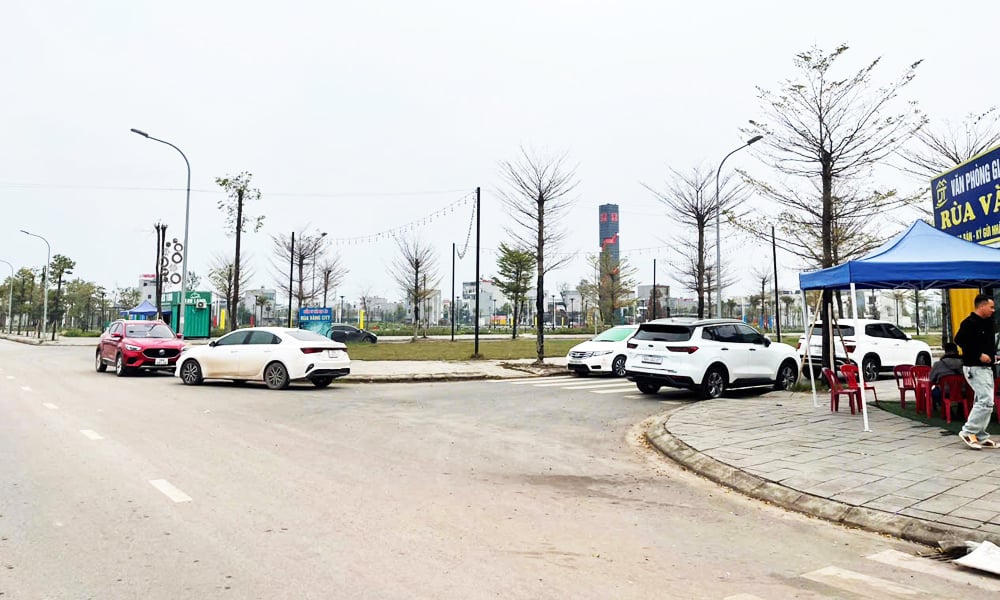 |
Land prices in the new urban area west of Voi town (Lang Giang district) once surged when there was news of administrative boundary reorganization. |
From a market management perspective, the recent surge in localized real estate activity is a matter of concern for state management agencies, which will take necessary actions to promptly understand and regulate supply and demand if needed. In terms of practical impact, the reported 30% increase in real estate transaction values in some areas will directly affect two groups: Firstly, real estate projects in the area will be partially impacted when used as a reference for calculating land use fees. Secondly, people with genuine housing needs will find it more difficult to access land for construction.
Localized real estate price surges can negatively impact the market. Regulators need to understand and regulate these situations to facilitate project implementation for investors and ensure affordable housing for the public. Therefore, verifying activities to ensure accuracy and transparency is crucial, and price manipulation and other forms of price gouging must be prevented and severely punished.
Currently, only a few real estate brokerage firms operate in a well-organized manner, while the majority are still individual brokers practicing independently. Therefore, the market is easily swayed by speculative trends and lacks transparency regarding products such as legal status, progress, and actual market potential. Many individuals spread rumors about trends on paper and collectively disseminate inaccurate information.
Recently, there have been numerous rumors about administrative boundary mergers, leading independent consultants to reinforce customers' belief in a new, well-invested, and modern capital city, thereby generating interest and boosting transactions. These are opaque practices in real estate brokerage. Creating such impacts also negatively affects those who engage in these practices, as they have lost the trust of their customers.
| Developing the real estate market requires professionalism from the four stakeholders: the government, investors, distributors, and consumers. To curb speculative bubbles, focus should be placed on professionalizing the distribution team. Secondary investors, on the other hand, need to accurately identify the growth potential of the real estate market and avoid rushing into investments based on herd mentality while neglecting fundamental legal factors. |
To develop the real estate market, professionalism is needed from four key players: the State, investors, distributors, and consumers. Currently, distributors (real estate exchanges and brokerage firms) are crucial components, contributing to the smooth flow of the real estate market. The law clearly stipulates the need for transparency and openness in real estate transactions. Therefore, if sales are professionalized through distributors on exchanges or brokerage firms, the market will be able to filter out price manipulation and artificial price surges.
In response to this situation, the Real Estate Association is intensifying its efforts to educate and guide its members to actively learn and research legal regulations in order to operate more professionally. In the coming period, the Association will develop a training plan for its members on regulations, support them in registering for real estate trading floor licenses, and facilitate the posting of brokerage information, etc. Simultaneously, state management agencies need to conduct specific inspections and verifications of fluctuations; assess and forecast these fluctuations; and effectively advise on solutions to regulate supply and demand. Measures exceeding their authority can be proposed to the Government and the National Assembly for implementation.
The core reason for creating artificial price surges and market manipulation is primarily due to the unprofessional nature of the distributors (among the four main components). In reality, most local distributors do not have the necessary operating licenses as required by the 2023 Real Estate Business Law; only a few brokerage firms publish their operational information on the state management agency's portal. Promoting the formal and professional operation of this component will give investors confidence in entrusting their products to distributors, creating opportunities for growth.
Recognizing this, for many years, the Provincial Real Estate Association has consistently built a strong membership, strengthened connections, and promoted activities. On the part of state management agencies, attention should be paid to managing investors and distributors to ensure they fully comply with legal regulations in their investment, business, capital mobilization, and investment activities.
To curb speculative bubbles, focus should be placed on professionalizing the distribution network, including real estate exchanges and brokerage firms. From another perspective, managing land use responsibility also needs attention, as this is a crucial and effective tool to curb speculation. The law stipulates that land users must use the land for its intended purpose within specific timeframes. Therefore, the early issuance of regulations governing this aspect is essential.
Secondary investors need to accurately identify the growth potential of real estate through accurate information, practical knowledge, and the guidance of professional and reputable brokers. They should avoid investing hastily based on herd mentality, disregard fundamental legal factors, and not be swayed by superficial prospects. Transactions must comply with all applicable laws and regulations regarding taxes, fees, etc.
Source: https://baobacgiang.vn/ngan-chan-sot-dat-ao-postid415375.bbg
![[Photo] National Assembly Chairman Tran Thanh Man working with the Hai Phong City Election Committee](https://vphoto.vietnam.vn/thumb/1200x675/vietnam/resource/IMAGE/2026/02/26/1772103806795_ndo_br_bnd-8224-jpg.webp)
![[Photo] National Assembly Chairman Tran Thanh Man inspects election preparations in Hai Phong city.](https://vphoto.vietnam.vn/thumb/1200x675/vietnam/resource/IMAGE/2026/02/26/1772095420401_ndo_br_bnd-8016-jpg.webp)
![[Photo] Thousands of tourists visit the Quang Trung Emperor Temple in Nghe An during the early spring season.](https://vphoto.vietnam.vn/thumb/1200x675/vietnam/resource/IMAGE/2026/02/26/1772095410680_img-9305-3882-jpg.webp)



























































Comment (0)