


The allure of the Ruc people
Even now, having settled in the Ruc Lan valley, cultivating their own rice and gradually adapting to civilized life, some Ruc people, especially the elderly, still fondly remember the forest, particularly the caves that were once their homes.
Ms. Cao Thi Hau (70 years old), currently living in Luong Nang village, Kim Dien commune, is one of the last Ruc people born in a cave. When the Border Guard and the local government discovered and persuaded the Ruc people to leave the cave, Ms. Hau was not yet 10 years old. Even so, for her, the memories (and habits) of a "hunting and gathering" life with survival skills in the jungle remain deeply ingrained in her mind.
More than half a century has passed, and despite all the changes in life, Mrs. Hau still fondly remembers the never-extinguishing fire in the cave, where she and her sisters gathered, waiting for their parents to return after their foraging trips through the forest and streams. It was also by that warm fire that their father told them legendary stories about their people. He also taught them indigenous knowledge and basic survival skills of the Ruc people in the deep, dark jungle.
|
Ms. Cao Thi Hau and director Truong Minh Quy in Doha (Qatar) - Photo: Provided by the interviewee. |

According to Ms. Hau, although the lives of the Ruc people have changed considerably, fortunately, they have preserved their unique and mysterious customs and cultural identity. In their spiritual beliefs, the Ruc people do not worship the dead but only the mountain and forest spirits. For them, when people die, they return to the forest and mountains, so they only worship mountain and forest spirits.
Currently, within the Ruc community, two very mysterious forms of magic still exist that other ethnic groups do not possess: the magic of "blowing to tighten" and "blowing to loosen," and the magic of "vaporization." The magic of "blowing to tighten" is used to stop a woman from giving birth, and "blowing to loosen" is used to allow her to give birth again.
Furthermore, the "vaporization" ritual possesses mystical powers that the Ruc people use to ward off wild animals and protect their community. In addition, some Ruc people, like Mrs. Hau, know how to use hundreds of types of medicinal herbs from the forest to make medicine and save lives.
In terms of agricultural production, the Ruc people now know how to cultivate wet rice, plant forests, grow cassava, sow corn, and raise buffalo, cattle, pigs, chickens, and ducks to obtain food for their daily meals. However, in modern life, they still frequently go into the forest to dig up wild yams, collect wild rice flour, set traps to hunt forest rats, or catch snails on rocky outcrops and in streams to supplement their diet. These things obtained from "Mother Forest" are not simply food, but also represent their identity and memories, ensuring that the Ruc people do not forget their origins.
With so many mysteries surrounding them, the Ruc people are ranked internationally as one of the top 10 most mysterious ethnic groups in the world. Over time, they have been an inexhaustible subject of media attention. The Ruc people have also begun to attract scientists and filmmakers to study and explore them; including director Truong Minh Quy and filmmakers from Ho Chi Minh City.
"Speed, Paper, and Water"
Truong Minh Quy (born 1990), from Dak Lak , is one of the most prominent and representative young directors of independent cinema in Vietnam today. His films often blur the lines between documentary and fiction, between reality and fantasy. Many of his works have garnered acclaim and won major awards at prestigious international film festivals.
Director Truong Minh Quy said that it was the life with many "mysteries" of the Ruc people that attracted him and his colleagues to spend three years "living and eating" with the people to produce the documentary film titled "Hair, Paper and Water," which is 71 minutes long.
|
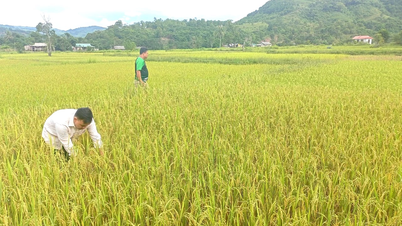
Hoa Son Valley (Kim Dien) where Ms. Cao Thi Hau and the Ruc community live - Photo: PP |

The film tells the story of the family of Ms. Cao Thi Hau, one of the last Ruc people born in a cave. Joining Ms. Hau are three other Ruc actors: Cao Thi Hieu (Ms. Hau's sister); Cao Xuan Doanh (Ms. Hieu's son); and Cao Thi Bat (Ms. Hau's cousin). The work is a reflection on cultural change, memory, and the connection between people and their roots (the cave) in the context of modernization.
The film "Hair, Paper, and Water" is a subtle blend of documentary language and poetic, thought-provoking cinematic style. Throughout the film, there are interweaving scenes of memories and the present of Ms. Cao Thi Hau, along with three Ruc actors.
“Hair, Paper and Water” had its global premiere at the 78th Locarno International Film Festival in August 2025. There, the film won the Golden Leopard award in the Contemporary Filmmaker category and the Pardo Verde special award (an award honoring films that contribute to environmental awareness or the relationship between humans and nature).
The Locarno Film Festival is one of the world's oldest and most prestigious film events, held annually in August in Locarno, Switzerland. The festival's highest award is the "Golden Leopard," given to the best film in the international competition category. Thus, by winning the "Golden Leopard," director Truong Minh Quy has added another important milestone for Vietnamese cinema at Locarno, continuing the success of filmmakers like Pham Ngoc Lan and Bui Thac Chuyen at this prestigious festival.
The film was subsequently selected to participate in several prestigious international film festivals around the world and received high praise from the international film community. Through "Hair, Paper, and Water," the images of the colorful and mysterious life of the Ruc people in the past and present, as well as the majestic natural landscapes of Phong Nha-Ke Bang, attracted positive reception from audiences at the festival venues.
Recently, from November 16-26, 2025, when the film was screened in Doha (Qatar), director Truong Minh Quy and the film crew invited actress Cao Thi Hau to participate. This was the first time Ms. Hau, a Ruc woman born in a cave, had the opportunity to "travel abroad" and visit one of the world's wealthiest and most luxurious cities. This is likely an unforgettable experience for Ms. Hau, but it is also the most vivid evidence of the Ruc community's integration into the civilized world.
Thus, the screening of "Hair, Paper, and Water" at prestigious international film festivals and its winning of the most prestigious awards has contributed significantly to promoting the image and people of the Ruc ethnic group to the world. From their caves deep within the mountains and forests, the Ruc people have now firmly integrated into civilized life. It is certain that they and their still mysterious way of life will attract more and more international tourists to Quang Tri.
Phan Phuong
Source: https://baoquangtri.vn/van-hoa/202602/bao-vang-cua-nguoi-ruc-1a45016/

![[Photo] Prime Minister Pham Minh Chinh presides over the meeting of the Steering Committee for the Development of Science, Technology, Innovation, Digital Transformation and Project 06.](https://vphoto.vietnam.vn/thumb/1200x675/vietnam/resource/IMAGE/2026/02/25/1772024613089_1772024091685-jpg.webp)
![[Photo] Prime Minister Pham Minh Chinh receives the Director General of TASS News Agency (Russian Federation)](https://vphoto.vietnam.vn/thumb/1200x675/vietnam/resource/IMAGE/2026/02/25/1772024599891_dsc-8041-jpg.webp)












































![[Photo] Lung Phinh is covered in white plum blossoms.](https://vphoto.vietnam.vn/thumb/402x226/vietnam/resource/IMAGE/2026/02/25/1772036291497_tl-z7563533595318-d0f6815e01d4b292632a5f65d005af7d-8745-jpg.webp)











Comment (0)