

 |
Chinese tourists wearing kimonos visit Sensoji Temple in Asakusa Ward, Tokyo, Japan, in November 2025. Photo: The Japan Times . |
Following their victory over Vietnam U23 in the Asian U23 semi-finals on January 20th, China advanced to the final to face Japan. While the football field witnessed a clash between the two nations, bilateral tourism was clearly being impacted by recent tensions.
Anxiety
In November 2025, following controversial remarks by Japanese Prime Minister Sanae Takaichi, the Chinese government urged its citizens to limit travel to Japan, Nikkei reported.
According to the Japan National Tourism Organization (JNTO), the number of Chinese tourists visiting Japan in December 2025 decreased by approximately 45% compared to the same period last year.
The Nikkei Shimbun newspaper noted that the sharp decline in the Chinese market is casting a shadow of "unease" over the prospects of Japan's tourism industry, especially since it used to be a major source of spending tourists.
Analysts are concerned that the prolonged decline in Chinese tourist flows could have a long-term impact on Japan's growth. The country's population continues to decline, at a time when tourism is seen as a crucial pillar for compensating for labor shortages and stimulating the economy , according to the Global Times .
| NUMBER OF CHINESE TOURISTS TO JAPAN IN THE YEARS 2019-2025 | ||||||||
| Source: Japan's Ministry of Land, Infrastructure, Transport and Tourism | ||||||||
| Label | 2019 | 2020 | 2021 (Covid-19) | 2022 | 2023 | 2024 | 2025 | |
| Number of visitors | Million views | 9.59 | 1.07 | 0.04 | 0.19 | 2.42 | 6.98 | 7 |
According to Honichi Lab, a Japanese inbound market research platform, JTB travel group stated in its 2026 trend forecast report that the number of tourists to Japan is likely to decrease due to a significant weakening of demand from mainland China and Hong Kong (China).
Specifically, bookings from Chinese tourists for the 2026 Lunar New Year holiday are only 50% of what they were the previous year , while the figure for the Hong Kong market is only 10%.
The Hokkaido region, in particular, continues to attract a certain number of individual travelers, despite a sharp decline in group tours.
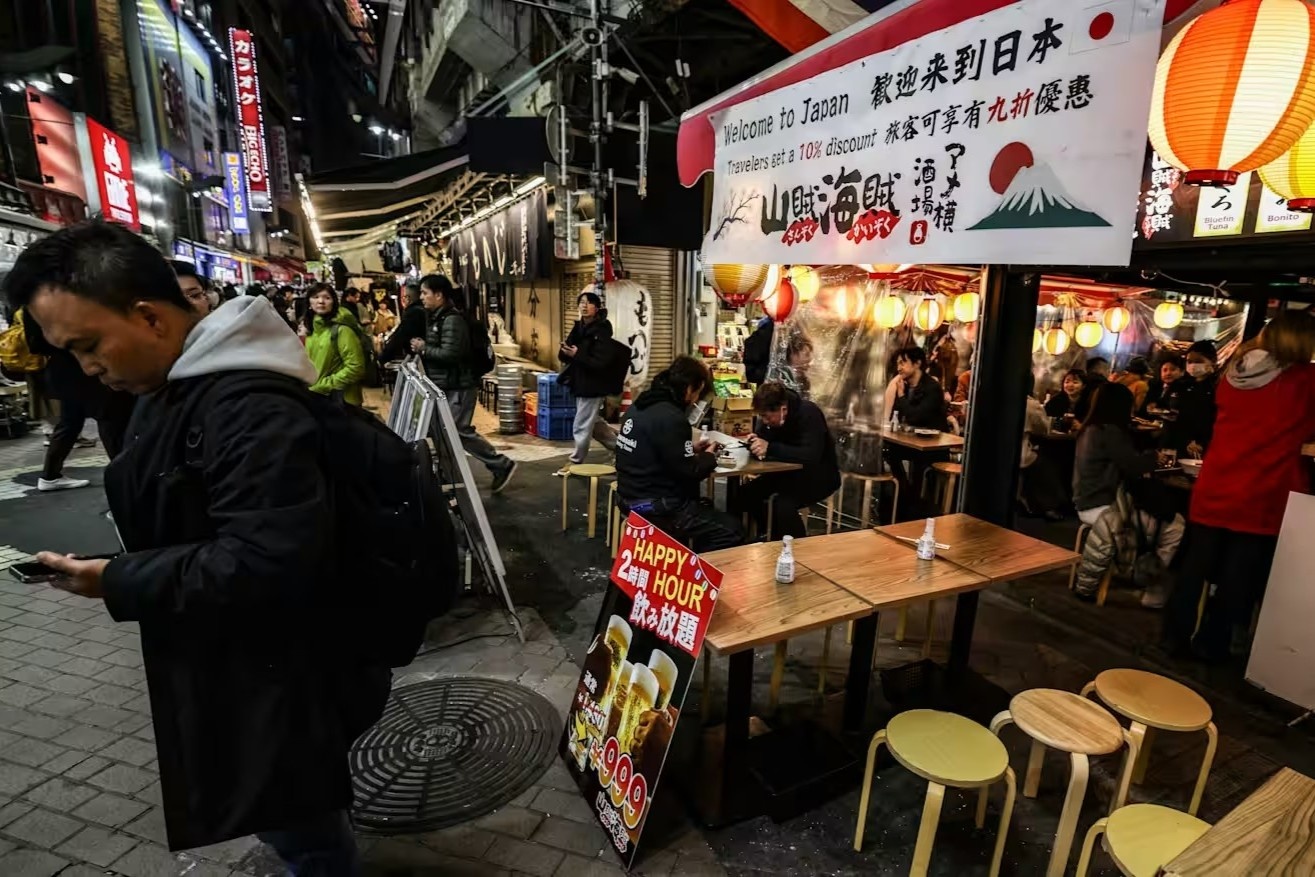 |
Business at bars and restaurants in Tokyo, which are popular with Chinese tourists, nearly came to a standstill in December 2025. Photo: Yuki Kohara. |
Japanese media reported that cities like Takayama (Gifu Prefecture) and Aichi Prefecture saw a decline in retail sales due to fewer Chinese tourists.
A confectionery shop in Takayama reported a 20% drop in sales. Meanwhile, in Kyoto and Kanazawa, hotel room prices have begun to fall due to declining demand.
Preliminary balance of payments figures for November 2025, released by Japan's Ministry of Finance, show a tourism surplus of 452.4 billion yen, a 19% decrease compared to the same period last year.
According to Nikkei , this surplus has decreased for six consecutive months, clearly reflecting the impact of the slowdown in Chinese tourist flows amid ongoing bilateral tensions.
"Although the number of visitors from China has decreased, we have received a large number of tourists from other markets, enough to offset this decline," said Japan's Minister of Land, Infrastructure, Transport and Tourism, Yasushi Kaneko.
He said Japan will continue its efforts to attract Chinese tourists back as soon as possible.
 |
Tourists walk through an underground shopping mall in Asakusa, Tokyo, on November 16, 2025. Photo: VCG. |
Record
Japan's Ministry of Land, Infrastructure, Transport and Tourism announced that the number of international visitors to the country in 2025 has exceeded 40 million . This is the first time this figure has been recorded, setting a new record for Japan's tourism industry.
Minister Kaneko described surpassing the 40 million visitor mark as "a major achievement" as Japan aims to welcome 60 million international visitors by 2030.
He noted that the number of visitors from Asia has increased compared to the pre-pandemic period. The significant growth from Europe, the US, and Australia shows that the international visitor market to Japan is becoming increasingly diversified.
| NUMBER OF INTERNATIONAL VISITORS TO JAPAN 2010-2025 | |||||||||||||||||
| Source: Japan's Ministry of Land, Infrastructure, Transport and Tourism | |||||||||||||||||
| Label | 2010 | 2011 | 2012 | 2013 | 2014 | 2015 | 2016 | 2017 | 2018 | 2019 | 2020 | 2021 (Covid-19) | 2022 | 2023 | 2024 | 2025 | |
| Number of visitors | Million views | 8.61 | 6.21 | 8.36 | 10.4 | 13.41 | 19.74 | 24.3 | 28.7 | 31.19 | 31.9 | 4.11 | 0 | 3.83 | July 25th | 36.87 | 42.7 |
However, according to forecasts released by JTB, the number of international visitors to Japan in 2026 could fall to 41.4 million.
JTB believes the rapid recovery in travel demand has passed its peak and growth is expected to slow down. Amid declining demand from mainland China and Hong Kong, 2026 is projected to see year-on-year declines.
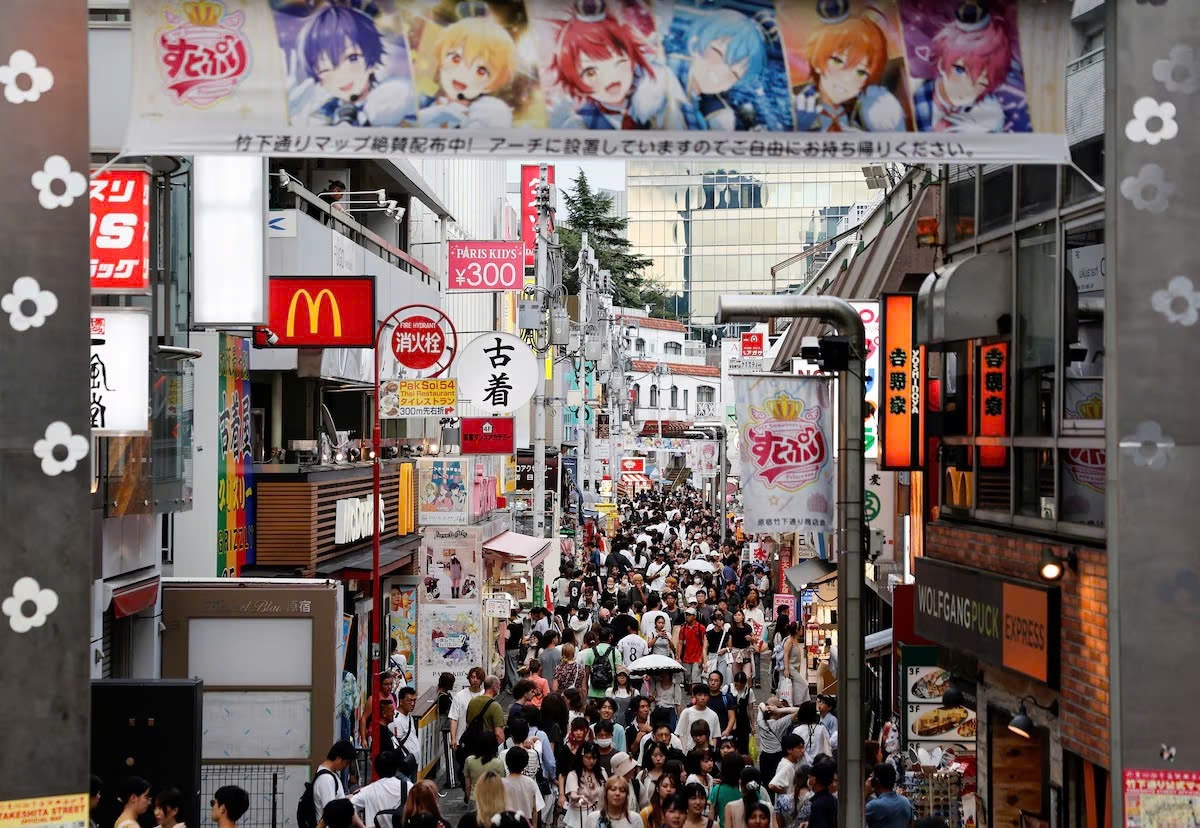 |
Tourists walk along Takeshita Street in the Harajuku shopping district of Tokyo, Japan, in 2024. Photo: Reuters. |
Minister Kaneko was cautious when discussing market prospects, stating that he did not want to give a specific forecast yet, as the number of international visitors is affected by various factors.
He emphasized that Japan will continue to promote tourism from various markets, attracting high-spending tourists. The tourism industry will also address issues related to overcrowding, aiming for sustainable tourism development.
Source: https://znews.vn/bat-an-cua-nhat-ban-khi-khach-trung-quoc-quay-lung-post1621460.html


![[Image] Hanoi's urban life under the challenge of a "scorching hot" environment](https://vphoto.vietnam.vn/thumb/1200x675/vietnam/resource/IMAGE/2026/05/25/1779706979265_nang-nong-t5-2026-minh-duy-7-4636-jpg.webp)

![[Image] Close-up view of the interchange connecting the two expressways and Long Thanh Airport.](https://vphoto.vietnam.vn/thumb/1200x675/vietnam/resource/IMAGE/2026/05/25/1779703378210_ndo_br_z7863716673926-224453a31600126cce10622af6290afd-4549-jpg.webp)
























































































Comment (0)