

In Nghe An province, people in Yen Thanh district go into the forest to catch black spiders with yellow stripes to sell to traders who export them to China as a snack, earning nearly 200,000 VND a day.
In mid-August, Tran Thi Hien, 43 years old, and two neighbors sat in the yard of their house in Lang Cau hamlet, Lang Thanh commune, Yen Thanh district, sorting spiders they had just caught from the forest.
Wearing plastic gloves, three women separate spiders, about the size of their little finger and index finger, into two different categories and put them into nylon bags and large plastic containers to sell to traders. This is a seasonal job for people in the area every autumn.
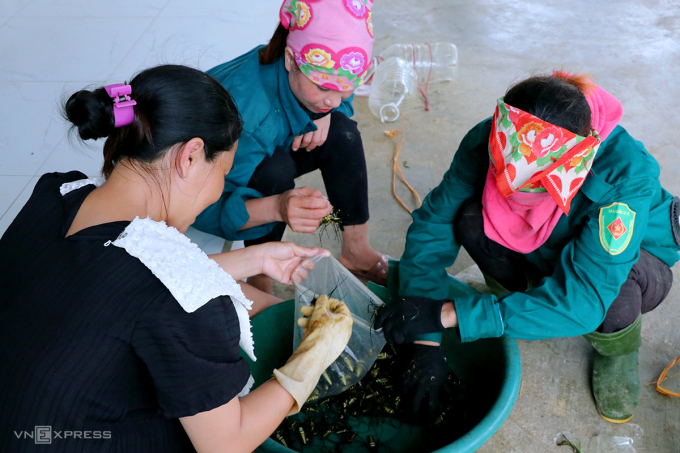
Residents of Lang Thanh commune sort spiders they caught from the forest. Photo: Hung Le
Ms. Hien works in the fields, and after the harvest season, she plants and strips bark from acacia trees for forest owners in the commune, earning over 300,000 dong a day. During this time, on rainy days, she takes nylon bags, small sacks, plastic containers, and a one-meter-long bamboo pole into the forest in Lang Thanh commune to catch spiders spinning webs on the branches of acacia trees.
These spiders have black bodies with yellow stripes, measuring over 2 cm in length and 1 cm in width, with multiple legs. They live in clusters under bee farms in acacia and eucalyptus forests. Local people call this animal the "devil-faced spider" because of its bizarre appearance. About four years ago, no one dared to catch them because they thought the spiders were venomous and feared they would attack and harm their health.
At this time of year, spiders are in their egg-laying season, and when prepared as a dish, they have a rich and savory flavor, so people focus on catching them for about 2-3 months. Whenever she goes into the forest, Ms. Hien uses a long pole, over a meter long, to reach up to the tall melaleuca trees, knock the spiders down to the ground, and then catch them. On average, a lucky person can catch more than a kilogram a day, or at least 500 grams, earning between 150,000 and 200,000 dong from selling them.
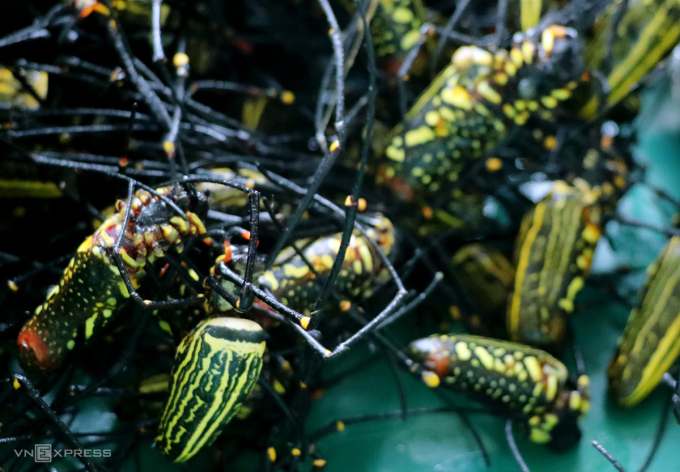
Black spiders with yellow stripes are sold for processing into food. Photo: Hung Le
"Spiders move slowly, so you just need to be quick and alert to catch them. However, people have to wear gloves for protection, because their bites are quite painful. The bites aren't venomous, but they swell up and take a few days to heal," Ms. Hien said, adding that catching spiders is quite hard and dangerous due to the rugged mountainous terrain, sometimes resulting in falls and injuries, but it also provides money to support one's life.
Ms. Nguyen Thi Ngoc, 33 years old, a trader in Lang Thanh commune, said that spiders as thick as an index finger are bought at 300,000 VND per kilogram, with prices below that of 100,000 VND. Transactions are bustling in the late afternoon, with more than 10 people coming to buy goods each day. On average, Ms. Ngoc collects 600 kg of spiders per season.
Ms. Ngoc stores the collected spiders in the refrigerator. After about 2-3 days, once she has gathered enough, her husband drives the truck carrying the plastic bags and sacks containing the spiders to Thanh Hoa to supply to dealers who then export them to China as a snack.
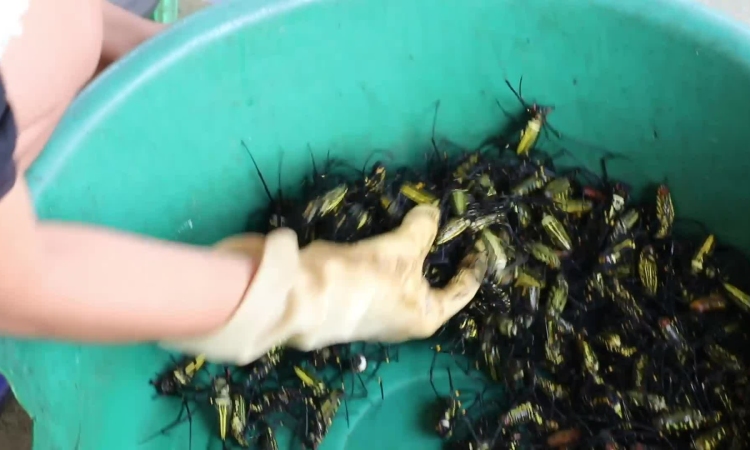
Classification of forest spiders. Video : Hung Le
"Preparing spiders is quite simple. Just remove the silk sacs from their abdomens, wash them thoroughly, and fry them until crispy. You can also season them and roast them with lime leaves. Dishes made from spiders are always considered a delicacy. Before shipping them to partners, I usually keep a few for myself," Ms. Ngoc said.
Mr. Nguyen Trong Huong, Director of the Agricultural Services Center of Yen Thanh district, said that people catching spiders to sell is due to word-of-mouth. Regarding state management, no agency has yet issued any directive or regulation prohibiting the catching of this species.
"However, we advise against catching spiders for food. Spiders are a link in the ecosystem; while they can be harmful, they can also be beneficial. Furthermore, plants and animals in nature are very diverse, and many plants and animals contain toxins that are harmful to health; not all species are edible," Mr. Huong said.
The black and yellow striped spider, commonly known as the banana spider, scientific name Nephila pilipes , inhabits Southeast Asia and Oceania, and is often found in primary and secondary forests and gardens.
Source link




![[Photo] General Secretary and President To Lam receives Amazon's Senior Vice President David Zapolsky](https://vphoto.vietnam.vn/thumb/1200x675/vietnam/resource/IMAGE/2026/05/22/1779466547770_a1-bnd-3513-6601-jpg.webp)


















































































Comment (0)