

In its development plan for the 2020-2025 period, Vinh Linh district has identified one of its key tasks as building Ben Quan town to meet the criteria of a type V urban area; expanding and developing the town towards a comprehensive economic urban area, forming an axis within the triangle of Ho Xa - Cua Tung - Ben Quan urban areas, connecting the three key economic zones of Vinh Linh district for mutual development. During these historic April days, we had the opportunity to travel to western Vinh Linh, visiting Ben Quan town, a land steeped in epic history, a place that bears witness to many victories in the long marches to save the country, where the aspiration to build Ben Quan into a youthful, dynamic mountain town and the dream of "transforming from the forest to the city" has now become a reality, filled with anticipation and hope.

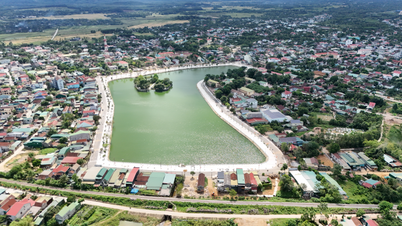
The town center of Ben Quan, Vinh Linh district today - Photo: D.T.
The farm is green, the color of soldiers' uniforms.
During my journalistic career, I visited Ben Quan many times. A rather substantial essay I wrote in 1992, with evocative illustrations by artist Tran Nguyen Luu, published in the Quang Tri newspaper in the autumn of 1992, also wrote about this very familiar land, titled "The Vast Ha Beach".
Located in the northwest of Vinh Linh district, this area was once a major thoroughfare that was used by officials and soldiers of many feudal dynasties. This route was the escape path to the resistance base against the French in western Quang Binh province used by the patriotic King Ham Nghi and his entourage when the Tan So mountain stronghold in the Cua region was besieged by the enemy.
During the resistance against the French, the upland road became a vital communication route connecting the free zone of Military Region IV with Military Region V. During the resistance against the Americans, this small road was widened, becoming the eastern branch of the legendary Ho Chi Minh Trail, passing through Ben Quan.
The Ben Quan - Bai Ha - Quyet Thang Farm area became a solid rear base for the Vinh Linh region during the two wars against foreign invaders; it was the location of the B5 Front's command post. The Ben Quan area was a gateway for penetrating deep into the Route 9 and North Quang Tri fronts; it served as a rear base and "launching pad" for many main army units participating in combat in the Southern battlefield during the war against the US.
In Hamlet 3, Ben Quan town, there is a memorial plaque commemorating a national-level revolutionary historical site: the T5 missile battery of the 238th Missile Regiment, marking a heroic event that once shocked world public opinion: the first time the most advanced B52 strategic bomber of the US Air Force was shot down in the Vietnam War. This site was classified by the Ministry of Culture, Sports and Tourism in Decision No. 3998/QD-BVHTTDL dated January 10, 2010.
After nine years of protracted resistance, on July 20, 1954, the Geneva Accords on ending the war and restoring peace in Indochina were signed. The resistance war against French colonialism by our army and people ended in victory.
According to the Geneva Accords, our country was temporarily divided at the 17th parallel, Hien Luong Bridge, and Ben Hai River, awaiting a general election in July 1956 to unify the country. However, the treachery of the dictatorial Ngo Dinh Diem government, aided by the US, carried out its ambition of permanently dividing our country.
From this point, the entire Vietnamese nation embarked on a more than twenty-year-long resistance war against the US and its puppets to realize the aspiration of national reunification. In this situation, to protect and build a socialist North Vietnam as a solid rear base for the revolution in the South, the Party and State organized the transfer of some military units to economic activities under the model of military farms. This aimed to rearrange the defense strategy, expand residential areas, implement the people's war strategy, and advance the North Vietnamese countryside towards socialism through rural collectivization.
“The establishment of a town-level administrative unit in western Vinh Linh is a recognition of the extraordinary efforts of the pioneers who opened up the land and officially marks a new stage of development for the land and people here. In the process of renewal, this is also the source of strength, a continuous connection to the glorious tradition between the Party Committee of Quyet Thang State Farm and the Party Committee, government, and people of Ben Quan town today...” |
After completing its combat mission in the resistance war against French colonialism, the 325th Division was assigned by the Party, State, and the Central Military Commission to be stationed in Quang Binh province and the Vinh Linh area to both protect the border, develop the economy, and ensure national defense and security. Recognizing its particularly important position in the border region and in the socialist North, on August 19, 1958, in the western part of Vinh Linh, in Vinh Ha commune, officers and soldiers of the 332nd Battalion, 18th Regiment, 325th Division, reinforced with units from other units, were assigned the task of establishing the Quyet Thang State Farm. Along with the decision to establish the farm, the Standing Committee of the Vinh Linh District Party Committee decided to establish the Quyet Thang State Farm Party Committee based on all party members, company party branches, and battalion party committees transferred from the army. The Party Committee of Quyet Thang Farm was one of the first 36 military farm party committees established after peace was restored in North Vietnam.
Upon its establishment, the Quyet Thang Farm was planned and allocated 1,200 hectares of hilly land in Vinh Long, Vinh Ha, and Vinh Khe communes by the Government to develop industrial crops such as rubber, tea, and pepper, as well as raise buffalo, cattle, pigs, and freshwater fish. Simultaneously, it was intended to be a strategic location within the Vinh Linh area's combat defense line, serving as a "launching pad" to support the battlefield in Northern Quang Tri. The goal was to develop the Quyet Thang Farm into an economically prosperous, politically strong, and militarily secure area on the western frontier.
When it was first established, the Quyet Thang State Farm maintained the same management, organization, staffing, and operational methods as the military. Workers received salaries and allowances according to their military ranks, and their food rations were provided by the military. From 1961, the officers and workers of the Quyet Thang State Farm no longer received military salaries. The farm held a "star-lowering ceremony," and the soldiers became farm workers, directly under the Ministry of State Farms, receiving salaries according to the agricultural worker's rank and grade...
In just under eight years, with the strength of unity and the determination of the soldiers of Uncle Ho's army, the farm completed land reclamation and basic construction. By the end of 1964, the farm had planted 1,014 hectares of rubber trees, 54 hectares of tea plants, 32.5 hectares of pepper plants, and hundreds of hectares of various vegetables. The farm had a herd of over 2,200 buffaloes and cows, 600 pigs, a mechanical repair workshop, and many other basic construction works serving production and daily life.
It can be said that on the historical land of Ben Quan town, every inch of land, every mountain, every river, every building, every valley, every hill is steeped in the blood, sweat, and tears of countless generations before. The residents of Ben Quan town today are descendants of the pioneering soldiers of Uncle Ho who came to explore and develop this new land in the western part of Vinh Linh. They were the first to build the Quyet Thang Farm into a Heroic Labor Unit. This "pioneering" generation also laid the foundation for the strong Party Committee of Ben Quan town today.
A green city amidst the forest
By 1994, the Quyet Thang Farm residential area had met the socio-economic and cultural characteristics and the requirements for state management. Considering the proposals from the competent authorities of Vinh Linh district and Quang Tri province, the Government issued Decree No. 79/ND-CP dated August 1, 1994, establishing Ben Quan town in Vinh Linh district. At this time, the town covered an area of 419 hectares, with a population of 3,421 people and 1,064 households. From then on, Ben Quan took on a new responsibility: to develop a type V urban area in the forest region of Vinh Linh.

A new house nestled amidst lush green rubber plantations in Ben Quan town, Vinh Linh district - Photo: D.T.
Ben Quan has a rather complex terrain with many streams, hills, and mountains, making transportation difficult. However, it has great potential for investment in the development of industrial crops and forestry, and for building integrated farm economic models. It is a central location, traversed by the Ho Chi Minh Highway, National Highway 9D, and Provincial Road DT 571, serving as a hub for trade among the western communes of Vinh Linh district.
In economic development, the agricultural, forestry, and fisheries sectors account for a high proportion, becoming the town's strengths. The people have focused on exploiting the potential of the hilly land, identifying rubber trees, forestry, and livestock farming as key priorities.
In addition, the plan includes renovating neglected gardens, developing forest garden models, introducing many new plant varieties with high commercial value to replace those with low economic value, along with maintaining the area for freshwater fish farming and annual rice production.
The industrial, handicraft, construction, and trade and service sectors have undergone many positive changes, creating diverse activities for the exchange and circulation of goods, basically meeting the needs of consumers.
Particularly in recent years, the task of building Ben Quan town into a civilized urban area has always been given utmost attention by the Party Committee, the People's Committee, and the associations and organizations of Ben Quan town. They have strived and worked together to achieve many remarkable results.
Specifically, the general urban plan has been approved and publicly announced by the Provincial People's Committee; infrastructure facilities have received investment for construction, upgrading, and repair, including the town's People's Committee headquarters, 3 schools, and cultural centers in 5 hamlets; the number of households with solidly built houses conforming to the general architecture has reached 90%. The entire town has 35.55 km of roads, including 4 km of asphalt concrete roads, 15.6 km of paved roads, and 14.45 km of cement concrete roads.
Roads are upgraded and repaired annually, facilitating the flow of goods and the movement of people. Electricity has reached almost all residential areas; the "lighting up rural roads" program in 5 hamlets has achieved a rate of up to 95%.
From a region with many limited living conditions, 100% of households in Ben Quan now have access to clean water; 99.6% of households have toilets, bathrooms, and clean water storage tanks.
The town has successfully implemented information technology in its management and administration, such as using an electronic one-stop service system, common software applications, and digital signatures. Significant progress has been made in the fields of culture, sports, health, and education.
A prominent feature of Ben Quan town is that its population originates from many regions across the country, formed during the construction and development of the Quyet Thang State Farm, who settled and made their living in this western part of Vinh Linh.
Despite lacking traditional kinship or village ties, the community of Ben Quan town is closely bound together by camaraderie, solidarity, and the pioneering spirit of the working class.
By the end of 2023, the town had 1,059 households meeting the criteria for culturally exemplary families for three consecutive years, accounting for 92.6%; all 5 hamlets were recognized as culturally exemplary hamlets by the District People's Committee. Another positive development is that the average per capita income in 2023 reached 66 million VND; the multidimensional poverty rate was lower than the local standard, with only 11 out of 1,156 households in the entire town currently facing poverty, representing 0.95%...
Now, passing through Ben Quan town, one can easily find bustling new streets resembling those of a city. This August, coinciding with the 70th anniversary of Vinh Linh's traditions, Ben Quan town will also reach its vibrant 30th anniversary.
Over 30 years, from a remote forest farm to a dynamic new city along the vital Ho Chi Minh Highway, Ben Quan has leveraged its rich historical traditions and the collective will of its people to care for the future, creating immense internal strength capable of achieving prosperity, happiness, and beauty in the near future...
Dao Tam Thanh
Source

![[Photo] National Assembly Chairman Tran Thanh Man working with the Standing Committee of the Law and Justice Committee](https://vphoto.vietnam.vn/thumb/1200x675/vietnam/resource/IMAGE/2026/05/21/1779378929214_ndo_br_1-4610-jpg.webp)
![[Photo] General Secretary and President To Lam presides over a working session with the Central Policy and Strategy Committee on the development of the materials industry.](https://vphoto.vietnam.vn/thumb/1200x675/vietnam/resource/IMAGE/2026/05/21/1779359935432_a3-bnd-3129-1412-jpg.webp)




































































Comment (0)