

The Nguyen Thi Dinh Memorial Area, located in Luong Hoa commune, Giong Trom district, Ben Tre province, is built on a total area of 15,000 m2.
The Nguyen Thi Dinh Memorial Area is one of the most significant tourist destinations in Ben Tre, the birthplace and home of the first female general of the Vietnam People's Army. The people of Ben Tre always respectfully and affectionately call General Nguyen Thi Dinh by the familiar name "Co Ba" (Aunt Ba).
Born on February 13, 1920, she was the youngest of ten children in Luong Hoa commune, Giong Trom district, Ben Tre province. At the age of 16, she joined the revolution, undertaking the tasks of a courier, distributing leaflets, and mobilizing the masses for struggle. In 1938, she was admitted to the Indochinese Communist Party. In 1946, she was a member of a delegation of cadres from Zone 8 who sailed north to meet President Ho Chi Minh to report on the revolutionary situation in the South and request weapons support, thus opening the legendary Ho Chi Minh Trail on the sea, the precursor to the later "numberless ships."
Upon returning to her hometown, Ms. Ba, along with the Ben Tre Provincial Party Committee, led the people in an uprising to break the enemy's grip in the three communes of Dinh Thuy, Binh Khanh, and Phuoc Hiep (Mo Cay district, now Mo Cay Nam district), creating the Dong Khoi movement on January 17, 1960, which initiated a simultaneous uprising throughout the province and the entire South at that time. Her name is inextricably linked to the Ben Tre Dong Khoi movement and the "Long-Haired Army" that struck fear into the enemy.
The image of Co Ba Dinh, dressed in a traditional Vietnamese blouse, checkered scarf, conical hat, and carrying a small shoulder bag, became a symbol of faith for the soldiers and people of Southern Vietnam and for women revolutionaries throughout the country.
During her service, Co Ba Dinh was captured and brutally tortured by the enemy many times. However, the fighting spirit of this woman from Ben Tre remained unwavering, her loyalty to the revolution and the nation unwavering. In 1974, Co Ba Dinh was promoted to the rank of Major General in the Vietnam People's Army, a majestic yet kind-hearted female general, imposing yet warm and sincere.
The female general was once praised by President Ho Chi Minh: "The Deputy Commander-in-Chief of the Southern Liberation Army is Ms. Nguyen Thi Dinh. Only our country in the whole world has such a female general. It is truly glorious for the South, for our entire nation."
At 10:50 PM on August 26, 1992, General Nguyen Thi Dinh passed away. She lived a life fully dedicated to the nation and made immense contributions to the country and its people. She was awarded two Ho Chi Minh Orders, the First Class Military Merit Order, and many other prestigious medals. In 1968, she received the Lenin International Peace Prize. On August 30, 1995, she was posthumously awarded the title of Hero of the People's Armed Forces. A life of fighting and sacrifice, General Nguyen Thi Dinh became a legend, not only representing the heroic, indomitable, loyal, and capable women of the South, but also serving as a model for Vietnamese women and progressive women worldwide.
After her death, the people of Hat Mon commune (Phuc Tho district, Hanoi) erected an altar to her in the temple dedicated to the Trung Sisters. Many streets and schools in Vietnam are named after her. On October 18, 2011, the Vietnam Women's Union of Ben Tre province held the inauguration ceremony for the Memorial Exhibition House. This is where many artifacts related to the life and revolutionary career of Nguyen Thi Dinh are displayed.
The Nguyen Thi Dinh Memorial Area covers nearly 15,000 square meters. The temple is simply constructed, with beautiful and dignified patterns and motifs, set within a garden filled with lush, green trees and fruit trees, creating a cool and airy atmosphere.
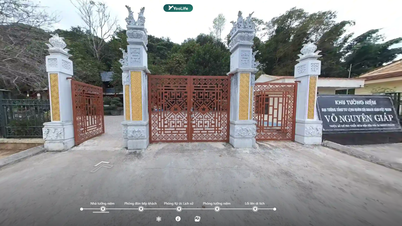
The structure is built in the style of a traditional Vietnamese village communal house, with a self-contained gate featuring decorative patterns at the front; inside are a stele house, a temple, an exhibition hall, and a spacious grounds with many shady trees.
Passing through the triple-arched gate with its red tiled roof shaped like a boat and a phoenix's tail, visitors will encounter the Memorial House. The Memorial House is built in the ancient four-pillar architectural style, with a two-tiered roof covered in fish-scale-colored tiles. Inside the Memorial House, prominently displayed in the center is a granite block carved into the shape of a turtle supporting a stele. The stele, inscribed in Vietnamese, records the life, biography, and career of the female general Nguyen Thi Dinh.
The temple dedicated to Co Ba Dinh is built high and airy, in the four-pillar style, with round columns and a two-tiered roof supported by curved eaves at the four corners. The eaves at the top of the columns and gables are decorated with motifs.
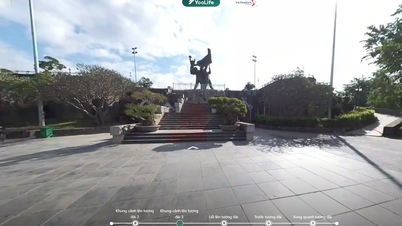
The temple has three entrances and a wide corridor surrounding it. Inside the temple is a bronze statue of General Nguyen Thi Dinh, dressed in a traditional Vietnamese blouse and checkered scarf, an image most remembered by the people of the coconut region when they think of her, placed respectfully on a granite pedestal.
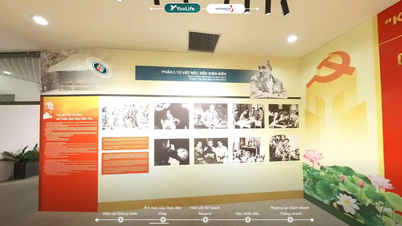
In front of the temple is a ceremonial courtyard, with ornamental plants planted around the architectural structures. Pedestrian walkways connect with green lawns in front, creating a beautiful, harmonious, and impressive overall appearance. Besides the temple, there is also an exhibition room displaying artifacts, images, and documents illustrating the life and revolutionary career of Cô Ba.
The Nguyen Thi Dinh Memorial Area is one of the proud achievements of the people of Ben Tre, serving to educate the younger generation about the province's revolutionary historical traditions and becoming an indispensable historical site for visitors from near and far whenever they travel to Ben Tre.
Every year, on the 28th day of the 7th lunar month, the anniversary of Co Ba's death, in addition to family, relatives, and friends, many tourists from within and outside the province come to visit Co Ba's temple and participate in community activities, social gatherings, and listen to stories from the past alongside specific artifacts in Co Ba's exhibition room.
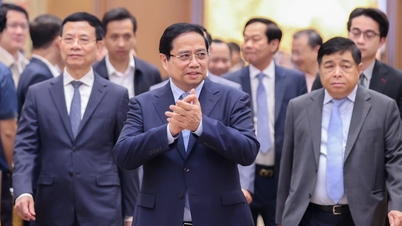
![[Photo] Prime Minister Pham Minh Chinh presides over a meeting on private sector economic development.](/_next/image?url=https%3A%2F%2Fvphoto.vietnam.vn%2Fthumb%2F1200x675%2Fvietnam%2Fresource%2FIMAGE%2F2025%2F12%2F20%2F1766237501876_thiet-ke-chua-co-ten-40-png.webp&w=3840&q=75)



















































Comment (0)