

When pineapple plants produce more than just fruit
During harvest season, the pineapple hills of Ngoc Lien commune, Thanh Hoa province, are left with long, thorny leaves. Years ago, these pineapple leaves were discarded. But now, in a small workshop at the Dong Tam Agricultural Service and Seed Cooperative (Dong Tam Cooperative), these seemingly worthless pineapple leaves are being spun into shimmering silk threads, a green raw material for the garment industry.
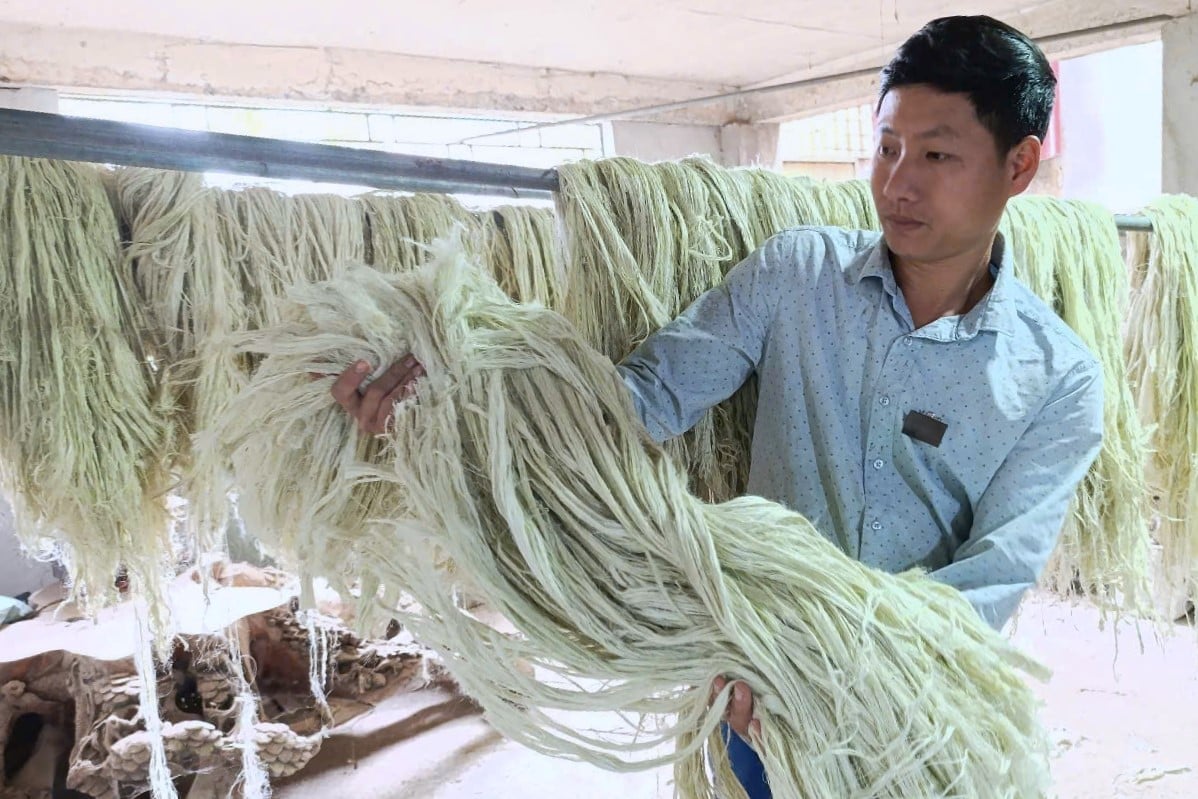
According to Mr. Do Dong Tam, transforming pandan leaves into silk threads for the textile industry is a promising direction. Photo: Trung Quan.
Amidst the rhythmic hum of the silk-separating machine, Mr. Do Dong Tam, Director of the Cooperative, carefully held up each freshly spun silk thread to the sunlight. The thin, ivory-white, strong, and soft threads were clearly visible in his sun-tanned palm. The way he spoke about pandan leaves, gently stroking each thread, gave the listener the feeling that he was cherishing something incredibly precious. To obtain these white silk threads, he and the cooperative members had spent many years experimenting, paying the price with numerous failures.
“When we first started making silk from pandan leaves, the cooperative suffered continuous losses because the machinery we used wasn't suitable, we lacked experience in selecting leaves with a high fiber content, and we didn't know how to process them to remove the fiber... But thinking about how successful it would be a promising direction for the future, increasing income while protecting the environment, we encouraged each other to keep trying,” Mr. Tam said with a gentle smile.
He shared that Ngoc Lien commune currently has about 1,200 hectares of pineapple. After each harvest, thousands of tons of pineapple leaves are left in the fields. People often chop them up, bury them in the ground as fertilizer, burn them, or spray them with chemicals to avoid the effort of cleaning them up and to prepare the land for the next crop. These methods inadvertently cause smoke and dust, pollute the environment, and spread diseases to the next crop.
“There were days when driving on the highway through pineapple-growing areas, I felt like I couldn’t breathe because of the thick smoke from burning leaves. At that time, I wondered why we couldn’t utilize pineapple leaves or process them properly to turn them into useful products, thus avoiding waste and protecting the environment,” Tâm shared.

Each year, tens of thousands of tons of pineapple leaf by-products are generated after harvesting, but most of them remain unutilized. Photo: Trung Quan.
With that idea in mind, Mr. Tam diligently researched effective models for processing pandan leaves. In 2024, through a local farmer training course, he learned about a model for producing silk yarn from pandan leaves for the textile industry and processing pandan leaf waste into organic fertilizer, implemented by the Institute for Cooperative Economic Development (Vietnam Cooperative Alliance).
After attending training sessions, he became "addicted" to the technology of extracting silk fibers from pandan leaves. With the support of experts, he quickly mastered the technique and boldly invested in a spinning machine to establish the first model in his hometown.
To ensure a reliable supply of raw materials for silk fiber processing, the cooperative purchases pandan leaves from local people at a price of 600-800 VND/kg. Simultaneously, they have established a production area for the MD2 pandan variety on nearly 5 hectares. This new pandan variety boasts both high-quality fruit and long, thick leaves, making it ideal for silk fiber production. Importantly, the cooperative applies a green production process, avoiding chemical fertilizers and pesticides to create truly environmentally friendly products.
According to Mr. Tam, making silk from pandan leaves requires patience and meticulousness. To produce 1 kg of dried silk, tens of kilograms of fresh leaves are needed. Pandan leaves are very hard and contain a lot of water. Extracting the fine fibers inside requires many steps: removing the leaf tissue, washing, drying, and then processing again to achieve a natural white color. The entire process uses almost no chemicals, relying almost entirely on water and mechanical methods, so even a small mistake can cause the silk to discolor or deteriorate.

Processing pandan leaves into silk threads provides farmers with additional income. Photo: Trung Quân.
The finished silk fibers are currently purchased by affiliated textile businesses as raw materials for eco-friendly product lines at consistently good prices, ranging from 160,000 to 190,000 VND/kg. However, what Mr. Tam is most proud of is that the journey of pandan leaves doesn't end at just the silk fibers; almost nothing goes to waste. After separating the fibers, the leftover pandan leaf pulp is further utilized, composted with probiotics to create organic fertilizer for crops such as pineapples, longan, and jackfruit.
“Although our scale isn't large yet, it will certainly be a very promising direction in the future. On a given cultivated area, in addition to income from the fruit, people can earn extra income from pandan leaves without polluting the environment or spreading diseases. More importantly, the market is increasingly favoring natural, environmentally friendly fibers, so this product line has a fairly stable market,” Mr. Tam said.
Opening up green avenues for large-scale raw material production areas.
Thanh Hoa currently has nearly 4,000 hectares of pineapple, making it one of the largest pineapple-growing regions in North Central Vietnam. Each year, tens of thousands of tons of pineapple leaf by-products are generated after harvest, but most remain unutilized.
Meanwhile, fibers from pineapple leaves have been utilized by many countries to produce bio-fabrics, handbags, shoes, interior materials, and more. This is seen as a trend in the sustainable fashion industry, gradually replacing polluting synthetic fibers.

Using fiber made from pandan leaves is considered a trend in the sustainable fashion industry. Photo: Trung Quân.
Notably, this model does not require expanding the planting area. Value is created directly from the by-products that would otherwise be discarded. A pineapple plant now not only yields fruit but also provides raw materials for textiles and organic fertilizer. Furthermore, the model opens up livelihoods for rural workers. The processes of collecting, transporting, separating fibers, and preliminary processing all require labor. For mountainous regions lacking employment, this could be a significant way to increase income.
"When people realize that they shouldn't just grow trees to sell the fruit, but start thinking about how to exploit the full value of the crop, then all difficulties can be overcome. With additional support policies regarding capital, technology, and market connections, Thanh Hoa's pineapple industry can completely form a new value chain from by-products," Mr. Tam assessed.
Mr. Tam believes that in many rural areas, the most difficult thing is not what crops to grow, but how to fully exploit the value of those crops. And sometimes, a new direction begins with very small things. However, to go further, the journey of pandan leaf fiber production still faces many obstacles. The biggest difficulty currently is the investment capital for machinery, processing technology, and establishing a stable raw material supply area. Production is still mainly on a small scale and experimental in nature. Many cooperatives and households want to get involved but are hesitant due to the high initial investment costs.
Source: https://nongnghiepmoitruong.vn/bien-la-dua-thanh-tien-d811392.html

![[Photo] National Assembly Chairman Tran Thanh Man working with the Standing Committee of the Law and Justice Committee](https://vphoto.vietnam.vn/thumb/1200x675/vietnam/resource/IMAGE/2026/05/21/1779378929214_ndo_br_1-4610-jpg.webp)


![[Photo] General Secretary and President To Lam presides over a working session with the Central Policy and Strategy Committee on the development of the materials industry.](https://vphoto.vietnam.vn/thumb/1200x675/vietnam/resource/IMAGE/2026/05/21/1779359935432_a3-bnd-3129-1412-jpg.webp)


























































Comment (0)