

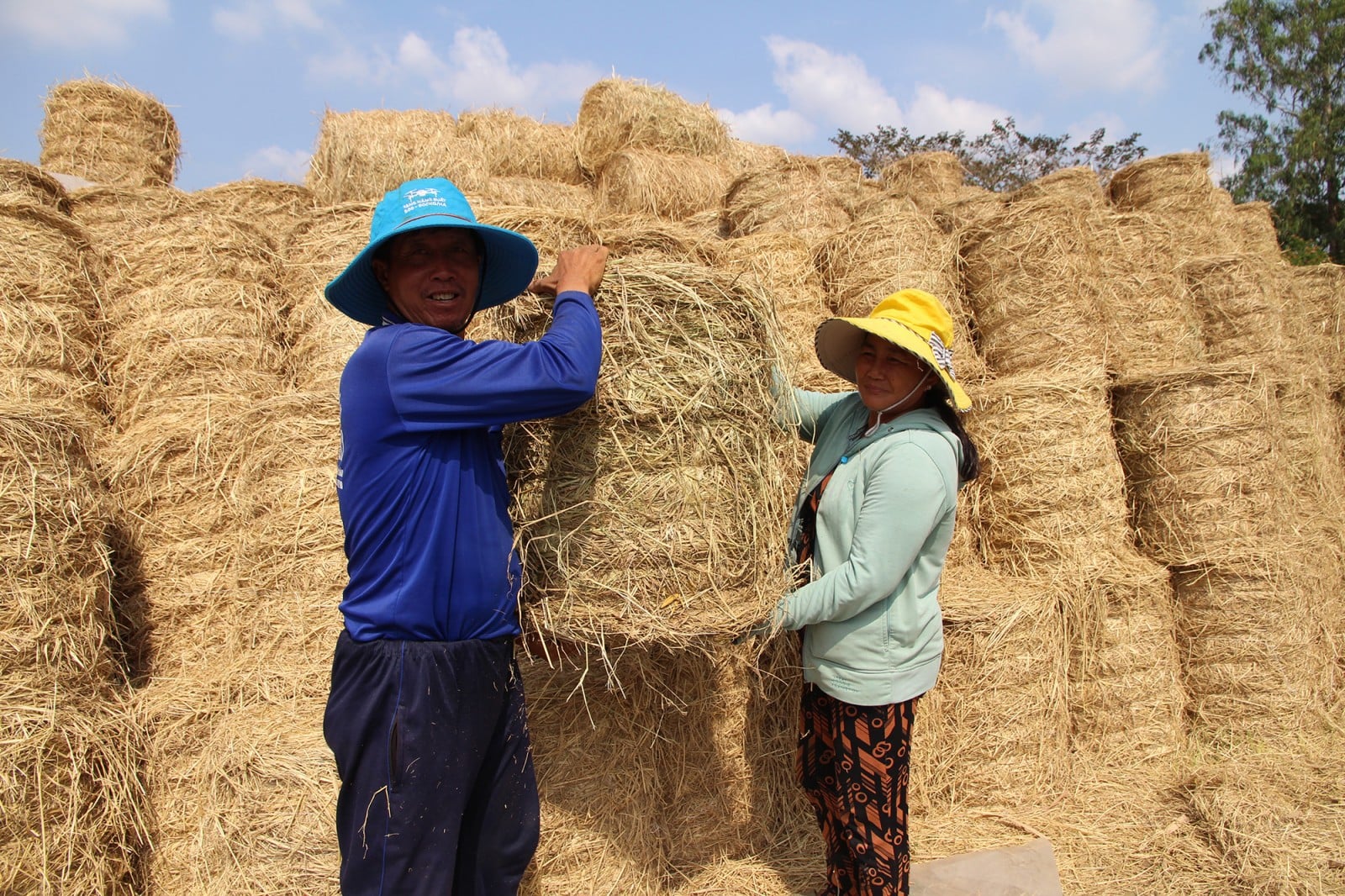
Mr. Mười Sự and his wife stand beside the bales of straw they just purchased. Photo: MINH HIỂN
Smoke-filled fields
Many years ago, after each rice harvest, most of the straw was burned right in the fields. This practice, which lasted for many years, severely affected the air quality, degraded the soil, and increased greenhouse gas emissions. Mr. Nguyen Ba Phuc, a resident of Phu Lam commune, said that in the past, during the straw burning season, thick smoke filled the entire village, making it difficult to see each other even from a distance of several tens of meters. "The straw smoke not only caused suffocation and eye irritation but also affected people's health. In recent years, thanks to straw buyers, the practice of burning straw has decreased significantly," Mr. Phuc shared.
Having witnessed this situation for many years, Mr. Mười Sự, residing in Long Thạnh 2 hamlet, Phú Lâm commune, chose a different path. Instead of burning the straw, he began collecting it after harvest and finding markets for farmers. Starting with a few straw baling machines and small-scale sales, Mr. Mười Sự gradually invested in more machinery, expanded his collection network, and established a large-scale straw purchasing model in the area.
Currently, Mr. Mười Sự purchases straw from approximately 50,000-60,000 plots of land annually. On average, each plot yields 10-11 bales of straw, totaling around 500,000-600,000 bales per year. To manage this large volume of work, he invested in 5 plows, rented 8 more, and operates 16 bale trucks continuously in the fields. On average, his network supplies the market with 5,000-7,000 bales of straw per day, each weighing about 18-20 kg. Mr. Mười Sự's phone is almost constantly ringing. "Every day I receive 200-300 calls from farmers selling straw, people placing orders... Sometimes the phone rings continuously from morning till night," Mr. Mười Sự shared.
Besides generating additional income for farmers after each rice harvest, straw collection significantly reduces the practice of burning rice stalks in the area. According to many farmers in Phu Lam commune, straw used to be considered waste and was burned quickly, but now that it is purchased directly from the fields, farmers have an additional source of income and no longer experience the smoke and dust that once enveloped their villages.
Mr. Mười Sự also built a straw distribution network spanning many provinces and cities in the South. From Phú Lâm commune and neighboring areas, trucks carrying straw continuously travel to many provinces such as Đồng Tháp, Vĩnh Long, and Ho Chi Minh City…
Turning straw into a source of profit.
The bales of straw that were once left abandoned in the fields have now become a raw material for many industries, such as feed for dairy cows, mulching dragon fruit plants to retain moisture during the dry season, growing clean mushrooms, or supplying industrial paper mills. Mr. Mười Sự also built a warehouse in Phú Tây hamlet to store approximately 20,000 bales of straw to ensure a steady supply for mushroom growers during the rainy season, guaranteeing a stable year-round straw supply.
Although it's just an individual business, Mr. Mười Sự's model brings many practical benefits to the environment. Collecting straw helps reduce methane and CO2 emissions directly from burning fields. The straw, after being used for mushroom cultivation, is then used as organic fertilizer, reducing reliance on chemical fertilizers.
Chairman of the Provincial Farmers' Association, Nguyen Van Cop, highly praised Mr. Muoi Su's innovative spirit in pioneering the straw purchasing model in Phu Lam commune. According to Mr. Nguyen Van Cop, what is valuable about Mr. Muoi Su is not only the economic efficiency but also the way this farmer sees new value in something once considered waste in the fields.
Mr. Mười Sự's model is a vivid example of the green agriculture and circular economy direction that the agricultural sector is encouraging. "Mr. Mười Sự transforms straw into a valuable resource, opening up a new way of thinking for farmers about making money from agricultural by-products," said Mr. Nguyễn Văn Cọp.
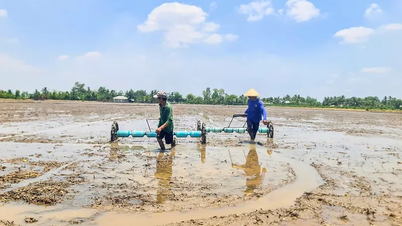
Amidst the scorching sun of the upstream region, Mr. Muoi Su's straw baling machines tirelessly run across the fields. Each bale of straw loaded onto the truck means that no more smoke from burning fields rises into the villages, contributing to the development of green and low-emission agriculture in the Mekong Delta.
Source: https://baoangiang.com.vn/bien-rom-thanh-nguon-loi-a485378.html






































































Comment (0)