

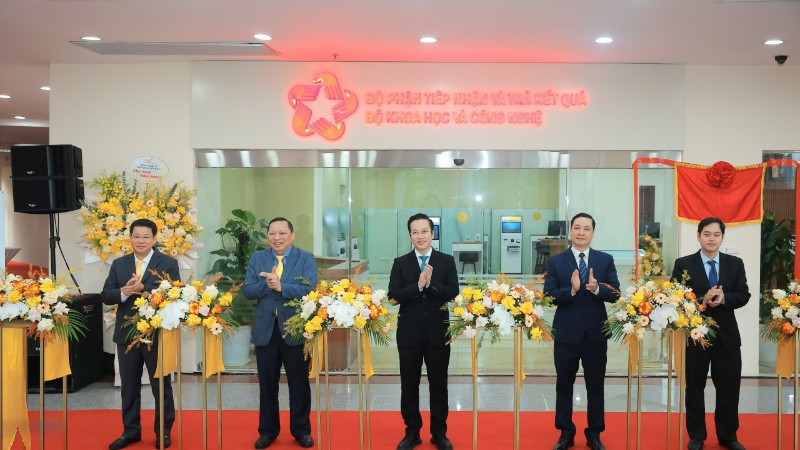
On December 19th, the Ministry of Science and Technology officially inaugurated a modern, centralized one-stop service center at its headquarters (113 Tran Duy Hung Street, Hanoi). This project is a celebration of the 14th National Congress of the Communist Party of Vietnam.
Speaking at the opening ceremony, Mr. Ha Minh Hiep, Chief of the Office of the Ministry of Science and Technology, said that this is an important event, demonstrating the determination to accelerate administrative procedure reform, improve the quality of service to people and businesses, and promote digital transformation in state management activities in science and technology.
What sets the reception and results delivery department of the Ministry of Science and Technology apart is its strong application of digital technology throughout the entire process of receiving, processing, and tracking applications, thereby aiming for a professional, modern, transparent, and citizen-centered administration.
The one-stop service center is organized according to a "centralized one-stop service" model, replacing the previous decentralized approach with separate specialized units. Accordingly, the entire process of handling administrative procedures for citizens and businesses is designed to be unified and seamless at a single point of contact for receiving and delivering results, reducing travel time, simplifying operations, and facilitating the monitoring and supervision of application processing progress.
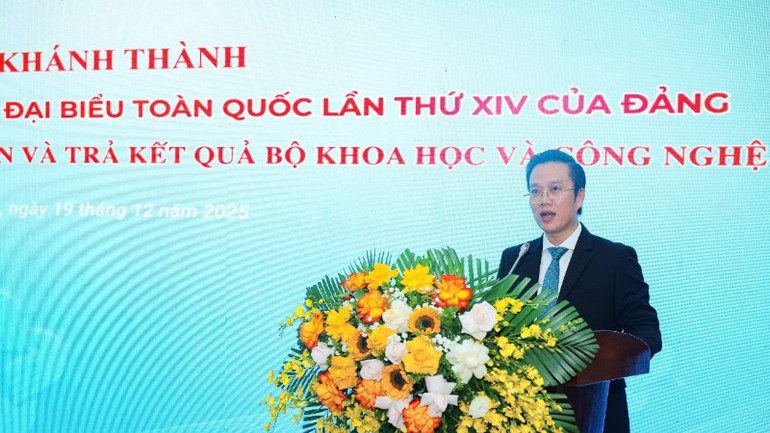
The one-stop service center is built on a centralized, modern, and digital orientation, applying synchronized information technology solutions and connecting the Ministry's administrative procedure processing system with the National Public Service Portal and specialized databases. Business processes are standardized and publicly available; each file is assigned an identification code, clearly defining the processing time and responsibilities of each stage, helping organizations and individuals proactively track the status and monitor the progress of the process.
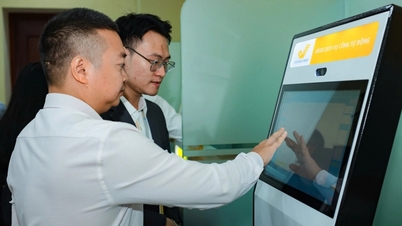
At the one-stop service center, citizens and businesses can choose from various methods for carrying out administrative procedures, depending on their technological readiness. Self-service kiosks are located in the reception area, allowing users to look up procedures, check document requirements, digitize paper documents, submit applications online, and track processing status.
For those unfamiliar with numerical procedures or complex paperwork, the in-depth support and consultation area will provide step-by-step guidance, ensuring that all individuals can easily access public services. This is a significant shift from a "staff-assisted" model to a "citizens and businesses proactively implementing" model, in which state agencies play a role in guiding, supporting, and controlling the process in a transparent and efficient manner.
Currently, the model is being implemented in a way that combines in-person services, online services with in-person support, and a fully online system. This approach ensures that no one is left behind while gradually fostering the habit of using online public services among organizations and citizens.
A key highlight of the model is its ability to track, monitor, and measure accountability in handling administrative procedures. Through the file code, citizens and businesses can look up the processing status, know exactly which stage their application is at, and the deadline for resolution. This enhances transparency, reduces the need for repeated inquiries to multiple points of contact, and increases enforcement discipline among agencies handling administrative procedures.
The one-stop service center is defined not only as a place to receive applications, but also as a digital touchpoint between the Ministry and citizens and businesses; therefore, the quality of its operation becomes a direct measure reflecting the level of administrative reform, the level of digital transformation, and the credibility of the Ministry.
Organizing a one-stop service center in a centralized, modern model goes beyond simply unifying the point of contact for receiving applications; it aims to restructure the entire application processing procedure towards digitalization, interconnectedness, and transparency, using the digital environment as its foundation.
This is also the next step in the roadmap towards streamlining administrative procedures at all levels, with an integrated approach that synchronizes people, technology, and processes, in line with the government's administrative reform and digital transformation orientation in the current period.
The one-stop service center operates on the basis of close coordination between specialized units of the Ministry and the Vietnam Post Corporation - a unit directly under the Ministry, which has extensive experience in implementing the Project on reforming the one-stop and integrated one-stop service mechanisms according to Decision No. 468/QD-TTg of the Prime Minister and has coordinated the implementation of the one-stop service center model in many localities nationwide.
Vietnam Post will also participate in coordinating several stages of the process: supporting the receipt, guidance, digitization of documents, and delivery of results for administrative procedures, thereby contributing to improving professionalism in service, ensuring a smooth, unified, and efficient operation process from receipt to delivery of results for citizens and businesses.
Source: https://nhandan.vn/bo-khoa-hoc-va-cong-nghe-khai-truong-bo-phan-mot-cua-thuc-day-cai-cach-hanh-chinh-so-post931419.html
![[Photo] Prime Minister Pham Minh Chinh attends the Conference on the Implementation of Tasks for 2026 of the Industry and Trade Sector](/_next/image?url=https%3A%2F%2Fvphoto.vietnam.vn%2Fthumb%2F1200x675%2Fvietnam%2Fresource%2FIMAGE%2F2025%2F12%2F19%2F1766159500458_ndo_br_shared31-jpg.webp&w=3840&q=75)





![[INFOGRAPHIC] Legion Go Gen 2 sets a new standard for gaming.](https://vphoto.vietnam.vn/thumb/402x226/vietnam/resource/IMAGE/2025/12/19/1766146888809_info-taycamgames-02-jpg.webp)





![[Photo] Prime Minister Pham Minh Chinh attends the Conference on the Implementation of Tasks for 2026 of the Industry and Trade Sector](https://vphoto.vietnam.vn/thumb/402x226/vietnam/resource/IMAGE/2025/12/19/1766159500458_ndo_br_shared31-jpg.webp)

































































Comment (0)