

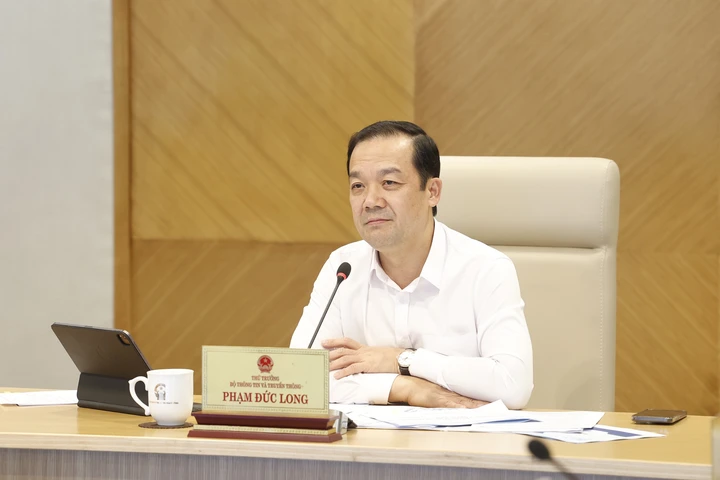
Deputy Minister of Information and Communications Pham Duc Long chaired the conference.
Attending the Conference were Deputy Ministers Phan Tam, Nguyen Huy Dung, and Nguyen Thanh Lam; heads and deputy heads of units under the Ministry; representatives from the Ministry's Office in Ho Chi Minh City and Da Nang; representatives from the Office of the Party Committee, the Chief of the Party Committee Office; representatives from the Vietnam Information and Communications Trade Union; and leaders from Vietnam Post Corporation and VTC Multimedia Corporation.
Three things to keep in mind when deploying a virtual assistant to support your work.
At the conference, Deputy Minister Pham Duc Long, along with leaders from several units including the Radio Frequency Department; the Ministry's Inspectorate; and the Department of Publishing, Printing and Distribution, tested and directly asked questions to the virtual assistant systems of these units.
The Deputy Minister gave three important notes regarding the deployment of virtual assistants to support work at units under the Ministry.
First, units need to proactively ask questions and guide the virtual assistant to understand various types of legal documents such as laws, decrees, and circulars. This helps the virtual assistant to answer accurately and provide more effective support in legal and administrative tasks.
The second point to note is ensuring that the knowledge taught to the virtual assistant is accurate and reliable. Inaccurate knowledge will lead to the virtual assistant providing misleading information, causing undesirable consequences in the work support process. Therefore, organizations must check and verify information before communicating it to the virtual assistant.
Finally, Deputy Minister Pham Duc Long emphasized the importance of building an accurate and comprehensive database. Virtual assistants need a rich and accurate data source to be able to retrieve information effectively. Units need to invest in building and maintaining databases, and regularly updating information so that virtual assistants can meet users' information search needs quickly and accurately.
The application of virtual assistants in the workplace is a significant step in the digital transformation process of the Ministry of Information and Communications, helping to improve work efficiency and enhance the quality of public services. With the three points mentioned above, Deputy Minister Pham Duc Long hopes that the units will effectively deploy virtual assistants, bringing practical benefits to daily work.
Applying international experience adapted to the reality in Vietnam.
At the conference, Mr. Le Van Chung, representing the Postal Department, presented a paper on building a database on international postal institutions, including updating and organizing data by topic. Specifically, the Postal Department compiled regulations from the Universal Postal Union (UPU), the European Union (EU), and postal laws of 10 countries, along with information on postal management agencies and statistics in this field.
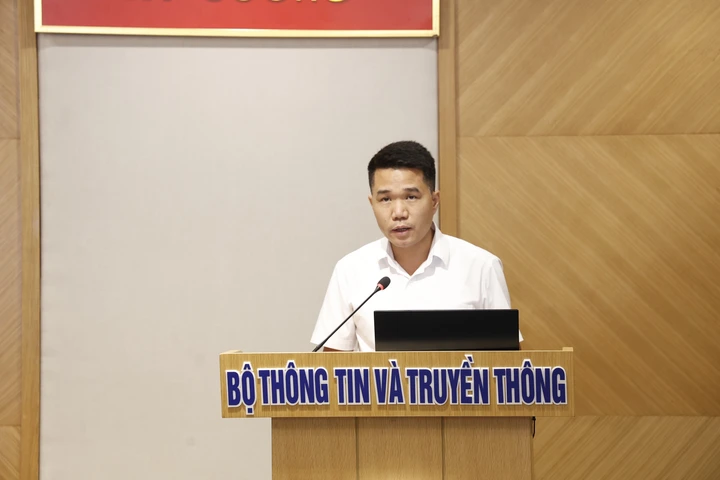
Mr. Le Van Chung, representing the Postal Department, presented a paper on building a database on international postal institutions.
Mr. Chung stated that the Postal Department has shared this document with 63 Departments of Information and Communications and postal enterprises through platforms such as Viber and Zalo, receiving positive feedback. The Postal Department will continue to update and enrich the data to support the drafting of the revised Postal Law, which is expected to be submitted to the National Assembly in the 2025-2026 period.
Ms. Shen Mailing, representing the Bureau of Grassroots Information, presented a paper on China's experience in applying a national digital platform for combating high-tech crime. According to her, this platform, developed and launched by the Criminal Police Department of the Ministry of Public Security of China on February 1, 2021, integrates with popular Chinese social media platforms such as WeChat, Sina Weibo, and TikTok. Its notable features include crime scene reporting; direct crime reporting; timely warnings and identity verification of account holders; and prevention of account hacking by fraudsters. Over three years of operation, China's "High-Tech Crime Prevention and Control Information Platform" has issued 40.67 million warning signals; successfully blocked 1.9 billion scam calls and 2.1 billion scam messages; and blocked 2,106 million fraudulent websites, helping 61.78 million people escape scams.
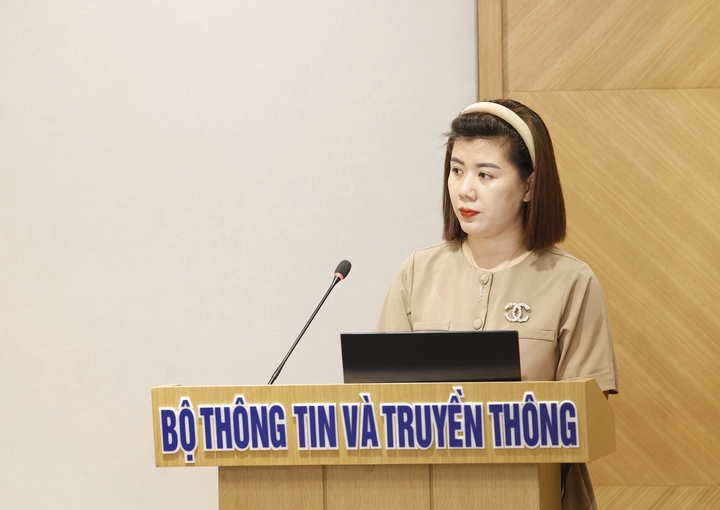
Representing the Department of Grassroots Information, Ms. Tham Mai Linh presented a paper on China's experience in applying a national digital platform to combat high-tech crime.
At the conference, a representative from the Department of Grassroots Information stated that, through research, the Ministry of Information and Communications, together with telecommunications enterprises, has implemented the 156 hotline to receive reports of spam and fraudulent calls, and is also coordinating with the Ministry of Public Security to deploy technological solutions to help people detect signs of online fraud. Therefore, based on the basic features of international platforms, the Department of Grassroots Information proposed that the leadership of the Ministry of Information and Communications direct relevant agencies and units to research and develop a national digital platform for combating high-tech crime in Vietnam. The goal is to improve the effectiveness of combating high-tech crime, in accordance with the actual conditions of the country.
At the conference, Deputy Minister Pham Duc Long highly appreciated the presentations and proposals from the two units, and encouraged them to apply international experience in developing applications to achieve the best results and quality, in accordance with the situation in Vietnam.
Pay close attention to the work progress and avoid delays.
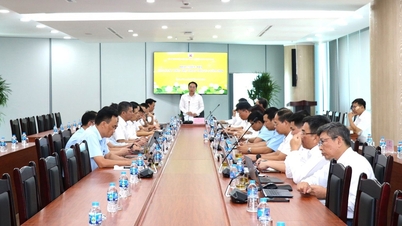
Concluding the conference, Deputy Minister Pham Duc Long emphasized that units need to pay attention to the progress of their work regularly throughout the month, avoiding delays and missed deadlines.
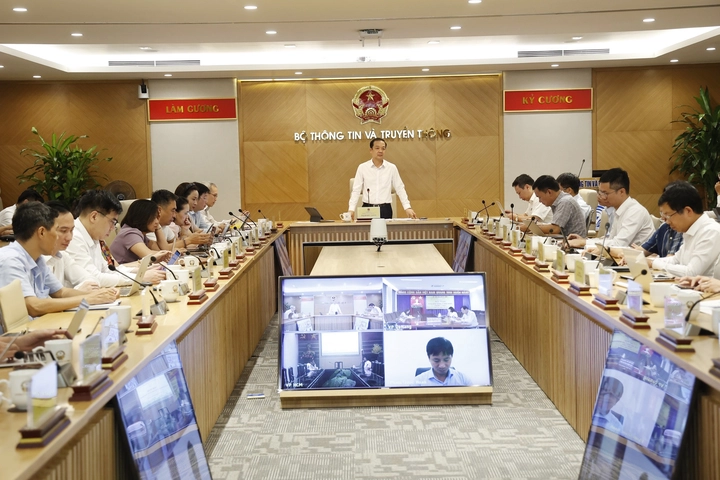
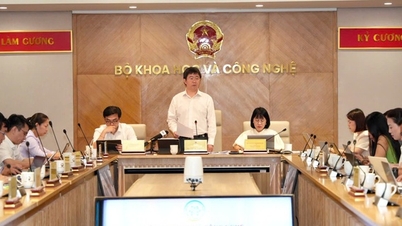
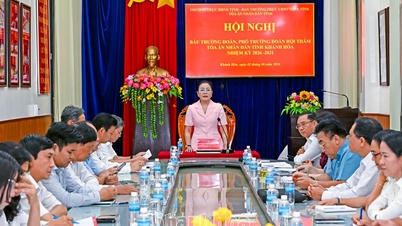
Overview of the Conference
The Deputy Minister also requested that the units contribute their opinions to the summary report on Resolution 36-NQ/TW on promoting the application and development of information technology to meet the requirements of sustainable development and international integration, and at the same time, pay attention to completing the projects to be submitted to the Government in the coming time and ensuring progress.
The Deputy Minister assigned the National Digital Transformation Department to advise on projects related to digital transformation, and the Information Center to develop an action plan based on data and simplify administrative procedures. Simultaneously, it is necessary to ensure information security and promote data usage, and research data liberation.
Overview of the Information and Communications Technology (ICT) sector in the first 7 months of 2024:
- Revenue : VND 2,414,666 billion, an increase of 249% compared to the same period in 2023.
- Profit: VND 175,615 billion, a 19% increase compared to the same period last year.
- Budget contributions: 70,435 billion VND, an increase of 255% compared to the same period last year.
- Contribution to GDP : VND 558,522 billion, an increase of 209% compared to the same period.
- Labor force: 1,532,163 workers, an increase of 28% compared to the same period last year.
In July 2024, the Ministry advised the Government and the Prime Minister to issue 01 Decree and 01 Decision, and issued 03 Circulars within its authority, specifically:
- Decree No. 82/2024/ND-CP dated July 10, 2024, amending Decree No. 73/2019/ND-CP dated September 5, 2019, of the Government regulating the management of investment in information technology applications using state budget funds.
- Decision No. 715/QD-TTg dated July 26, 2024, on the restructuring of the National Committee on Digital Transformation.
- Circular No. 06/2024/TT-BTTTT dated July 1, 2024, stipulates the recognition of foreign electronic signature service providers; and the recognition of foreign electronic signatures and electronic signature certificates in Vietnam.
- Circular No. 07/2024/TT-BTTTT dated July 2, 2024, provides detailed regulations on the mechanism, principles of price control, and pricing methods for renting and using cable networks in buildings, and the rental price of passive telecommunications infrastructure between telecommunications enterprises, organizations, and individuals owning telecommunications facilities.
- Circular No. 08/2024/TT-BTTTT dated July 10, 2024, detailing wholesale activities in telecommunications./.
Source: https://mic.gov.vn/bo-tttt-giao-ban-quan-ly-nha-nuoc-thang-7-2024-197240806090648027.htm



![[Photo] General Secretary and President To Lam presides over a meeting on preparations for the review of one year of operation of the three-tiered government system.](https://vphoto.vietnam.vn/thumb/1200x675/vietnam/resource/IMAGE/2026/06/02/1780391821195_a1-bnd-4595-9717-jpg.webp)























































































Comment (0)