

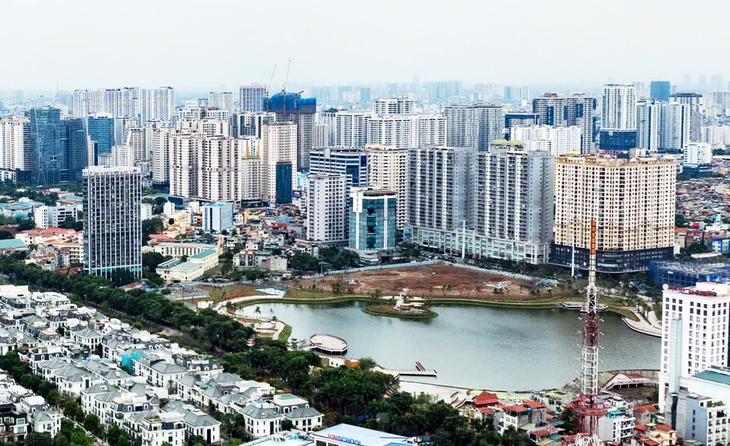
Some businesses argue that rising land use fees will make it difficult to control housing prices.
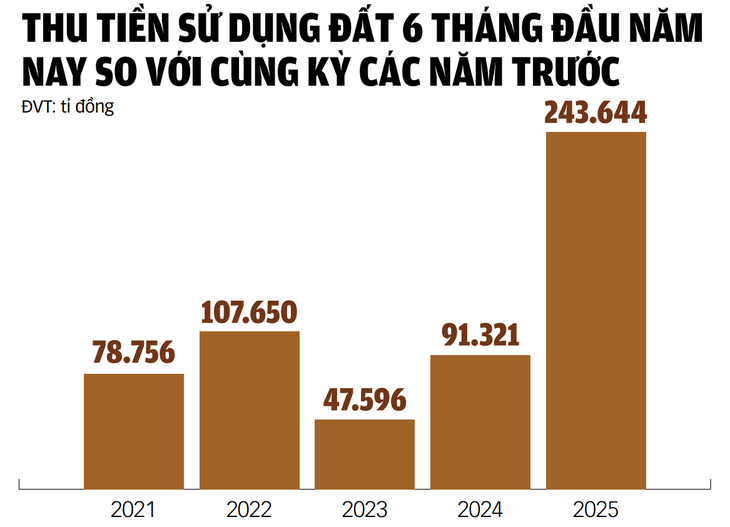
The sharp increase in land revenue in the first half of this year has also made it more difficult for businesses to access land. Even businesses with projects that have been stalled for decades, now that legal obstacles have been removed, are finding it difficult to implement their projects because land use fees and land taxes have increased tenfold.
What caused the surge in land use fees?
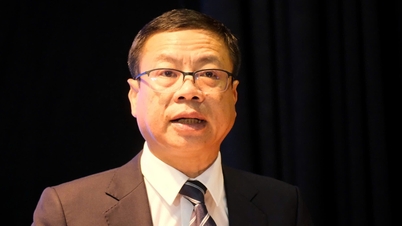
Professor Dang Hung Vo, former Deputy Minister of Natural Resources and Environment , stated that the increase in land use fee revenue in the first half of this year was due to the upward adjustment of land price tables. When land prices are raised closer to market value, revenue from land use naturally increases. In particular, Ho Chi Minh City, the locality with the highest land price adjustment, has land prices equivalent to 70% of market value.
"For a long time, Vietnam has been among the world's leading countries in terms of land revenue. Even when land prices were low like in previous years, land revenue in our country was approximately 3% of GDP, on par with developed countries like the US and UK, and higher than Japan and South Korea," Mr. Vo further shared.
According to Mr. Do Thien Anh Tuan, a lecturer at the Fulbright School of Public Policy and Management, the fact that a number of localities are accelerating the organization of land auctions, especially in areas with high economic value such as urban belts, industrial zones, or areas with newly completed infrastructure, also contributes to increasing revenue from land.
In addition, the recovery of the real estate market from the end of 2024 to 2025 and a series of policies to ease market conditions have begun to show results.
"Accelerating project approval, finalizing planning, and improving transparency in the land-use conversion process have facilitated transactions, thereby generating significant revenue for the budget from land use fees," Mr. Tuan added.
However, according to Mr. Nguyen Quoc Hiep, chairman of GP Invest, although budget revenue has surged thanks to increased land use fees, state management agencies need to consider how the sudden increase in land fees in the first half of this year is impacting investment, production, and business.
"Land use fee revenue surged in the first half of this year because many projects that had been underway for a long time were forced to proceed with the new land price list at the beginning of this year. In Hanoi, some projects were stalled for decades and could not be implemented until the beginning of this year, when businesses were finally able to get the obstacles removed and continue their projects," Mr. Hiep said.
Representatives from several other businesses also argued that the sharp increase in land use fees in the first half of this year is not a good sign for the investment and business environment, especially for real estate investment.
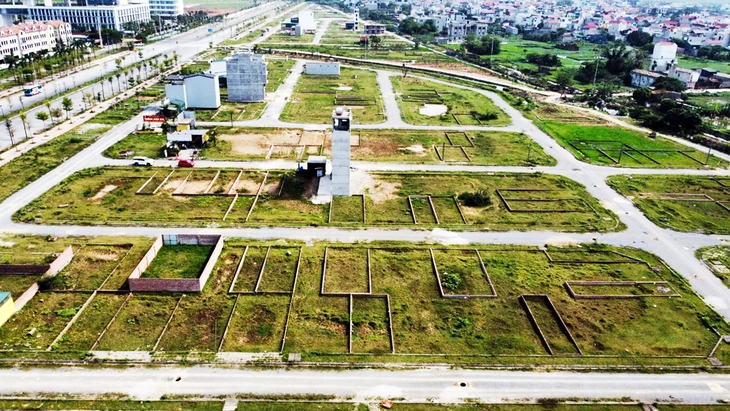
Land auctions contribute to increased land use fee revenue in the first half of 2025 - Photo: B. NGOC
Land use fees are driving up house prices.
Besides the positive impact of increased budget revenue, according to Mr. Nguyen Quoc Hiep, high land prices also bring many negative consequences. These include rising house prices because all input costs are factored into the price, and no developer wants to incur losses. However, reality also shows that simply raising house prices doesn't guarantee sales.
"Apartment prices are already at 70-80 million VND/ m² , which is already outrageous. If they're pushed up to over 100 million VND/ m² , who will buy them? Housing prices are exceeding the affordability of salaried workers."
"Even those who have money to buy houses for investment, to speculate, and are willing to buy at high prices hoping for price increases, will stop investing when the market slows down," Mr. Hiep expressed his concern.
Meanwhile, Mr. NQK, a developer in Hanoi, said that many developers are currently reconsidering their plans because house prices have already risen very high, and market demand is gradually decreasing. At some point, market demand will cease, and the market will come to a standstill. Even after paying land use fees, developers will be unable to continue investing in projects because they won't be able to sell their products.
According to Mr. NQK, the Ministry of Agriculture and Environment is also planning to amend the 2024 Land Law to revert to the land price table and land use coefficient as in the 2014 Land Law. Accordingly, the land price framework will remain unchanged for 5 years and will be adjusted by the land use coefficient.
Therefore, more specific regulations are needed regarding land use coefficients. While we delegate the determination to the provinces, regulations are necessary to establish these coefficients to prevent arbitrary calculations. Investors also need to understand the land prices of their projects in order to prepare estimates and calculate outputs, Mr. NQK added.
Furthermore, many businesses have expressed concern that, according to the Land Law, the land price list will take effect from January 1, 2026, but many localities have not yet developed a new land price list and are still using the current one. Therefore, calculations need to be made to ensure the timely issuance of the new land price list at the beginning of 2026.
According to representatives from several businesses, land prices are a major concern in most projects. "If localities follow Decree 71, the land valuation process for projects faces many obstacles, requiring 1-2 years to complete the valuation for a single project. Therefore, the first issue that needs attention when amending the Land Law is revising the land valuation method," said one business owner.
Source: Ministry of Finance, data: LE THANH - Graphics: TUAN ANH
* Mr. Do Thien Anh Tuan (Lecturer at the Fulbright School of Public Policy and Management):
Driving up land prices could stifle production.
The pursuit of collecting land use fees can push localities into selling land for money, driving up land prices through auctions, distorting the market, increasing investment costs, and hindering production.
This could stifle the competitiveness of the economy, diminishing the attractiveness of investment in high-value-added manufacturing and service industries.
Revenue from land must be more sustainable.
From the perspective of a land expert, Mr. Dang Hung Vo believes that land prices should be close to market value, but the State must have appropriate financial policies regarding land. In particular, land policies must control housing prices, as many countries are doing.
"The way other countries handle it is that investors only have to pay 30% of the land use fee upfront, instead of paying the full amount upfront like we do. The state only calculates the tax when the facility becomes operational. That means the remaining 70% is collected as a tax on the increased land value once the facility is operational," Mr. Vo said.
Meanwhile, Mr. Do Thien Anh Tuan argued that a comprehensive reform of land and real estate revenue policies is needed, not only to create a sustainable revenue system for the budget but also to rationally regulate income, ensure social equity, and develop a healthy real estate market.
According to Mr. Tuan, it is necessary to gradually eliminate the so-called "fees" and replace them with a property tax system. Specifically, the property tax should be designed according to a progressive scale, meaning that the more real estate a person owns, or the higher the value of their property, the higher the tax rate.
This is not only aimed at increasing revenue, but more importantly, at regulating the additional income from land – a form of passive income that is currently not taxed proportionally like income from labor or production and business activities.
"The core function of property tax is redistribution, that is, taking a portion of the benefits from the group that owns many properties and redistributing them. Here, the tax is not aimed at lowering house prices but at creating resources to support vulnerable groups in accessing housing, developing social housing, renovating impoverished urban areas, or investing in public infrastructure serving the majority."
"Along with property tax, we should also decisively apply a progressive income tax on real estate transfers to regulate income and curb speculative behavior," Mr. Tuan further analyzed.
Source: https://tuoitre.vn/boi-thu-tien-dat-khong-voi-mung-20250813224319634.htm



![[Image] National Assembly discusses the implementation of the socio-economic development plan.](https://vphoto.vietnam.vn/thumb/1200x675/vietnam/resource/IMAGE/2026/04/20/1776696707422_ndo_br_img-20260420-185419-jpg.webp)
![[Photo] General Secretary and President To Lam meets with National Assembly delegates from ethnic minorities.](https://vphoto.vietnam.vn/thumb/1200x675/vietnam/resource/IMAGE/2026/04/20/1776696701056_a1-bnd-8331-3342-jpg.webp)














































































Comment (0)